Gaia Space Mission and Milky Way Galaxy Discoveries
Source:The Hindu ↗
Why It Matters
Global space exploration missions like Gaia provide fundamental insights into astrophysics, stellar evolution, and cosmic structures, holding high relevance for Science and Technology syllabus under Space Research.
Summary
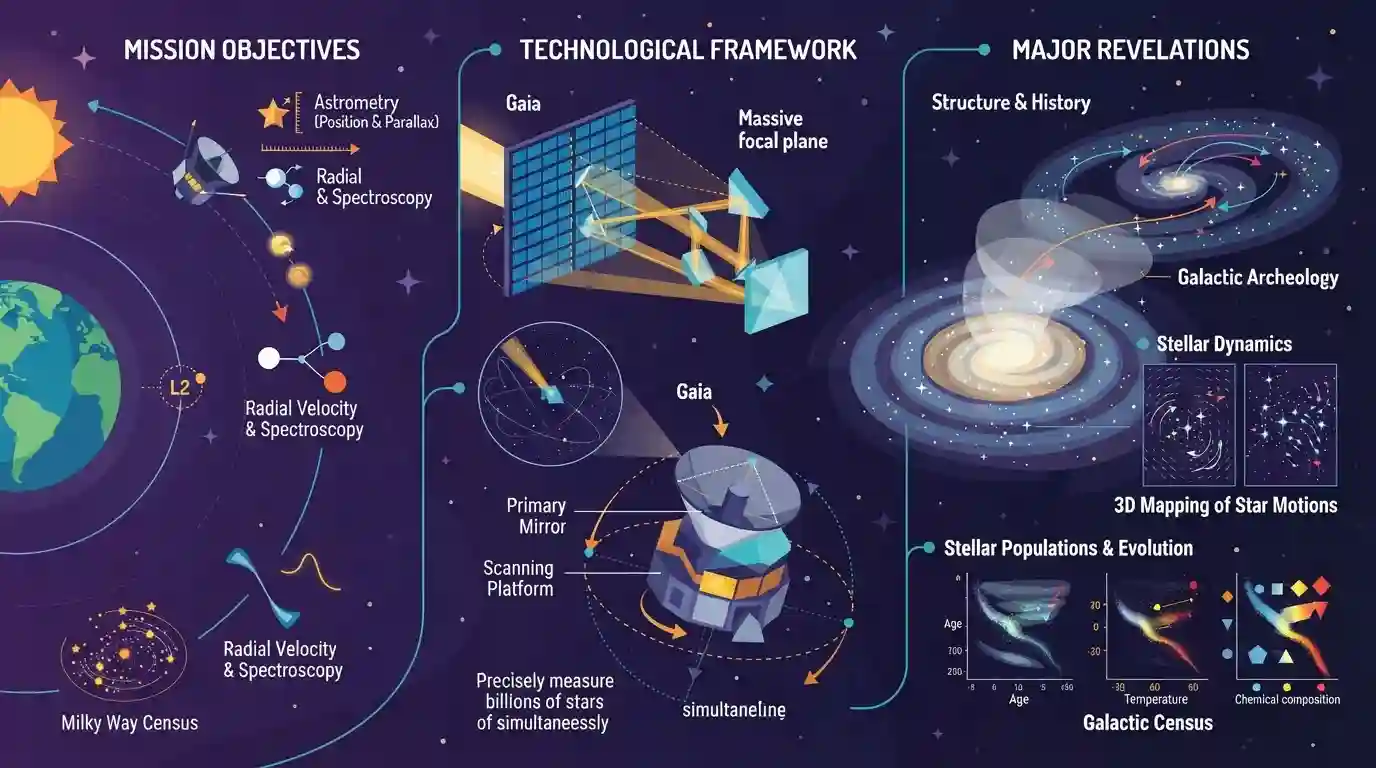
An overview of the European Space Agency's Gaia space mission, its objectives, technological framework, and major revelations regarding the structure, history, and stellar dynamics of the Milky Way galaxy.
Key Points
- The Gaia space mission, launched by the European Space Agency (ESA), maps the positions, distances, and motions of over a billion stars in the Milky Way with unprecedented precision.
- Data from Gaia has provided critical insights into the formation, history, and evolutionary dynamics of the Milky Way, revealing past galactic collisions and star-formation patterns.
- By creating a high-precision 3D map of our galaxy, Gaia acts as a crucial astronomical observatory for understanding stellar evolution and cosmic distances.
Important Terms
Gaia Space Mission

A European Space Agency space observatory launched in 2013 to create the most precise three-dimensional map of the Milky Way by charting positions, distances, and motions of nearly two billion stars.
UPSC context
UPSC Prelims/Mains: Important international space missions, space technology, and astronomy discoveries concerning galactic evolution.
European Space Agency
An intergovernmental organization of European nations dedicated to space exploration, operating major scientific, Earth observation, and interplanetary missions like Gaia, Euclid, and JUICE.
UPSC context
UPSC Prelims: Global space agencies, international space collaborations, and space technology advancements.
Prelims Trap
Gaia is a NASA planetary exploration mission designed to land on Mars and sample atmospheric composition.
Aspirants often confuse the European Space Agency's Gaia mission with NASA missions or planetary probes; Gaia is an astrometry mission orbiting L2, not landing on planets.
Static Concepts Connected
What are the Lagrange Points and where is the Gaia spacecraft positioned?
- L2 Position: Orbital Location: Gaia is stationed at the Lagrangian point L2, approximately 1.5 million km from Earth in the anti-Sun direction.
- Stable Orbit: Gravitational Balance: L2 offers a stable gravitational environment with an uninterrupted view of the universe, unhindered by Earth or Moon shadows.
- Thermal Control: Thermal Stability: The location allows the spacecraft to maintain a highly stable thermal environment critical for high-precision astrometry.
Cross-Topic Patterns
Astronomy Missions & Deep Space Tracking
Deep-space astronomy missions like Gaia rely on precise astrometry, connecting directly to Indian navigation and satellite tracking infrastructure like the Indian Deep Space Network.

Major space science missions (like Gaia, James Webb, or LISA) are frequently tested via statements on agency, orbit, and key objectives.
Linked PYQs · 2
Linked PYQs · 2
- 2020PrelimsGS1
"The experiment will employ a trio of spacecraft flying in formation in the shape of an equilateral triangle that has sides one million kilometres long, with lasers shining between the craft." The experiment in question refers to
- 2022MainsGS3
Launched on 25th December, 2021, James Webb Space Telescope has been much in the news since then. What are its unique features which make it superior to its predecessor Space Telescopes ? What are the key goals of this mission ? What potential benefits does it hold for the human race?
