NASA Lunar Base Programme and India Space Cooperation
Source:The Hindu ↗
ఇది ఎందుకు ముఖ్యం
Understanding this development is crucial for UPSC aspirants as it links India's technological achievements (Chandrayaan-3) with strategic diplomacy (Artemis Accords) and the evolving geopolitical landscape of outer space exploration.
సారాంశం
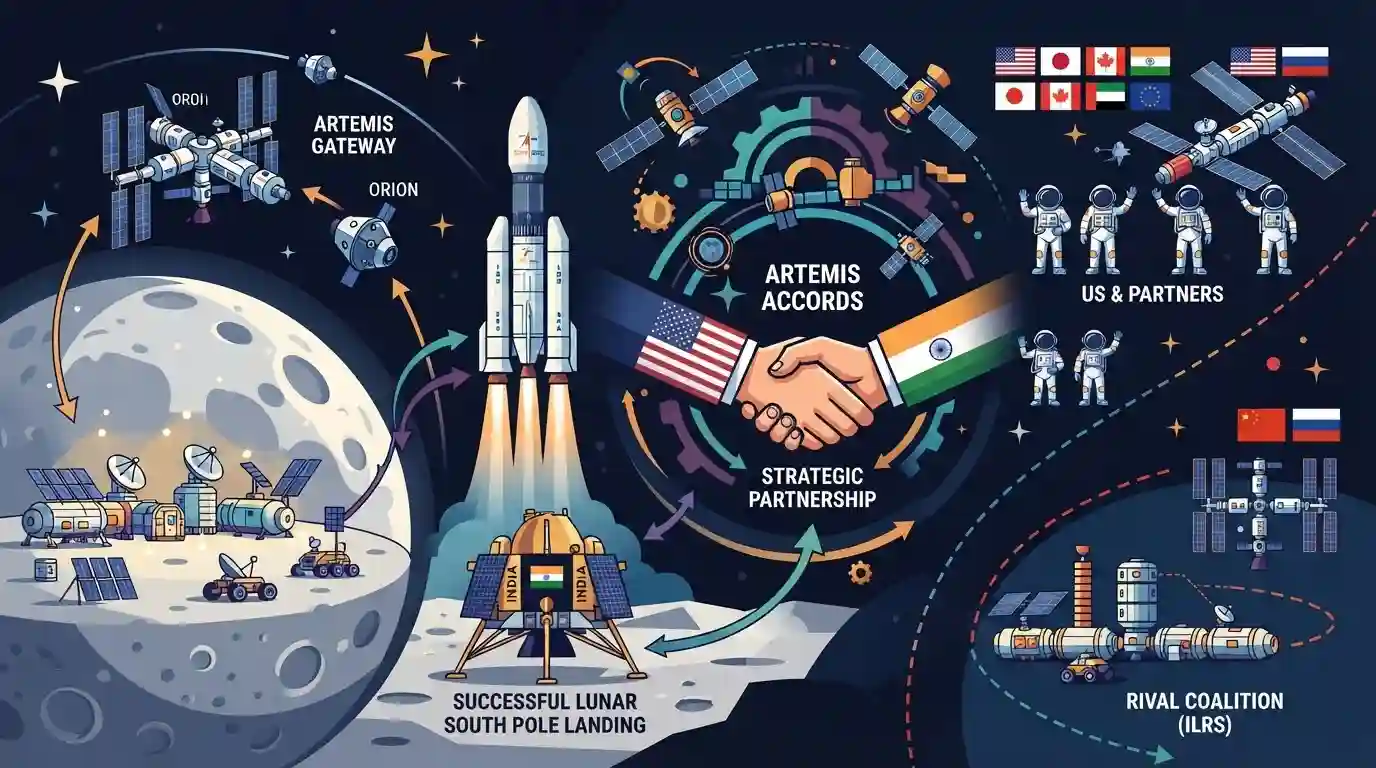
NASA's Artemis Base Camp initiative seeks to establish a permanent human outpost at the Moon's South Pole, accompanied by the Gateway lunar space station. Recognizing India's growing space capabilities, highlighted by the success of Chandrayaan-3 and its accession to the Artemis Accords, NASA is keen to integrate ISRO into its lunar ambitions. This partnership would leverage India's cost-effective space technologies while providing New Delhi with advanced technological access and astronaut training. Furthermore, the collaboration is driven by space geopolitics, as the US and its allies seek to build a robust coalition to counterbalance the rival China-Russia International Lunar Research Station (ILRS) project.
ముఖ్య అంశాలు
- NASA's Artemis Base Camp programme aims to establish a sustainable, long-term human presence at the lunar South Pole.
- The programme involves building surface habitats, rovers, and a lunar-orbiting space station called the Gateway.
- NASA actively seeks India's participation following India's signing of the Artemis Accords in 2023 and the historic success of the Chandrayaan-3 mission near the lunar South Pole.
- India offers proven, cost-effective space technologies and a highly skilled workforce, making it an invaluable partner for deep space exploration.
- The collaboration has a strong geopolitical dimension, serving as a strategic counterweight to the China-Russia led International Lunar Research Station (ILRS) initiative in the emerging 'new space race'.
- Partnering with NASA provides India access to advanced technologies, joint missions (like ISS astronaut training), and deeper integration into the global commercial space economy.
ముఖ్యమైన పదాలు
Artemis Accords

A US-led international framework of principles for peaceful, cooperative space exploration. India became the 27th signatory in 2023, signaling closer Indo-US strategic space ties and paving the way for joint lunar and human spaceflight endeavors.
UPSC context
GS Papers 2 & 3. Tests knowledge of space diplomacy, India-US strategic alignments, and international space governance frameworks.
International Lunar Research Station (ILRS)
A planned lunar base initiative led by China and Russia, aiming to establish a comprehensive scientific experiment facility on the Moon by the 2030s. It represents a direct geopolitical rival to the US-led Artemis programme.
UPSC context
GS Paper 2 (International Relations). Crucial for understanding the emerging US-China geopolitical space race and shifting global alliances.
Artemis Base Camp
NASA’s concept for a permanent human outpost at the lunar South Pole. It will include a foundational surface habitat, rovers, and infrastructure to support sustained lunar exploration and serve as a stepping stone for Mars.
UPSC context
GS Paper 3 (Space Tech). Tests knowledge of future human spaceflight, lunar colonization goals, and international scientific cooperation.
Lunar Gateway
A modular space station planned to orbit the Moon. Designed by NASA alongside international partners, it serves as a multi-purpose staging point and communications relay for lunar surface missions and deep-space exploration.
UPSC context
GS Paper 3 (Space Tech). Important for questions on next-generation space infrastructure, international space stations, and deep-space transit.
ప్రిలిమ్స్ ఉచ్చు
"The Artemis Accords are legally binding space treaties administered by the United Nations."
The Accords are US-led, non-binding political commitments grounded in the 1967 Outer Space Treaty. They are neither legally binding nor administered by the UN.
అనుసంధానమైన స్థిర భావనలు
What are the core principles of the 1967 Outer Space Treaty?
- Non-appropriation: Outer space and celestial bodies cannot be claimed by any nation through sovereignty, use, or occupation.
- Peaceful use: Placing nuclear weapons or other weapons of mass destruction in orbit or on celestial bodies is strictly prohibited.
- State liability: States bear international responsibility for national space activities and are liable for damage caused by their space objects.
Why is the Lunar South Pole the primary target for permanent moon bases?
- Water Ice: Permanently Shadowed Regions (PSRs) contain ancient water ice, which is crucial for human life support and synthesizing hydrogen rocket fuel.
- Solar Illumination: Elevated crater rims and peaks adjacent to PSRs receive near-constant sunlight, providing uninterrupted solar energy for lunar habitats.
అంతర-అంశ నమూనాలు
Space Blocs & The New Cold War
The US-led Artemis and the China-Russia ILRS demonstrate how terrestrial strategic alliances are being directly exported to outer space, shifting it from a global commons to a fractured geopolitical domain.
Lunar Mining & Energy Security
Establishing lunar bases is the precursor to Space Resource Utilization (SRU), linking GS-3 Space Tech directly with long-term energy security through the future extraction of lunar water-ice and Helium-3.

A multi-statement Prelims question comparing the US-led Artemis Accords with the China-Russia ILRS is highly likely in 2026.
అనుసంధాన PYQలు · 3
అనుసంధాన PYQలు · 3
- 2016MainsGS3
Discuss India's achievements in the field of Space Science and Technology. How the application of this technology has helped India in its socio-economic development?
- 2017MainsGS3
India has achieved remarkable successes in unmanned space missions including the Chandrayaan and Mars Orbitter Mission, but has not ventured into manned space missions. What are the main obstacles to launching a manned space mission, both in terms of technology and logistics? Examine critically.
- 2023MainsGS3
What is the main task of India's third moon mission which could not be achieved in its earlier mission? List the countries that have achieved this task. Introduce the subsystems in the spacecraft launched and explain the role of the Virtual Launch Control Centre' at the Vikram Sarabhai Space Centre which contributed to the successful launch from Sriharikota.
