Nihang Sikh Community Traditions and Terai Region Shrine Dynamics
Source:The Hindu ↗
Why It Matters
This topic is highly relevant for UKPSC PCS Prelims as it combines medieval history (Sikh Gurus and the Khalsa), regional culture (Uttarakhand's historical Gurdwaras like Nanakmatta, Hemkund, and Reetha Sahib), and regional geography/demographics (the Terai region, Udham Singh Nagar agricultural land, and census data).
Summary
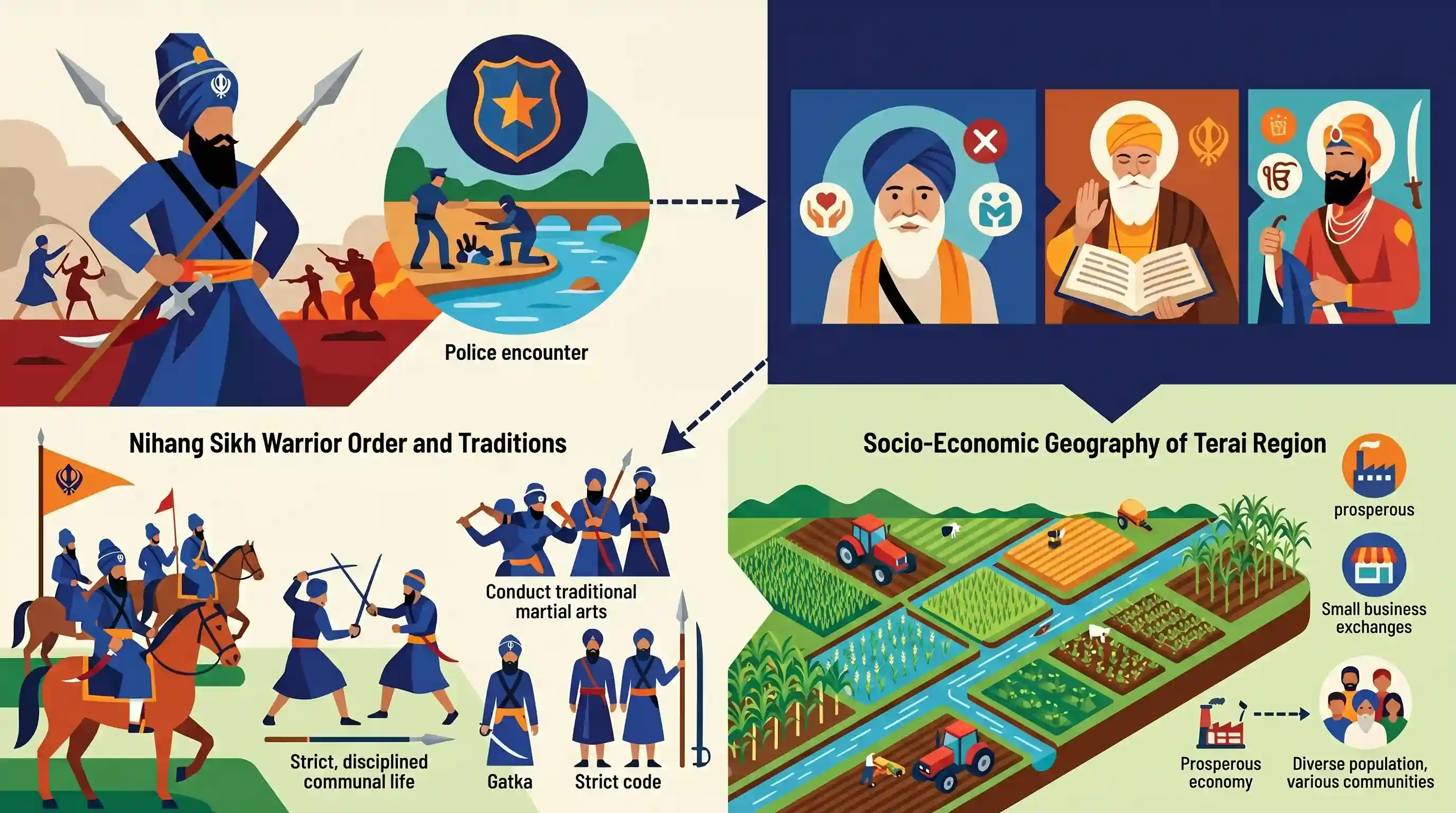
The article analyzes the controversy following the assassination of Baba Tarsem Singh, the Kar Seva chief of Gurdwara Nanakmatta Sahib in Udham Singh Nagar, Uttarakhand, and the subsequent police encounter of the prime accused Nihang Sikh shooter in Haridwar. The incident sheds light on the history and strict code of the armed Nihang warrior order, the deep historical significance of Sikh shrines like Nanakmatta Sahib in Uttarakhand (visited by Guru Nanak Dev Ji and Guru Hargobind Ji), and the socio-economic dynamics of the prosperous Terai region where these shrines are located.
Key Points
- The controversy centers on the assassination of Baba Tarsem Singh, the prominent Kar Seva (voluntary service) chief of Gurdwara Nanakmatta Sahib in Udham Singh Nagar, Uttarakhand, who was shot dead in March 2024 inside the Gurdwara premises.
- The attackers were linked to the Nihang Sikh community. Following the incident, the Uttarakhand Special Task Force (STF) neutralized one of the key shooters, Amarjit Singh, in an encounter in Bhagwanpur, Haridwar.
- The event brought intense focus to the Nihang Sikhs, an ultra-orthodox, armed warrior order of Sikhism tracing their origins to the creation of the Khalsa by Guru Gobind Singh in 1699. They are characterized by blue robes (chola), high turbans (dumaala), and traditional weapons.
- The controversy also highlighted local power struggles and factionalism over lucrative Gurdwara properties and trusts in the fertile Terai region (specifically Udham Singh Nagar). The district, often called the Rice Bowl of Uttarakhand, has the highest agricultural land area (net sown area) in the state.
- Nanakmatta Sahib is of profound historical and cultural importance to Uttarakhand. It is associated with Guru Nanak Dev Ji's third Udasi (travels) in 1514 AD, during which he held spiritual debates with Nath/Gorakhpanthi Yogis (transforming the site's name from Gorakhmatta to Nanakmatta). Guru Hargobind Ji also visited this historic site.
Important Terms
Shiromani Gurdwara Parbandhak Committee (SGPC)

The apex elected body of Sikhs responsible for managing historical Sikh gurdwaras (places of worship) and religious affairs in India, operating under the spiritual guidance of the Akal Takht.
UPSC context
GS Paper I (Modern History) and Paper II (Statutory Bodies). Tests religious governance structures.
Sikh Gurdwaras Act, 1925
A British-era legislation that legally defined Sikh identity and established a democratically elected body of orthodox Sikhs to manage historic gurdwaras, resolving the Gurdwara Reform Movement.
UPSC context
GS Paper I (Modern History, Reform Movements) and Paper II (Legislation). Tests socio-religious reform and colonial laws.
Budha Dal
The veteran section of the Nihang Sikh warrior order, traditionally consisting of older warriors and scholars responsible for safeguarding Sikh principles and maintaining major shrines and gurdwaras.
UPSC context
GS Paper I (Art and Culture). Tests historical understanding of the Khalsa panth and martial orders.
Taruna Dal
The youthful military wing of the Nihang Sikh order, historically composed of younger warriors tasked with active combat, defense of the community, and tactical field operations.
UPSC context
GS Paper I (Sikh History). Tests knowledge of historical military structures and medieval-to-modern religious divisions.
Gurdwara Prabandhak Committee Nanakmatta Sahib
The local administrative body responsible for the management, religious protocols, and daily operations of the historic Gurdwara Nanakmatta Sahib in Udham Singh Nagar, Uttarakhand.
UPSC context
GS Paper I (History & Geography). Tests geographical distribution and regional socio-religious shrines of national importance.
Prelims Trap
The armed Nihang warrior order was established by Guru Nanak Dev Ji to defend early shrines like Nanakmatta.
The Nihang order originated with Guru Gobind Singh's Khalsa (1699) and Guru Hargobind's Akal Sena, not Guru Nanak, who advocated peaceful dialogue during his Udasis.
Static Concepts Connected
What is the historical origin and significance of the Nihang order?
- Khalsa Origin: Traced back to Guru Gobind Singh's creation of the Khalsa in 1699, with military roots in Guru Hargobind's Akal Sena.
- Role as Vanguard: Served as elite frontline warriors (historically Akalis) defending the community and shrines during Mughal and Afghan invasions.
- Distinctive Attire: Strictly adhere to Maryada, wearing electric-blue robes, high pyramidal turbans (dumaala), and carrying traditional steel weapons.
What was the historical interaction between early Sikhism and the Nath Panthis?
- Philosophical Dialogue: Guru Nanak favored peaceful debates (Sidh Gosht) over asceticism, advocating active householder life over absolute renunciation practiced by Nath Yogis.
- Gorakhmatta Transition: Guru Nanak's 1514 visit to the Nath center Gorakhmatta led to its renaming as Nanakmatta after a spiritual dialogue with the Yogis.
- Hargobind's Consolidation: The sixth Guru, Guru Hargobind, later visited Nanakmatta to reclaim and consolidate the site, establishing the historic Gurdwara.
Cross-Topic Patterns
Militarized sects vs. modern state policing
Friction between traditional, armed religious orders and state law enforcement highlights the delicate constitutional balance between Article 26 (religious management) and Article 21 (public order/rule of law).
Terai migration and agrarian politics
Post-Partition peasant migration from Punjab transformed Udham Singh Nagar into Uttarakhand's agricultural powerhouse, creating highly lucrative Gurdwara trusts and subsequent socio-political contestations.

Prelims may test the spatial-historical overlap of Gorakhnath/Nath Panthis and early Sikh Gurus in the Himalayan foothills (Terai).
Linked PYQs · 3
Linked PYQs · 3
- 2016UKPSC_PRELIMSGS1
Under which Sikh Guru the Sikhs were transformed into the 'Khalsa'?
- 2025UKPSC_PRELIMSGS1
Which of the following districts of Uttarakhand has the highest agricultural land ?
- 2024UKPSC_PRELIMSGS1
Which of the following statements are true according to census of India 2011 data ? (1) Uttarkashi district has lowest density of population in Uttarakhand. (2) Rudraprayag district has the highest sex ratio in Uttarakhand. (3) U.S. Nagar has the highest % of Muslim population.
