Punjab Geographic Regions Shape Regional Electoral Dynamics
Source:Indian Express ↗
ఇది ఎందుకు ముఖ్యం
Understanding the socio-geographic divisions of a state provides critical insights into electoral politics, demographic vulnerabilities, and the rationale behind regional infrastructural investments. It bridges physical geography (river systems and Doabs) with polity (voting blocks, Dalit politics, and developmental equity).
సారాంశం
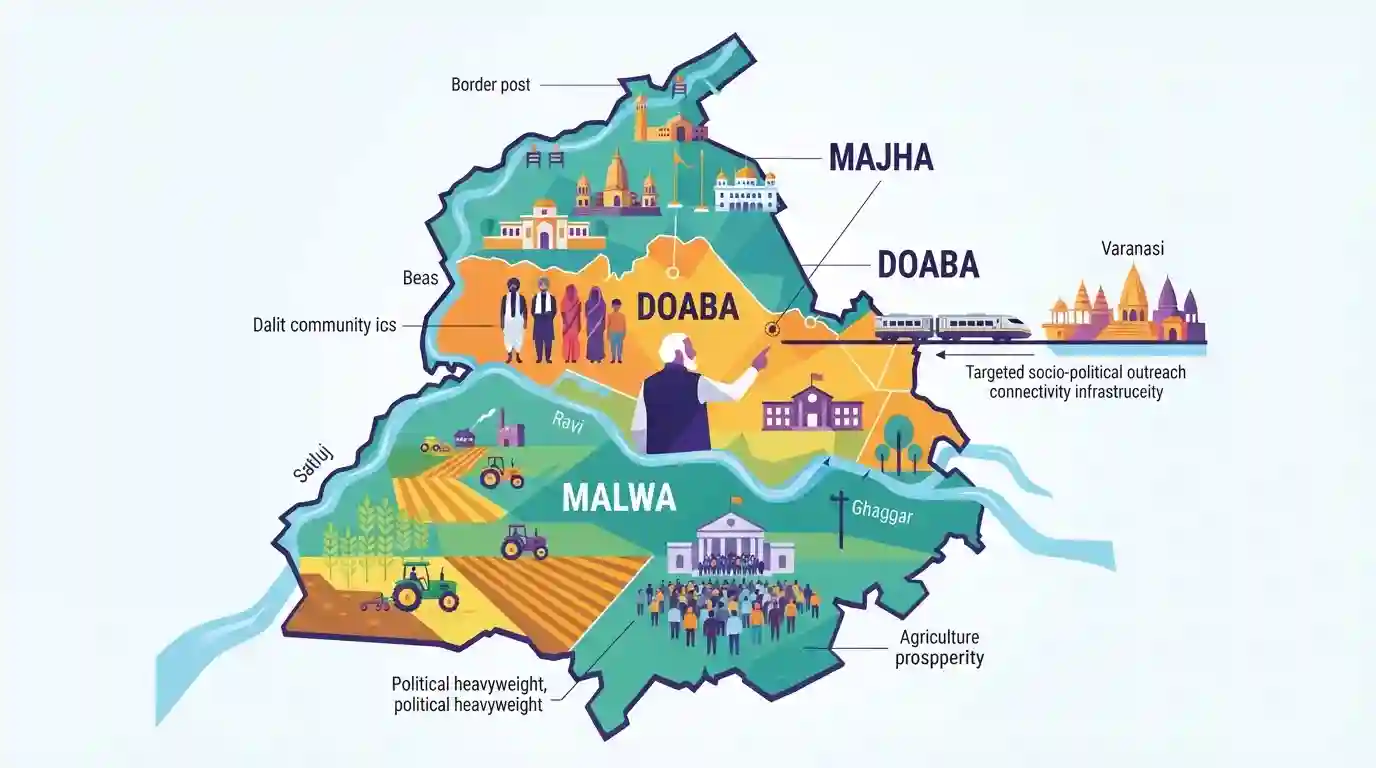
The political landscape of Punjab is heavily influenced by its three distinct geographic and cultural regions: Malwa, Majha, and Doaba, demarcated by the rivers Satluj, Beas, Ravi, and Ghaggar. Ahead of the 2027 assembly elections, the Prime Minister announced infrastructural projects deliberately spread across all three regions to project inclusive development. Malwa continues to be the political heavyweight due to its sheer size, while Majha retains significance through its border districts and historical religious sites. Doaba is marked by its substantial Dalit population, particularly the Ravidassia community. Infrastructure initiatives, such as new train connectivity to Varanasi, highlight targeted socio-political outreach to these communities, underscoring the interplay between regional geography, demography, and electoral strategy.
ముఖ్య అంశాలు
- The Prime Minister recently announced multiple infrastructure projects strategically distributed across Punjab’s three geographic regions—Malwa, Majha, and Doaba—ahead of the 2027 assembly elections.
- Malwa, located between the Satluj and Ghaggar rivers, is the state's largest and most politically dominant region, holding 69 of the 117 Assembly seats.
- Majha, bound by the Ravi, Beas, and Satluj rivers, comprises border districts and is culturally significant as the historical heart of Sikhism.
- Doaba, situated between the Satluj and Beas rivers, holds the highest concentration of Scheduled Castes (around 40%), particularly the politically crucial Ravidassia community.
- The flagging off of a train from Jalandhar to Varanasi (the birthplace of Guru Ravidas) serves as a direct political outreach to the Dalit community and followers of Dera Sachkhand Ballan.
- The even distribution of projects counters the narrative of regional bias, emphasizing inclusive infrastructural growth and political mobilization across the state.
ముఖ్యమైన పదాలు
Dera Sachkhand Ballan

A highly influential spiritual and institutional center of the Ravidassia Dalit community, based near Jalandhar, Punjab, which established Ravidassia as an independent faith in 2010 following the 2009 Vienna attack.
UPSC context
GS Paper I (Social Issues) & GS II (Electoral Politics); tests caste-based mobilization, Dalit empowerment, and the Bhakti movement's legacy.
Amrit Bharat Station Scheme
A Central Sector Scheme launched in 2023 by the Ministry of Railways to redevelop and modernize over 1,000 railway stations across India using tailored master plans.
UPSC context
GS Paper III (Infrastructure: Railways & Growth); tests government modernization schemes, urban integration, and logistics under PM Gati Shakti.
Delhi-Katra Expressway
A notified high-speed expressway (NE-5) connecting Delhi to Katra via Haryana and Punjab, designed to slash travel times, enhance economic corridors, and boost religious tourism.
UPSC context
GS Paper III (Infrastructure: Roads); tests logistics efficiency, corridor development, economic integration, and regional infrastructure planning.
Aam Aadmi Party (AAP)
A recognized national political party in India that forms the current government in Punjab, having achieved national status under Election Commission of India guidelines.
UPSC context
GS Paper II (Polity); tests the Representation of the People Act 1951, ECI's political party recognition criteria, and federal dynamics.
ప్రిలిమ్స్ ఉచ్చు
Punjab has the highest absolute population of Scheduled Castes (SCs) in India.
While Punjab has the highest percentage of SC population (32%), Uttar Pradesh has the largest absolute number of Scheduled Castes.
అనుసంధానమైన స్థిర భావనలు
What are the geographical boundaries and names of the key Doabs of Punjab?
- Bist Doab: Located between the Beas and Satluj rivers, historically corresponding to the Doaba region.
- Bari Doab: Situated between the Beas and Ravi rivers, which forms the core of the Majha region.
- Malwa Plains: The region lying south of the Satluj river, extending up to the Ghaggar river.
What is the historical and spiritual legacy of Bhakti reformer Guru Ravidas?
- Nirguna Bhakti: A 15th-century monotheistic poet-saint from Varanasi who rejected caste hierarchy and ritualism.
- Begumpura Concept: He envisioned 'Begumpura'—a stateless, classless city free from suffering, taxes, and discrimination.
- Scriptural Inclusion: Forty-one of his sacred hymns are incorporated into the Guru Granth Sahib, venerated by Sikhs.
అంతర-అంశ నమూనాలు
Bhakti Philosophy & Electoral Sociology
The egalitarian philosophy of 15th-century Bhakti saints continues to drive modern political mobilization and reservation dynamics among Scheduled Castes in Northwest India.
River Geomorphology & Agrarian Disparity
Differences in inter-fluvial soil quality across Bist and Bari Doabs influence regional cropping patterns, groundwater tables, and subsequent agricultural subsidy debates.

Indus river tributaries mapped against Bhakti saint birthplaces (Varanasi/Punjab links) likely to feature in 2026 Prelims.
అనుసంధాన PYQలు · 5
అనుసంధాన PYQలు · 5
- 2021PrelimsGS1
With reference to the Indus river system, of the following four rivers, three of them pour into one of them which joins the Indus direct. Among the following, which one is such river that joins the Indus direct?
- 2026PrelimsGS1
Identify the river of the Indian sub-continent on the basis of the following information : 1. It has an antecedent drainage system. 2. It flows through three countries. 3. It originates in the Tibetan Plateau and is an important river for irrigation. 4. It does not form distributaries. Select the answer from the following :
- 2016PrelimsGS1
Satya Shodhak Samaj organized
- 2021MainsGS1
Evaluate the nature of the Bhakti literature and its contribution to Indian culture.
- 2021MainsGS3
“Investment in infrastructure is essential for more rapid and inclusive economic growth.” Discuss in the light of India's experience.
