India Climate Change Commitments and Renewable Energy Targets
Source:Indian Express ↗
हे का महत्त्वाचे आहे
Crucial for understanding India's evolving stance on global climate governance, its NDC commitments, and the roadmap towards achieving net-zero emissions.
सारांश
The article evaluates India's climate promises made at international forums like COP26, including the Panchamrit targets, and reviews the country's progress, trajectory, and challenges in meeting these climate goals.
मुख्य मुद्दे
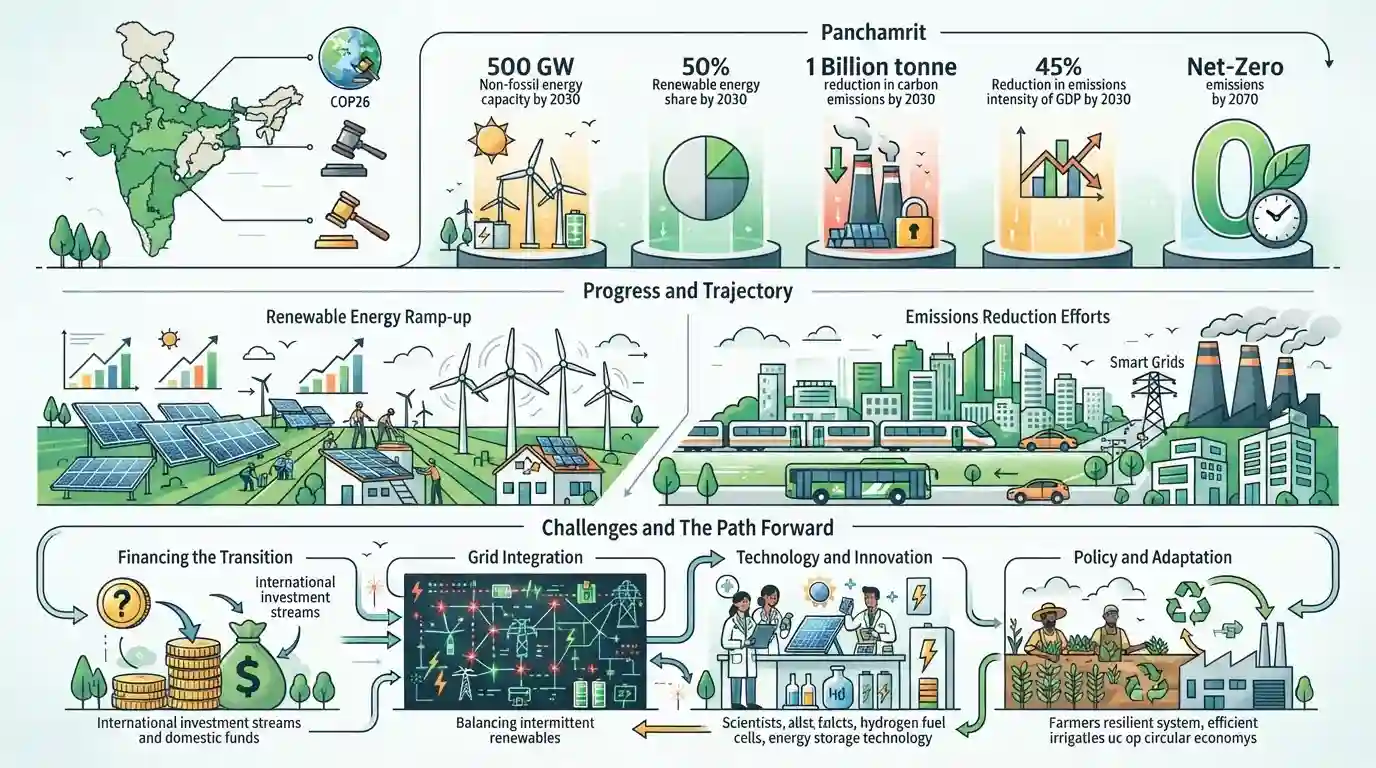
- At the Glasgow COP26 summit, Prime Minister Narendra Modi announced ambitious climate targets for India, including reaching 500 GW of non-fossil energy capacity and meeting 50% of energy requirements from renewables by 2030.
- India committed to reducing the emissions intensity of its GDP by 45% by 2030 from 2005 levels and achieving net-zero emissions by 2070.
- While India has made strong progress in renewable energy expansion and emission intensity reduction, challenges remain in scaling energy storage, phasing down coal, and ensuring climate finance.
महत्त्वाच्या संज्ञा
Paris Agreement

A landmark legally binding international treaty adopted under the UNFCCC in 2015 to limit global warming to well below 2 degrees Celsius above pre-industrial levels, while pursuing efforts to limit the increase to 1.5 degrees Celsius.
UPSC context
GS Paper III (Environment & Ecology, Climate Change). Crucial for questions on global climate architecture, India's international commitments, and net-zero targets.
Nationally Determined Contributions (NDCs)
Climate action plans submitted by each country under the Paris Agreement detailing national efforts to reduce greenhouse gas emissions and adapt to climate change impacts, periodically updated for higher ambition.
UPSC context
GS Paper III (Environment & Ecology). Tests understanding of decentralized climate targets, Panchamrit goals, and India's evolving policy trajectory.
UNFCCC
An international environmental treaty adopted in 1992 as the foundational framework for global cooperation to combat climate change by limiting atmospheric greenhouse gas concentrations.
UPSC context
GS Paper III (Environment and Ecology). Core concept for international climate governance, COPs, and multilateral environmental negotiations.
संबंधित स्थिर संकल्पना
What are the five elements of India's Panchamrit announced at COP26 Glasgow?
- 500 GW Capacity: Non-fossil capacity: Reach 500 GW of non-fossil energy capacity by 2030.
- 50% Renewables: Renewable share: Meet 50% of energy requirements from renewable energy by 2030.
- 1 Billion Tonnes: Carbon reduction: Reduce total projected carbon emissions by 1 billion tonnes from now till 2030.
- Emissions Intensity: Emissions intensity: Reduce carbon intensity of the economy by less than 45% by 2030 over 2005 levels.
- Net Zero 2070: Net zero: Achieve net-zero carbon emissions target by the year 2070.
आंतर-विषय नमुने
Panchamrit targets + UNFCCC climate finance
India's Panchamrit targets intersect with international climate finance negotiations under UNFCCC, where developing nations demand tech transfer and concessional green capital from historical emitters.
Renewable energy goals + Critical minerals security
Rapid scaling of renewable energy requires critical minerals like lithium and cobalt, linking climate commitments directly to supply chain vulnerabilities and foreign policy.

Expect a statement-based prelims question pairing specific Panchamrit numeric targets with baseline years (e.g., 2005 vs 2030).
संबंधित PYQ · 4
संबंधित PYQ · 4
- 2026PrelimsGS1
Consider the following statements with reference to India's response to climate change : I. India's Long-Term Low Emission Development Strategy (LT-LEDS) is a crucial tool for achieving net-zero emissions by 2070. II. India's 4th Biennial Update Report (BUR-4) submitted in December, 2024 recorded around 8% decrease in Greenhouse gas emissions in 2020 over 2019. III. Climate-resilient development necessarily depends on quick and short-term achievement of emission reduction targets. Which of the following relationships among the above statements is/are correct ? 1. Statement I is empirically supported by statement II. 2. Statement III contradicts the approach implicit in statement I. 3. Statement I and statement III together establish the premise of long-term sustainability. Select the answer using the code given below :
- 2016PrelimsGS1
The term 'Intended Nationally Determined Contributions' is sometimes seen in the news in the context of
- 2022MainsGS3
Do you think India will meet 50 percent of its energy needs from renewable energy by 2030 ? Justify your answer. How will the shift of subsidies from fossil fuels to renewables help achieve the above objective ? Explain.
- 2025MainsGS3
Write a review on India's climate commitments under the Paris Agreement (2015) and mention how these have been further strengthened in COP26 (2021). In this direction, how has the first Nationally Determined Contribution intended by India been updated in 2022?
