Pakistan Afghanistan border tensions escalate amid historical disputes
Source:Indian Express ↗
Why It Matters
The Af-Pak conflict is highly relevant for UPSC aspirants as it demonstrates the complexities of border management, the historical legacy of colonial borders (Durand Line), and the regional threat of cross-border terrorism. It provides crucial context for India's strategic calculations, neighborhood first policy, and internal security preparedness against spillover militancy.
Summary
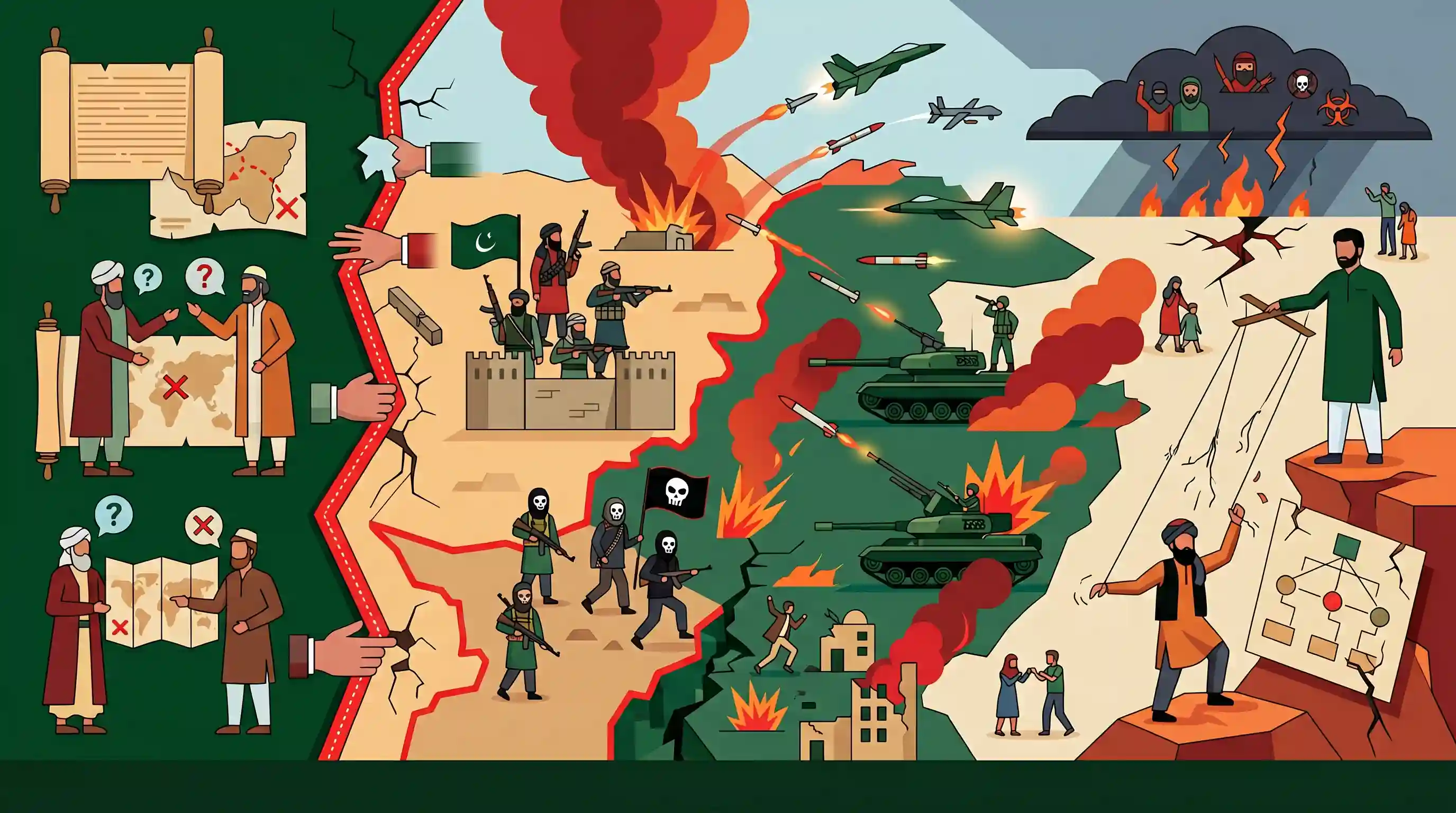
The escalating border conflict and 'open war' dynamics between Pakistan and Afghanistan are rooted in historical disputes, primarily the non-recognition of the Durand Line by Afghan governments. Following the Taliban's return to power in Kabul, relations have deteriorated sharply as Pakistan accuses the Afghan Taliban of harbouring the Tehrik-i-Taliban Pakistan (TTP), which conducts deadly attacks across the border. Pakistan's retaliatory cross-border airstrikes and the Taliban's armed responses highlight a severe regional security crisis. This fallout exposes the failure of Pakistan's strategic designs for a compliant proxy in Kabul and underscores the persistent threat of cross-border terrorism in the volatile Af-Pak region.
Key Points
- The core historical grievance between Pakistan and Afghanistan lies in the Durand Line, a 2,640 km border drawn by the British in 1893 which divides ethnic Pashtun communities and remains unrecognised by Afghanistan.
- Tensions have escalated into open border clashes due to Pakistan's allegations that the Afghan Taliban provides safe havens to the Tehrik-i-Taliban Pakistan (TTP), a militant group responsible for numerous terror attacks inside Pakistan.
- Pakistan recently conducted cross-border airstrikes targeting suspected TTP hideouts in Afghan provinces like Khost and Paktika, prompting retaliatory fire from Afghan Taliban forces.
- The escalating conflict exposes the failure of Pakistan's long-held 'Strategic Depth' policy, as the Taliban government in Kabul acts independently rather than as a compliant proxy.
- The instability and cross-border terrorism dynamics pose broader regional security challenges, closely watched by India given the implications for militancy and geopolitical stability in South Asia.
Important Terms
Durand Line Agreement (1893)

A 2,640 km boundary established in 1893 between British India and Afghanistan. Pakistan recognizes it as the official border, but successive Afghan governments reject its legitimacy as a colonial-era imposition.
UPSC context
GS Paper II: International Relations. Tests understanding of regional border disputes and historical treaties impacting South Asian stability.
Tehrik-i-Taliban Pakistan (TTP)
An umbrella militant organization formed in 2007 along the Af-Pak border. It seeks to overthrow the Pakistani government to implement strict Sharia law, often using Afghan sanctuaries for cross-border attacks.
UPSC context
GS Paper III: Internal Security. Relevant for studying cross-border terrorism, non-state actors, and security challenges in India's extended neighborhood.
Afghan Taliban
An Islamic fundamentalist movement that regained power in Afghanistan in 2021. Their governance, based on a strict interpretation of Sharia, creates regional security challenges and diplomatic dilemmas for neighboring countries.
UPSC context
GS Paper II: International Relations. Essential for analyzing the shifting geopolitical landscape in Central Asia and India’s security/humanitarian interests.
Strategic Depth
A Pakistani military doctrine seeking a compliant government in Kabul to ensure a secure western border and provide a "fallback" territory for military assets during a conflict with India.
UPSC context
GS Paper II: International Relations. Key to understanding Pakistan's regional foreign policy and its impact on India's security interests.
Prelims Trap
The Taliban government officially recognises the Durand Line as the international border with Pakistan.
Aspirants assume the historically Pakistan-backed Taliban accepts the border. In reality, no Afghan regime, including the Taliban, has ever recognized the Durand Line due to Pashtun nationalism.
Static Concepts Connected
What is Pakistan's 'Strategic Depth' doctrine regarding Afghanistan?
- Origin: A military and foreign policy concept developed by the Pakistani establishment in the 1980s.
- Core Objective: To cultivate a compliant, proxy government in Kabul that would serve as a rear-guard buffer and fallback space against an Indian military threat.
- Current Status: It is currently failing as the Afghan Taliban asserts sovereign independence, clashes over borders, and shelters the anti-state TTP militants.
What are the major British-era boundary lines defining South Asia?
- Durand Line: Drawn in 1893 to separate British India from Afghanistan; it divides the Pashtun and Baloch tribal belts and is unrecognised by Kabul.
- McMahon Line: Negotiated at the 1914 Simla Convention between Britain and Tibet; it forms the de facto border in India's eastern sector (Arunachal Pradesh) but is rejected by China.
- Radcliffe Line: The 1947 partition line that divided British India into the modern states of India and Pakistan (including present-day Bangladesh).
Cross-Topic Patterns
Colonial borders & ethnic kinships
The Durand Line's bisection of Pashtun lands mirrors India-Myanmar border challenges, where colonial lines split Kuki-Zo ethnic communities, complicating modern border management and FMR.
Chabahar Port and regional connectivity
With Af-Pak transit routes mired in conflict, India's geoeconomic strategy to bypass Pakistan via the Chabahar Port for Afghan and Central Asian connectivity becomes strictly indispensable.

Expect a multi-statement Prelims question matching colonial boundary lines (Durand, McMahon, Radcliffe) with the ethnic groups they divide.
Linked PYQs · 2
Linked PYQs · 2
- 2020MainsGS3
Analyze internal security threats and transborder crimes along Myanmar, Bangladesh and Pakistan borders including Line of Control (LoC). Also discuss the role played by various security forces in this regard.
- 2016MainsGS2
Increasing cross-border terrorist attacks in India and growing interference in the internal affairs of several member-states by Pakistan are not conducive for the future of SAARC (South Asian Association for Regional Cooperation)." Explain with suitable examples.
