India Updated Nationally Determined Contributions Targets
Source:Indian Express ↗
हे का महत्त्वाचे आहे
Crucial for understanding India's evolving stance on international climate policy, balancing economic development with net-zero commitments and global climate negotiations under the Paris Agreement.
सारांश
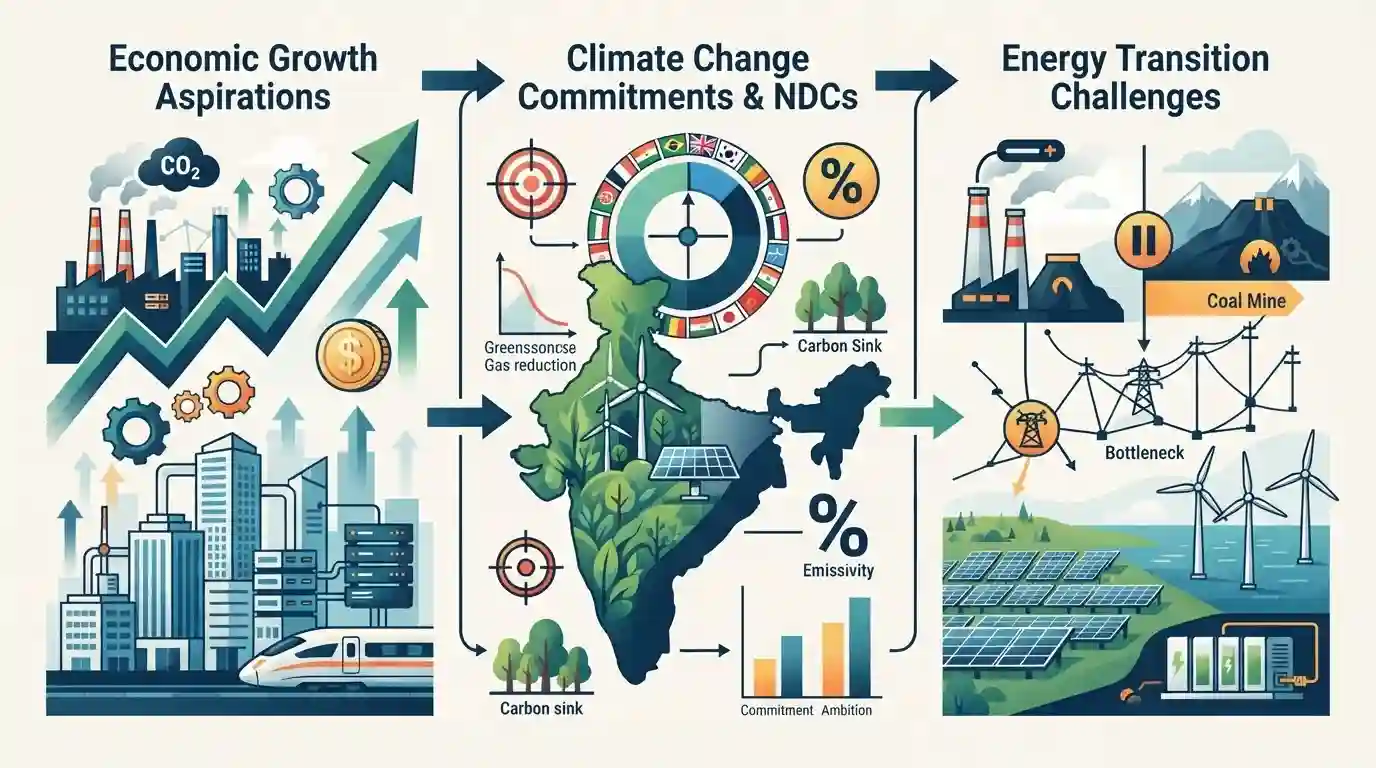
The article analyzes India's new climate targets (Nationally Determined Contributions), assessing their modesty and significance in the broader framework of global climate negotiations, economic growth aspirations, and energy transition challenges.
मुख्य मुद्दे
- India's new climate targets or updated Nationally Determined Contributions (NDCs) strike a balance between developmental priorities and global climate action.
- The targets are characterized as modest yet significant, keeping in line with the principle of Common But Differentiated Responsibilities (CBDR).
- They address greenhouse gas emission intensity reduction, renewable energy transition, and sustainable lifestyles (LiFE).
महत्त्वाच्या संज्ञा
Nationally Determined Contributions (NDCs)

Non-binding national climate action plans submitted under the Paris Agreement detailing targets for greenhouse gas emission reductions and adaptation efforts, updated every five years to increase ambition.
UPSC context
UPSC Prelims/Mains (GS Paper III - Environment): Core component of India's international climate commitments, emission reduction targets, and policy strategy.
Paris Agreement
A landmark 2015 legally binding international treaty under the UNFCCC aiming to hold global average temperature increase to well below 2°C, and pursue efforts to limit it to 1.5°C above pre-industrial levels.
UPSC context
UPSC Prelims/Mains (GS Paper III - Environment): Tests understanding of global climate governance, carbon budgets, and international diplomacy.
UNFCCC
An international environmental treaty adopted in 1992 to combat dangerous human interference with the climate system, serving as the parent convention for the Kyoto Protocol and Paris Agreement.
UPSC context
UPSC Prelims/Mains (GS Paper III - Environment): Foundational multilateral treaty framework for global climate negotiations and annual COP summits.
पूर्वपरीक्षा सापळा
India has committed to reducing its absolute greenhouse gas emissions by 45% by 2030 compared to 2005 levels.
Aspirants often confuse India's 'emission intensity reduction' target (a relative metric) with 'absolute emission reduction' targets undertaken by developed nations. India's absolute emissions will continue to grow as its economy expands.
संबंधित स्थिर संकल्पना
What are the core foundational principles governing international climate change negotiations under the UNFCCC framework?
- CBDR-RC Principle: Acknowledges historical responsibility of developed nations for cumulative GHG emissions and differing national capacities.
- Precautionary Principle: States should not use lack of full scientific certainty as an excuse to postpone cost-effective measures to prevent environmental degradation.
- Polluter Pays Principle: The polluter should bear the cost of pollution, internalizing environmental externalities into market pricing of goods and services.
- Intergenerational Equity: Ensures the rate of resource consumption does not exceed the Earth's regenerative capacity, protecting options for future generations.
आंतर-विषय नमुने
Renewable Energy + Critical Minerals Supply Chains
While India's updated NDCs emphasize non-fossil energy expansion, they simultaneously require massive imports of solar PV modules and critical minerals like lithium, intersecting with supply-chain security and international trade diplomacy.
LiFE Movement + Sustainable Consumption (SDG 12)
The LiFE (Lifestyle for Environment) movement bridges micro-level consumer behavior with macro-level sustainable development goals (SDG 12), shifting policy focus from welfare subsidies to behavioral nudges.

Updated NDCs + CBDR-RC + LiFE movement will likely feature in an analytical Prelims statement or a Mains GS-3 question on equity in global climate regimes.
संबंधित PYQ · 2
संबंधित PYQ · 2
- 2025MainsGS3
Write a review on India's climate commitments under the Paris Agreement (2015) and mention how these have been further strengthened in COP26 (2021). In this direction, how has the first Nationally Determined Contribution intended by India been updated in 2022?
- 2021MainsGS3
Describe the major outcomes of the 26th session of the Conference of the Parties (COP) to the United Nations Framework Convention on Climate Change (UNFCCC). What are the commitments made by India in this conference?
