India Nationally Determined Contributions and Climate Commitments
Source:Indian Express ↗
কেন এটি গুরুত্বপূর্ণ
Crucial for understanding India's evolving stance on global climate negotiations, its Nationally Determined Contributions (NDCs), and its roadmap toward long-term sustainability and net-zero commitments.
সারসংক্ষেপ
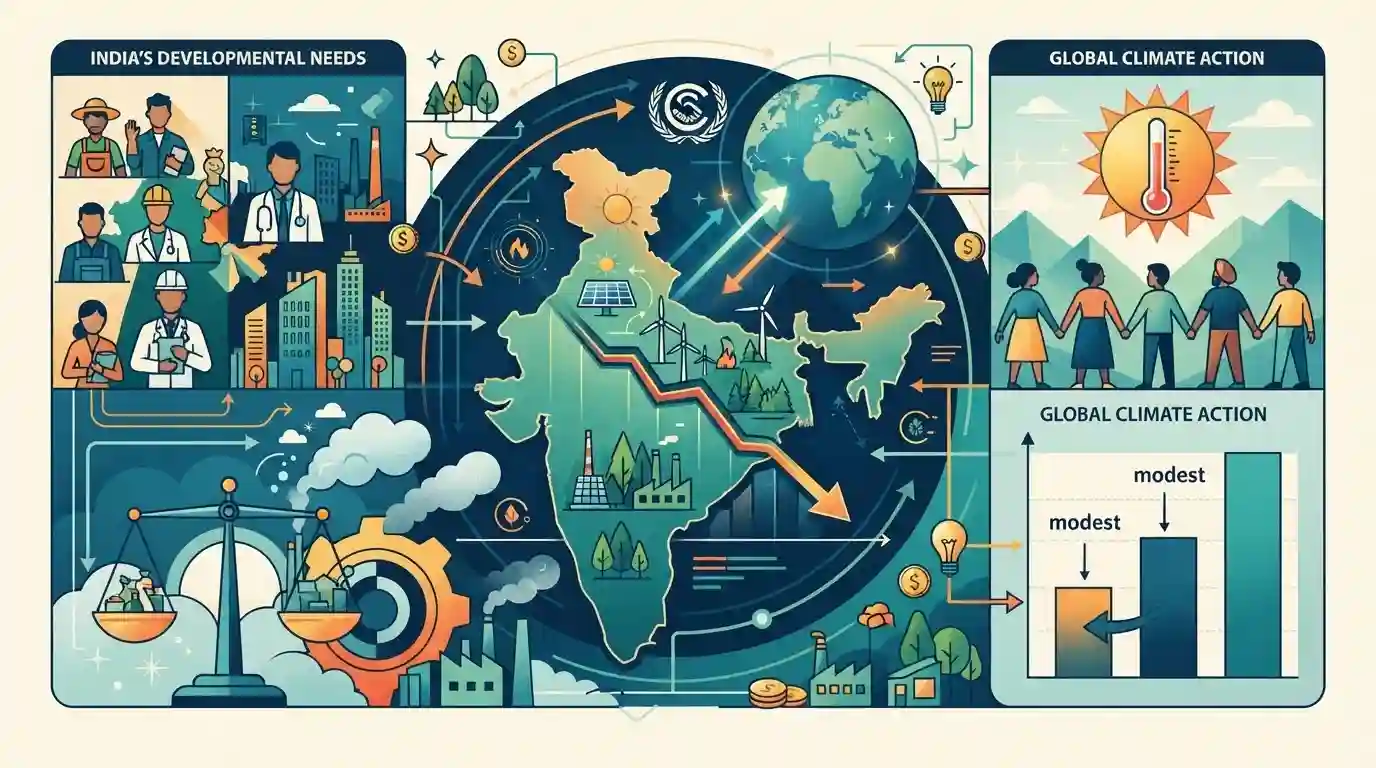
The article analyzes India's new climate targets under the Paris Agreement, evaluating their significance, modesty, and implications for global climate action while balancing domestic developmental needs.
মূল বিষয়
- India's new climate targets represent updated Nationally Determined Contributions (NDCs) under the Paris Agreement.
- The targets are described as modest yet significant, balancing developmental imperatives with global climate commitments.
- India continues to emphasize the principle of Common But Differentiated Responsibilities (CBDR) while scaling up its climate ambitions.
গুরুত্বপূর্ণ শব্দ
Paris Agreement

A legally binding international treaty adopted in 2015 under the UNFCCC to limit global temperature rise to well below 2°C, ideally 1.5°C, above pre-industrial levels.
UPSC context
Important for GS Paper III (Environment and Climate Change); tests international environmental conventions, mitigation goals, and global governance frameworks.
Nationally Determined Contributions (NDCs)
National climate action plans submitted every five years under the Paris Agreement outlining each country's targets for reducing greenhouse gas emissions and adapting to climate change.
UPSC context
Essential for GS Paper III (Environment); evaluates India's climate commitments, developmental balance, and international obligations.
UNFCCC
A global environmental treaty established at the 1992 Earth Summit to stabilize greenhouse gas concentrations in the atmosphere at a level that prevents dangerous anthropogenic interference with the climate system.
UPSC context
Crucial for GS Paper III (Environment and Ecology); tests foundational environmental treaty mechanisms, Conferences of the Parties (COPs), and global climate architecture.
প্রিলিমস ফাঁদ
India has legally committed to an absolute phase-out of coal by 2070 and an emissions-intensity reduction baseline of 2015.
Aspirants often confuse India's 'net-zero by 2070' pledge with a legally binding commitment to phase out fossil fuels entirely or misread the emissions intensity reduction baseline year as 2015 instead of 2005.
সংযুক্ত স্থির ধারণা
What are the core pillars of India's Panchamrit commitments under the Paris Agreement?
- 500 GW Target: Non-fossil capacity: Reach 500 GW of non-fossil energy capacity by 2030.
- 50% Renewables: Renewable share: Meet 50% of energy requirements from renewable energy by 2030.
- 1 Billion Tonnes: Emissions reduction: Reduce total projected carbon emissions by 1 billion tonnes from now to 2030.
- 45% Intensity: Intensity reduction: Reduce the emissions intensity of the GDP by 45% by 2030 over 2005 levels.
What is the principle of CBDR-RC in international climate change negotiations?
- Historical Burden: Historical responsibility: Acknowledges that developed countries bear historical responsibility for the bulk of greenhouse gas emissions.
- Different Capabilities: Different capacities: Mandates differentiated obligations based on countries' respective economic capabilities and developmental needs.
- UNFCCC Framework: UNFCCC anchor: Formally enshrined in the 1992 UN Framework Convention on Climate Change and carried into the Paris Agreement.
আন্তঃবিষয় প্যাটার্ন
NDCs + Green Finance & RBI Taxonomies
India's Panchamrit goals directly intersect with RBI's climate risk taxonomies and green bond frameworks, driving institutional credit towards non-fossil capacity expansion.
Net-Zero 2070 + CBDR & Global South Diplomacy
Balancing 2070 net-zero targets with coal dependency tests India's diplomatic balancing act between Western green push and Global South leadership.

Expect statement-based questions pairing India's 45% emissions-intensity target with the 2070 net-zero deadline under the Paris Agreement.
সংযুক্ত PYQ · 3
সংযুক্ত PYQ · 3
- 2025MainsGS3
Write a review on India's climate commitments under the Paris Agreement (2015) and mention how these have been further strengthened in COP26 (2021). In this direction, how has the first Nationally Determined Contribution intended by India been updated in 2022?
- 2016PrelimsGS1
The term 'Intended Nationally Determined Contributions' is sometimes seen in the news in the context of
- 2026PrelimsGS1
Consider the following statements with reference to India's response to climate change : I. India's Long-Term Low Emission Development Strategy (LT-LEDS) is a crucial tool for achieving net-zero emissions by 2070. II. India's 4th Biennial Update Report (BUR-4) submitted in December, 2024 recorded around 8% decrease in Greenhouse gas emissions in 2020 over 2019. III. Climate-resilient development necessarily depends on quick and short-term achievement of emission reduction targets. Which of the following relationships among the above statements is/are correct ? 1. Statement I is empirically supported by statement II. 2. Statement III contradicts the approach implicit in statement I. 3. Statement I and statement III together establish the premise of long-term sustainability. Select the answer using the code given below :
