Significance and Policy Impact of India New Climate Targets
Source:Indian Express ↗
ఇది ఎందుకు ముఖ్యం
Crucial for understanding India's evolving stance on global climate governance, international climate negotiations, and balancing economic growth with carbon emission cuts.
సారాంశం
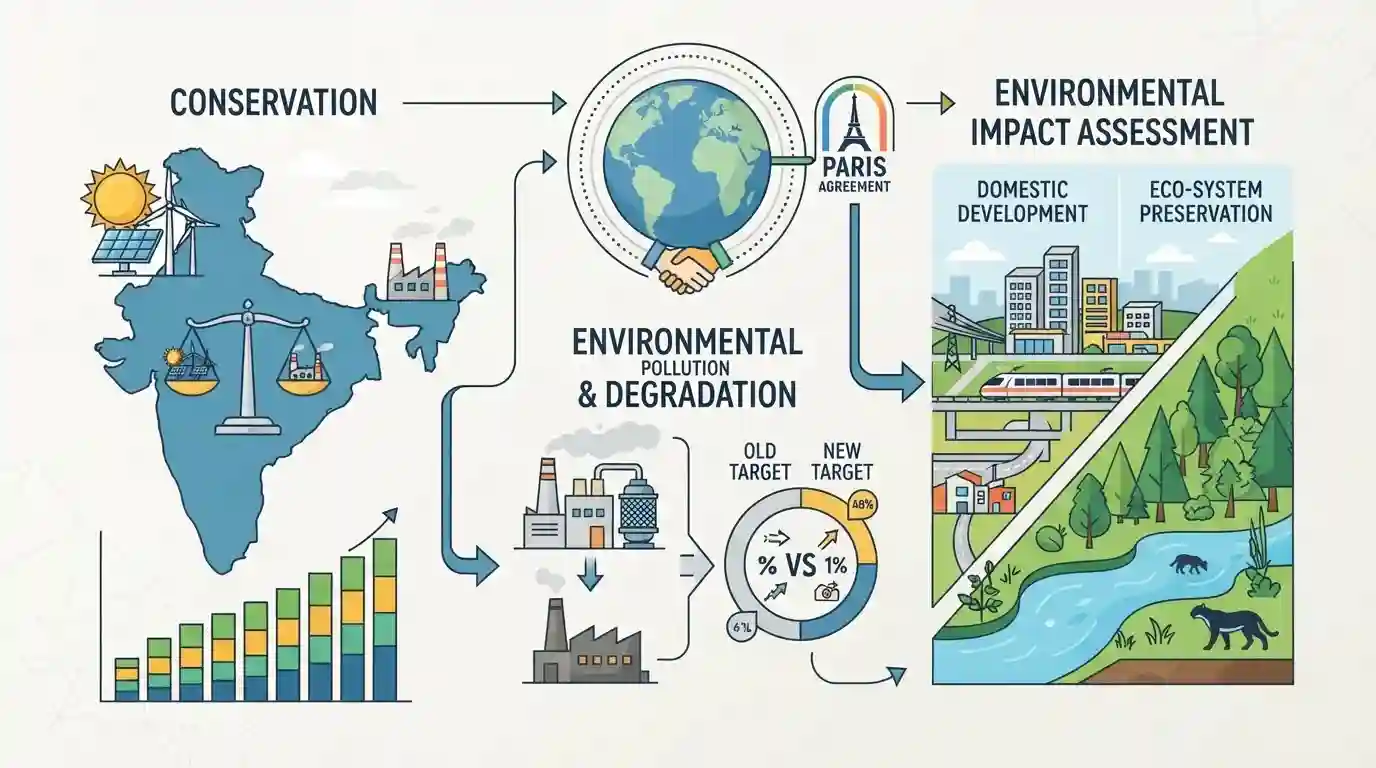
An analysis of India's updated climate targets, examining their significance, modesty, and alignment with international commitments like the Paris Agreement while balancing domestic developmental priorities.
ముఖ్య అంశాలు
- India's new climate targets represent modest yet significant milestones in aligning national growth with global decarbonization under the Paris Agreement.
- The updated Nationally Determined Contributions (NDCs) and long-term commitments balance economic imperatives with ecological responsibility.
- India continues to emphasize the principle of Common But Differentiated Responsibilities (CBDR) in global climate negotiations.
ముఖ్యమైన పదాలు
Nationally Determined Contributions (NDCs)

National climate action plans submitted under the Paris Agreement detailing targets to reduce greenhouse gas emissions and adapt to climate impacts.
UPSC context
UPSC Prelims/Mains (GS Paper III): Environment and Ecology. Tests knowledge of India's international climate commitments and emission reduction goals.
Long-Term Low Emission Development Strategy (LT-LEDS)
A strategic national roadmap submitted under the Paris Agreement outlining low-carbon development pathways toward achieving long-term goals like net-zero emissions.
UPSC context
UPSC Prelims/Mains (GS Paper III): Conservation and environmental pollution. Evaluates India's long-term decarbonization strategy alongside developmental priorities.
UNFCCC
The primary international treaty body established to combat climate change by stabilizing greenhouse gas concentrations in the atmosphere.
UPSC context
UPSC Prelims: International environmental conventions, treaty frameworks, and global governance mechanisms.
Paris Agreement
A legally binding international treaty on climate change adopted under the UNFCCC, aiming to limit global warming to well below 2°C.
UPSC context
UPSC Prelims/Mains (GS Paper III): Global environmental agreements, principles of CBDR-RC, and climate diplomacy.
IPCC
The United Nations body for assessing the science related to climate change, providing regular scientific reports to guide policymakers.
UPSC context
UPSC Prelims: International bodies, climate science assessments, and carbon budgeting frameworks.
ప్రిలిమ్స్ ఉచ్చు
India's Nationally Determined Contributions are legally binding emission reduction caps under the Paris Agreement.
Aspirants often confuse India's net-zero target year (2070) with global net-zero targets (2050), or assume NDCs are legally binding under international law.
అనుసంధానమైన స్థిర భావనలు
What are the core pillars of India's updated Nationally Determined Contributions (NDCs) under the Paris Agreement?
- Intensity Reduction: Emissions Intensity: Aiming for a 45% reduction in emissions intensity of GDP by 2030 (and scaled further for 2035) from 2005 levels.
- Non-Fossil Share: Non-Fossil Capacity: Targeting 50% (moving towards 60%) cumulative electric power installed capacity from non-fossil fuel-based energy by 2030.
- Carbon Sequestration: Carbon Sinks: Creating an additional carbon sink of 2.5 to 3 billion tonnes of CO2 equivalent through additional forest and tree cover.
అంతర-అంశ నమూనాలు
Climate Targets + Critical Minerals Security
India's net-zero 2070 pathway intersects with critical mineral supply chains (lithium, cobalt) required for massive RE scaling, linking energy security with international trade and the Quad.
CBDR-RC + North-South Climate Diplomacy
The emphasis on CBDR-RC bridges international climate law with North-South geopolitical negotiations in multilateral forums like UNFCCC and WTO.

Expect a statement-based prelims question pairing India's exact NDC numeric targets (emission intensity, non-fossil share) with CBDR-RC principles.
అనుసంధాన PYQలు · 2
అనుసంధాన PYQలు · 2
- 2025MainsGS3
Write a review on India's climate commitments under the Paris Agreement (2015) and mention how these have been further strengthened in COP26 (2021). In this direction, how has the first Nationally Determined Contribution intended by India been updated in 2022?
- 2026PrelimsGS1
Consider the following statements with reference to India's response to climate change : I. India's Long-Term Low Emission Development Strategy (LT-LEDS) is a crucial tool for achieving net-zero emissions by 2070. II. India's 4th Biennial Update Report (BUR-4) submitted in December, 2024 recorded around 8% decrease in Greenhouse gas emissions in 2020 over 2019. III. Climate-resilient development necessarily depends on quick and short-term achievement of emission reduction targets. Which of the following relationships among the above statements is/are correct ? 1. Statement I is empirically supported by statement II. 2. Statement III contradicts the approach implicit in statement I. 3. Statement I and statement III together establish the premise of long-term sustainability. Select the answer using the code given below :
