India Updated Climate Commitments and Sustainable Growth Targets
Source:Indian Express ↗
हे का महत्त्वाचे आहे
India's climate commitments and Nationally Determined Contributions (NDCs) are central to GS3 Environment syllabus, reflecting the nation's balancing act between rapid economic growth and global climate mitigation goals.
सारांश
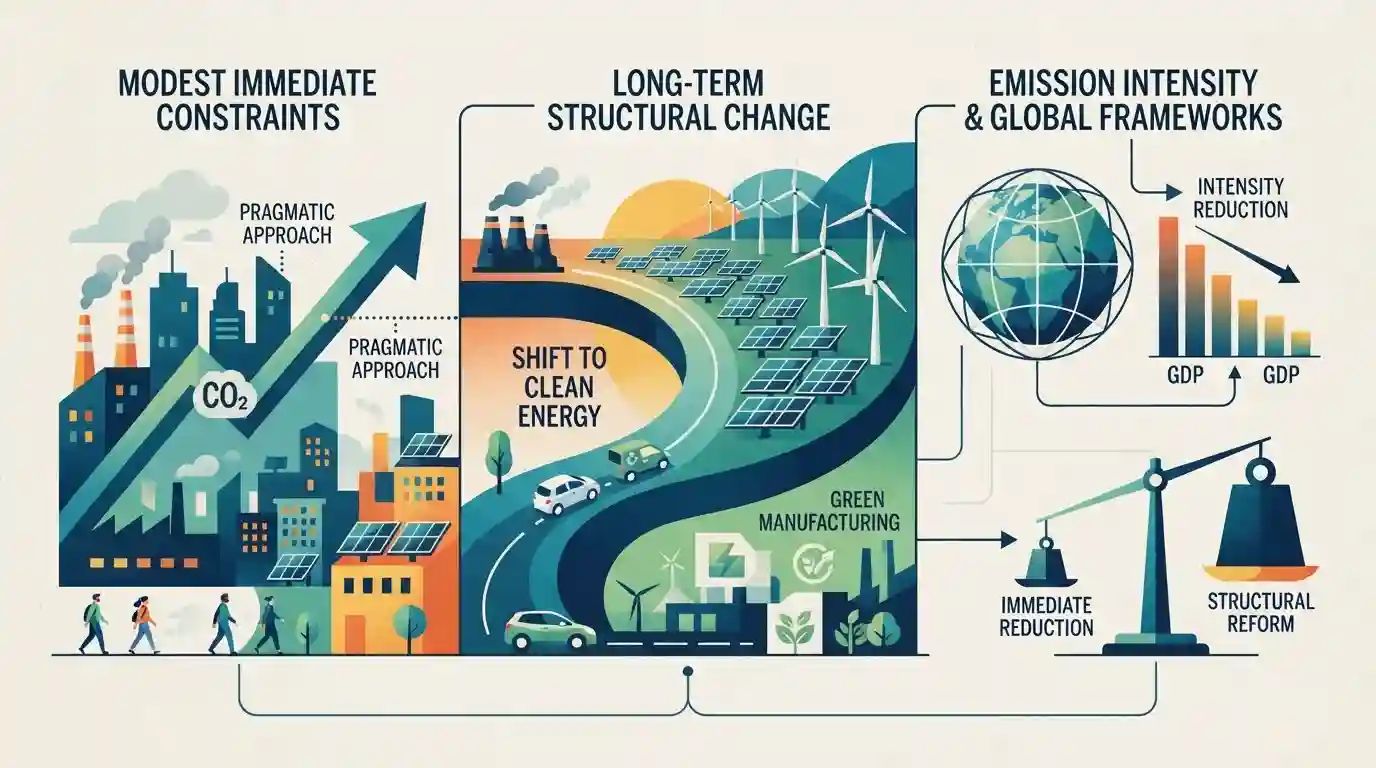
The article explores India's updated climate targets, analyzing how they represent a pragmatic approach—being modest in immediate absolute emission constraints yet significant in steering long-term structural changes toward renewable energy expansion, emission intensity reduction, and adherence to global climate frameworks.
मुख्य मुद्दे
- India's updated climate targets under the Paris Agreement strike a balance between sustainable growth and aggressive decarbonization, making them modest yet significant.
- The targets reflect India's ongoing commitment to expanding renewable energy capacity, lowering emission intensity, and achieving long-term climate goals without compromising developmental priorities.
- India emphasizes the principle of equity and Common But Differentiated Responsibilities (CBDR) in global climate forums.
महत्त्वाच्या संज्ञा
Paris Agreement

An international legally binding treaty on climate change adopted in 2015, aiming to hold global temperature rise to well below 2°C above pre-industrial levels and pursue efforts to limit it to 1.5°C.
UPSC context
GS Paper III: Conservation, environmental pollution, and international climate agreements. Tests knowledge of global governance frameworks.
Nationally Determined Contributions (NDCs)
National climate action plans submitted by countries under the Paris Agreement detailing steps to reduce greenhouse gas emissions and adapt to climate change impacts.
UPSC context
GS Paper III: Environmental impact assessment and climate commitments. Tests understanding of India's evolving climate policy targets.
UNFCCC
The parent treaty of the Paris Agreement, serving as the foundational international environmental treaty to stabilize greenhouse gas concentrations in the atmosphere.
UPSC context
GS Paper III: Conservation and environmental degradation. Tests institutional mechanisms governing international environmental cooperation.
पूर्वपरीक्षा सापळा
India has committed to an absolute reduction in its total greenhouse gas emissions by 2035 compared to 2005 levels.
Aspirants often confuse absolute emission reduction targets with emission intensity reduction targets. India's NDCs target GDP emission intensity, not absolute emissions peak immediately.
संबंधित स्थिर संकल्पना
What are the core pillars and legal nature of Nationally Determined Contributions (NDCs) under the Paris Agreement?
- Voluntary Plans: Voluntary nature: NDCs are national plans highlighting climate actions, greenhouse gas emission reductions, and adaptation efforts, submitted every five years.
- Procedural Bindingness: Legal bindingness: The Paris Agreement makes the process of submitting and successive updating of NDCs legally binding, but not the targets themselves.
- Equity & CBDR: CBDR-RC principle: Targets reflect each country's historical responsibility and national circumstances, distinguishing developed and developing nations.
आंतर-विषय नमुने
Renewables + WTO Trade Disputes
India's enhanced renewable targets must be reconciled with WTO subsidy rules and domestic content requirements for solar cells.
Energy Transition + Fiscal Federalism
Balancing coal dependency with aggressive non-fossil targets directly tests energy security and fiscal space for transition.

India's updated NDC targets (2035 emission intensity, non-fossil capacity) will likely appear as statements in a multi-part environment prelims question.
संबंधित PYQ · 3
संबंधित PYQ · 3
- 2025MainsGS3
Write a review on India's climate commitments under the Paris Agreement (2015) and mention how these have been further strengthened in COP26 (2021). In this direction, how has the first Nationally Determined Contribution intended by India been updated in 2022?
- 2021MainsGS3
Describe the major outcomes of the 26th session of the Conference of the Parties (COP) to the United Nations Framework Convention on Climate Change (UNFCCC). What are the commitments made by India in this conference?
- 2026PrelimsGS1
Consider the following statements with reference to India's response to climate change : I. India's Long-Term Low Emission Development Strategy (LT-LEDS) is a crucial tool for achieving net-zero emissions by 2070. II. India's 4th Biennial Update Report (BUR-4) submitted in December, 2024 recorded around 8% decrease in Greenhouse gas emissions in 2020 over 2019. III. Climate-resilient development necessarily depends on quick and short-term achievement of emission reduction targets. Which of the following relationships among the above statements is/are correct ? 1. Statement I is empirically supported by statement II. 2. Statement III contradicts the approach implicit in statement I. 3. Statement I and statement III together establish the premise of long-term sustainability. Select the answer using the code given below :
