India updated NDCs and climate targets under Paris Agreement
स्रोत:इंडियन एक्सप्रेस ↗
क्यों मायने रखता है
India's climate targets (NDCs) are a recurring theme in UPSC GS3 (Environment) and GS2 (International Relations). Understanding the pragmatic approach behind the 2035 targets—balancing economic growth with emission intensity reduction—is essential for answering Mains questions on India's energy transition, climate diplomacy, and demands for global climate finance.
सारांश
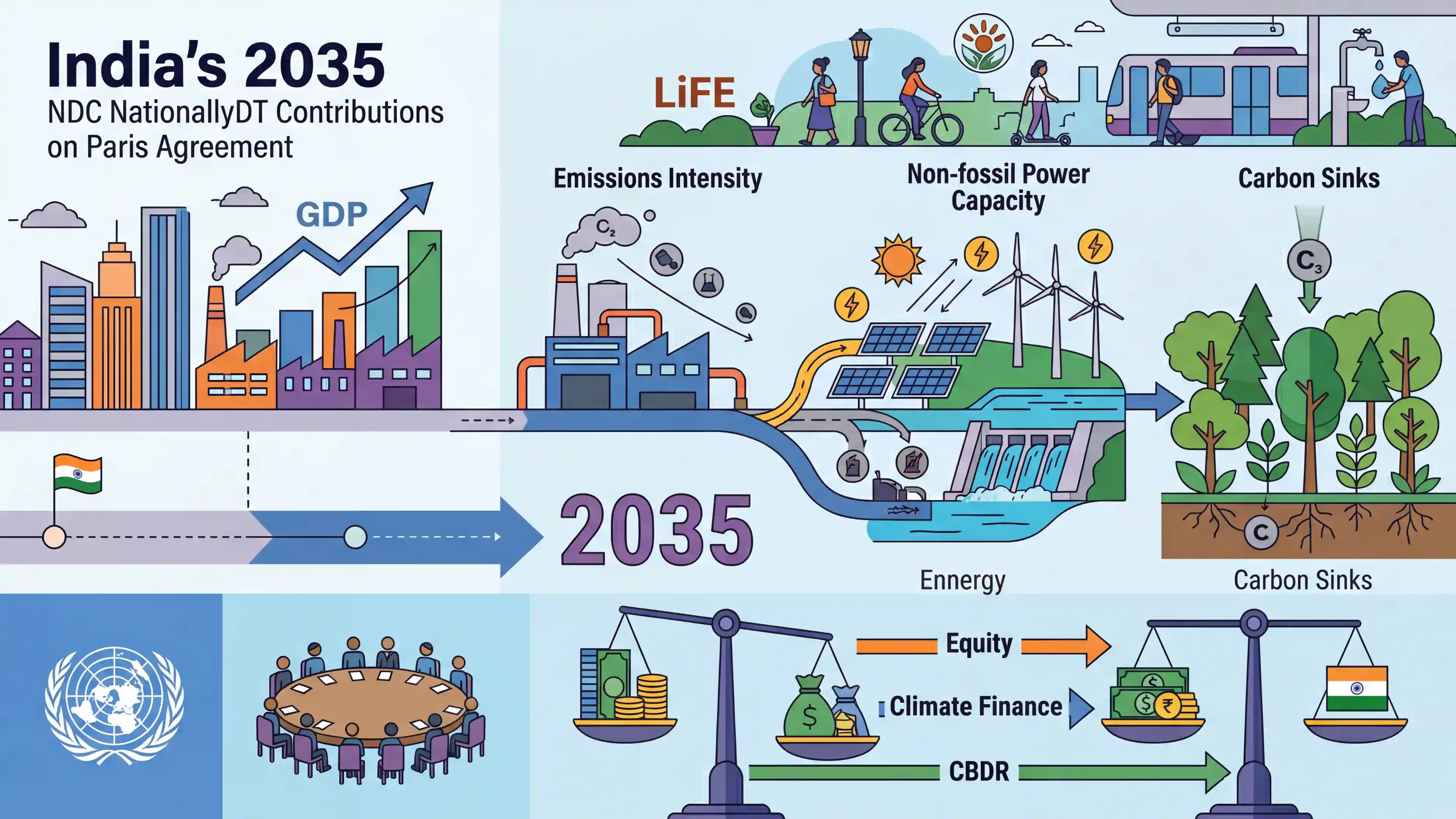
The article examines India's newly submitted Nationally Determined Contributions (NDCs) for 2035 under the Paris Agreement. Described as 'modest but significant,' the updated targets avoid radical absolute emission cuts in favor of realistic, progressive goals that do not jeopardize India's rapid economic growth and developmental priorities. By building on previous benchmarks for emissions intensity, non-fossil power capacity, and carbon sinks, India signals policy continuity. The commitments further reiterate the importance of the LiFE (Lifestyle for Environment) initiative and emphasize that global climate action must be rooted in equity, climate finance, and the principle of Common But Differentiated Responsibilities (CBDR).
मुख्य बिंदु
- India submitted its updated Nationally Determined Contributions (NDCs) for 2035 to the UNFCCC ahead of the COP30 deadline, adhering to the Paris Agreement's five-year update cycle.
- The 2035 targets are framed as 'modest but significant,' balancing steady climate progression with the imperative of sustained domestic economic growth and poverty eradication.
- The updated commitments build upon India's previous core pillars: reducing the emissions intensity of its GDP, increasing the share of non-fossil fuel-based electricity capacity, and enhancing carbon sinks through afforestation.
- India continues to anchor its climate diplomacy in the principle of Common But Differentiated Responsibilities (CBDR), calling on developed countries to fulfill promises on climate finance and technology transfer.
- The NDCs strongly integrate demand-side management and sustainable consumption patterns, heavily promoted through India's LiFE (Lifestyle for Environment) movement.
महत्वपूर्ण शब्द
Nationally Determined Contributions (NDCs)

Self-defined climate action plans under the Paris Agreement where countries outline targets for reducing greenhouse gas emissions and adapting to climate impacts, updated every five years.
UPSC context
GS Paper 3 (Environment). Critical for evaluating India's 2070 Net Zero trajectory and its role in global climate governance.
Paris Agreement
A 2015 legally binding international treaty aiming to limit global warming to well below 2°C, preferably 1.5°C, compared to pre-industrial levels.
UPSC context
GS Paper 2 (International Relations) & Paper 3. The primary legal framework for modern multilateral climate negotiations and India’s global environmental obligations.
LiFE (Lifestyle for Environment)
An India-led global movement promoting mindful consumption and sustainable individual behaviors to combat climate change, introduced at COP26 in Glasgow.
UPSC context
GS Paper 3 (Environment). Represents India's leadership in advocating for demand-side climate solutions and traditional sustainable practices.
Common But Differentiated Responsibilities (CBDR)
A principle acknowledging that while all states are responsible for addressing climate change, developed nations bear greater historical responsibility and possess more capacity.
UPSC context
GS Paper 3 (Climate Justice). Central to India's demand for equity, climate finance, and technology transfer from the Global North.
UNFCCC
The 1992 international treaty established to stabilize atmospheric greenhouse gas concentrations and prevent dangerous human interference with the climate system.
UPSC context
GS Paper 2 & 3. The foundational framework for all international climate summits (COPs) and major environmental protocols.
Emissions Intensity
The volume of greenhouse gas emissions produced per unit of a country's Gross Domestic Product (GDP).
UPSC context
GS Paper 3 (Environment). India’s key metric for climate targets, allowing economic growth while reducing the carbon footprint per unit of wealth.
प्रारंभिक ट्रैप
India has committed to reducing its absolute carbon emissions by 2035 under its updated NDCs.
India's NDCs target a reduction in the emissions intensity of its GDP, not absolute cuts. India's total absolute emissions will continue to grow as its economy expands.
संबंधित अवधारणाएँ
What is the 'Ratchet Mechanism' under the Paris Agreement?
- Five-year cycle: Countries are mandated to submit updated Nationally Determined Contributions (NDCs) every five years.
- Progression principle: Each successive NDC must represent a clear progression beyond the party's current commitments.
- Highest ambition: The updated pledges must reflect the party's highest possible ambition in light of national circumstances.
What is the principle of CBDR-RC in UNFCCC negotiations?
- Shared but distinct: Acknowledges all states share an obligation to address climate change, but their responsibilities are not equal.
- Historical responsibility: Developed nations bear greater responsibility due to their historical industrial emissions and larger carbon footprint.
- Respective capabilities: Climate action expectations are tied to a nation's financial and technological capacity, safeguarding developing nations' economic growth.
अंतर-विषय पैटर्न
Environmental Kuznets Curve & NDCs
India's focus on "emissions intensity" over absolute cuts reflects the Environmental Kuznets Curve, aiming to decouple economic growth from environmental degradation without stalling development.
LiFE & Behavioral Economics
The integration of the LiFE initiative into NDCs connects climate policy with 'Nudge Theory', emphasizing demand-side management and individual behavioral shifts over purely regulatory approaches.

Expect a 2026 Prelims question contrasting India's emission intensity targets with Net Zero 2070, linked to the Paris ratchet mechanism.
संबद्ध PYQ · 4
संबद्ध PYQ · 4
- 2025MainsGS3
Write a review on India's climate commitments under the Paris Agreement (2015) and mention how these have been further strengthened in COP26 (2021). In this direction, how has the first Nationally Determined Contribution intended by India been updated in 2022?
- 2022MainsGS3
Do you think India will meet 50 percent of its energy needs from renewable energy by 2030 ? Justify your answer. How will the shift of subsidies from fossil fuels to renewables help achieve the above objective ? Explain.
- 2021MainsGS3
Describe the major outcomes of the 26th session of the Conference of the Parties (COP) to the United Nations Framework Convention on Climate Change (UNFCCC). What are the commitments made by India in this conference?
- 2025PrelimsGS1
Consider the following statements : Statement I: Article 6 of the Paris Agreement on climate change is frequently discussed in global discussions on sustainable development and climate change. Statement II: Article 6 of the Paris Agreement on climate change sets out the principles of carbon markets. Statement III : Article 6 of the Paris Agreement on climate change intends to promote inter-country non-market strategies to reach their climate targets. Which one of the following is correct in respect of the above statements?
