India EU Strategic Agenda focuses on supply chains and tech security
Source:Indian Express ↗
Why It Matters
The India-EU strategic partnership is critical for India's foreign policy and economic security, serving as a linchpin for diversifying supply chains, securing critical technologies, and expanding trade through mechanisms like the BTIA and the TTC. Understanding this relationship is vital for answering GS-2 questions on bilateral relations and the impact of developed world policies on India's interests.
Summary
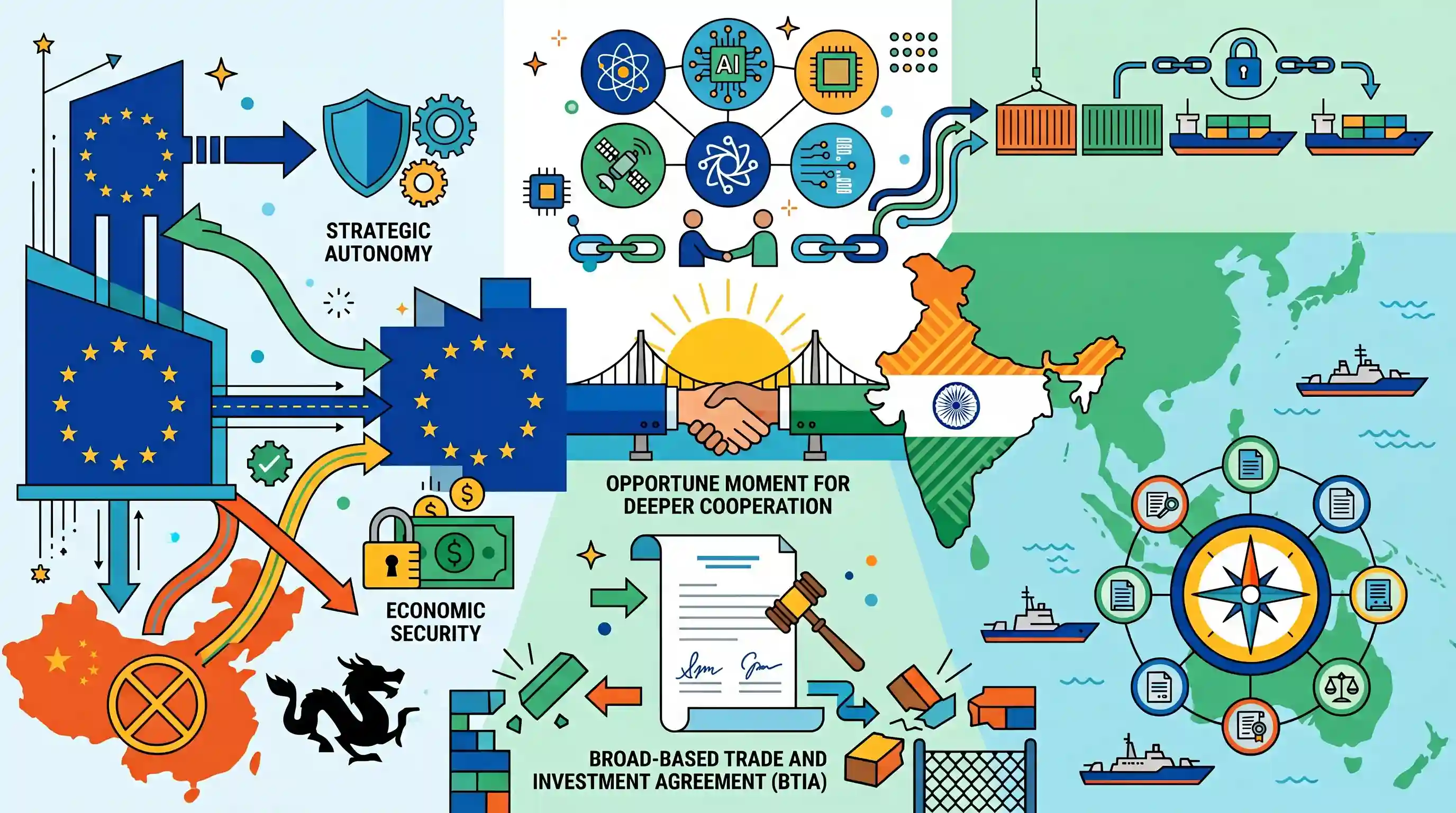
The article analyzes the European Union's newly adopted Strategic Agenda and its direct implications for India-EU relations. It highlights how the EU's evolving focus on economic security, strategic autonomy, and 'de-risking' from China creates an opportune moment for deeper cooperation with India. Key pillars of this enhanced partnership include operationalizing the Trade and Technology Council (TTC) to address critical technologies and securing supply chains. Furthermore, the agenda underscores the pressing need to overcome hurdles in finalizing the Broad-based Trade and Investment Agreement (BTIA) and expands bilateral alignment on maritime security and a rules-based order in the Indo-Pacific.
Key Points
- The EU's new Strategic Agenda prioritizes economic security, defense capabilities, and building competitive, resilient supply chains.
- The EU's broader strategy of 'de-risking' from China presents structural opportunities for India to emerge as a reliable trade and technology partner.
- The India-EU Trade and Technology Council (TTC) is positioned as a critical mechanism for collaborating on digital governance, green technologies, and supply chain security.
- Despite renewed political momentum, concluding the long-pending Broad-based Trade and Investment Agreement (BTIA) remains a significant challenge due to differences over tariffs, labor standards, and market access.
- Geopolitically, the EU and India are increasingly aligned in their objective to ensure a free, open, and rules-based maritime order in the Indo-Pacific region.
Important Terms
Broad-based Trade and Investment Agreement (BTIA)

A comprehensive free trade agreement under negotiation since 2007, aiming to reduce tariffs and barriers in goods, services, and investment sectors. Proposals recently revived after being stalled in 2013.
UPSC context
GS Paper II & III: Bilateral trade agreements and their impact on the Indian economy and foreign policy.
Trade and Technology Council (TTC)
A high-level strategic platform established in 2023 to coordinate cooperation on trade, trusted technology (AI, semiconductors), and security challenges. India is the second partner (after the US) to have one with the EU.
UPSC context
GS Paper II: Emerging international forums for technical cooperation and economic security.
India-EU Strategic Partnership
The guiding framework for India-EU relations since 2004, rooted in shared democratic values, a rules-based order, and multilateralism. It covers diverse areas from maritime security to climate change.
UPSC context
GS Paper II: Bilateral relations with major global entities and regional groupings.
De-risking
An economic strategy to reduce over-reliance on a single supplier (typically China) for critical goods by diversifying supply chains, without completely severing economic ties (unlike decoupling).
UPSC context
GS Paper II & III: Effect of global policies on India’s interests; supply chain resilience.
Strategic Autonomy
The ability of a state to pursue its national interests and make independent foreign policy decisions without being constrained by or dependent on other countries.
UPSC context
GS Paper II: Fundamental concepts in Indian foreign policy and international relations.
European Union (EU)
A political and economic union of 27 European member states that acts as a single market. It is one of India's largest trading partners and a key global regulator.
UPSC context
GS Paper II: Important international institutions and their mandate affecting India.
Prelims Trap
India is the only country with which the European Union has established a Trade and Technology Council (TTC).
The EU established its first TTC with the United States. India is the second country, making it a rare but not exclusive mechanism.
Static Concepts Connected
What are the primary sticking points in the India-EU BTIA negotiations?
- Tariff cuts: The EU demands steep reductions in Indian import duties on automobiles, wines, spirits, and dairy products.
- Services access: India seeks heavily liberalized visa norms (Mode 4) to allow its IT professionals and service sector workers easier access to the European market.
- Non-trade barriers: The EU insists on embedding strict labor standards, human rights clauses, and environmental norms within the core text of the trade agreement.
How does 'De-risking' differ from 'Decoupling' in global trade?
- De-risking: Diversifying supply chains to reduce vulnerability in critical sectors (e.g., tech, critical minerals) without fully cutting off broader general trade with a target nation.
- Decoupling: The complete, deliberate severance of economic, financial, technological, and supply chain ties between two major economies.
Cross-Topic Patterns
Green tech vs CBAM protectionism
While the EU agenda promotes green tech cooperation, its upcoming Carbon Border Adjustment Mechanism (CBAM) acts as a severe non-tariff barrier for Indian steel and aluminum exports.
Indo-Pacific maritime alignment
The EU’s focus on sea lines of communication expands India's Indo-Pacific partnerships beyond the US-led Quad, gradually integrating European navies into regional rules-based security architectures.

Expect a 2026 Prelims question linking the India-EU TTC mandate, BTIA negotiation hurdles, and the EU's 'de-risking' strategy.
Linked PYQs · 4
Linked PYQs · 4
- 2017PrelimsGS1
'Broad-based Trade and Investment Agreement (BTIA)' is sometimes seen in the news in the context of negotiations held between India and
- 2023PrelimsGS1
Consider the following statements: Statement-I: Recently, the United States of America (USA) and the European Union (EU) have launched the 'Trade and Technology Council'. Statement-II: The USA and the EU claim that through this they are trying to bring technological progress and physical productivity under their control. Which one of the following is correct in respect of the above statements?
- 2023MainsGS2
‘The expansion and strengthening of NATO and a stronger US-Europe strategic partnership works well for India.’ What is your opinion about this statement ? Give reasons and examples to support your answer.
- 2019MainsGS2
‘The long-sustained image of India as a leader of the oppressed and marginalised nations has disappeared on account of its new found role in the emerging global order.’ Elaborate.
