Structural Reforms Needed in National Testing Agency
Source:The Hindu ↗
Why It Matters
The integrity of public examinations is a core governance issue that affects millions of students and the meritocratic foundation of the country. Repeated failures in exam administration highlight the need for institutional reforms in statutory bodies (like NTA), directly connecting to GS Paper 2 topics on governance, accountability, and the newly enacted anti-cheating legislation.
Summary
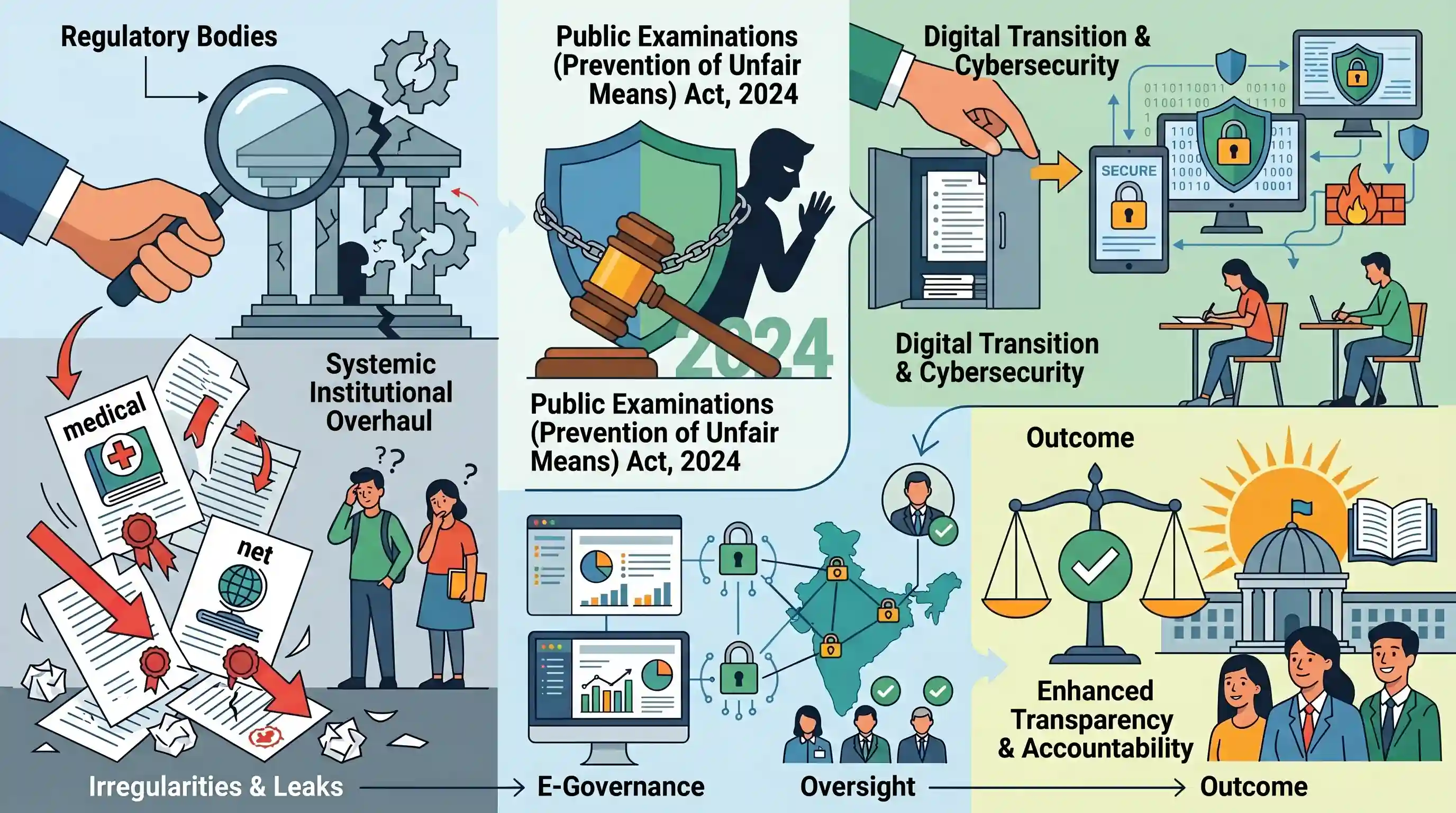
Following allegations of widespread irregularities and paper leaks in crucial examinations like NEET-UG and UGC-NET, experts are calling for a comprehensive structural review of the National Testing Agency (NTA). The vulnerabilities inherent in physical pen-and-paper exams have underscored the urgent need for a transition to secure, digital examination infrastructure equipped with strong cybersecurity protocols. While the enforcement of the Public Examinations (Prevention of Unfair Means) Act, 2024 provides a legal deterrent, experts emphasize that genuine reform requires systemic institutional overhaul, enhanced transparency, and greater accountability in India's higher education assessment mechanisms.
Key Points
- The National Testing Agency (NTA) is facing severe scrutiny due to alleged paper leaks and irregularities in major exams like NEET-UG and UGC-NET.
- Experts highlight that pen-and-paper examinations are highly vulnerable to physical breaches during transportation and handling across various nodes.
- There is a growing consensus on the need to structurally reform the NTA, shift towards robust digital testing infrastructure, and implement end-to-end cybersecurity measures.
- The government has invoked the Public Examinations (Prevention of Unfair Means) Act, 2024, to deter malpractices, but systemic institutional upgrades and greater transparency (like bringing NTA under RTI) are required.
Important Terms
National Testing Agency (NTA)

An autonomous, self-sustained premier testing organization under the Ministry of Education. It is registered as a society and conducts major national entrance examinations like NEET-UG, JEE Main, and UGC-NET to ensure standardized assessments.
UPSC context
GS Paper II: Statutory/Regulatory & Quasi-judicial bodies. Tests knowledge of institutional transparency and governance in the education sector.
Public Examinations (Prevention of Unfair Means) Act, 2024
Legislation enforced in June 2024 to curb malpractices in public exams. It penalizes paper leaks and organized cheating with imprisonment (3-10 years) and heavy fines (up to ₹1 crore), targeting systemic irregularities.
UPSC context
GS Paper II: Government Policies & Interventions. Tests understanding of legislative measures to ensure meritocracy and integrity in public recruitment/admissions.
Central Bureau of Investigation (CBI)
India's premier central investigative agency, functioning under the Ministry of Personnel. It is often tasked with probing high-stakes criminal conspiracies, including national-level examination paper leaks and institutional corruption.
UPSC context
GS Paper II: Statutory and Non-statutory bodies. Tests knowledge of the agency's role in maintaining accountability and federal-state investigative dynamics.
Right to Information (RTI) Act, 2005
A 2005 Act empowering citizens to request information from public authorities. It serves as a tool for transparency, holding bodies like the NTA accountable for their administrative and examination processes.
UPSC context
GS Paper II: Governance, Transparency, and Accountability. Vital for questions on citizen empowerment and administrative reforms.
Ministry of Education (MoE)
The nodal central ministry responsible for formulating the National Policy on Education. It oversees the NTA and higher education institutions, playing a key role in implementing systemic examination reforms.
UPSC context
GS Paper II: Issues relating to development and management of Social Sector/Services relating to Education.
Supreme Court of India
The highest judicial body in India that provides legal oversight during examination crises. It hears petitions regarding paper leaks and can order re-exams or independent probes to protect student rights.
UPSC context
GS Paper II: Structure, organization, and functioning of the Judiciary. Tests understanding of judicial activism and protection of fundamental rights.
Prelims Trap
"The Public Examinations Act, 2024 applies to all state-level public service commission exams."
The 2024 Act applies exclusively to Central testing authorities (UPSC, SSC, NTA, RRB). Public examinations conducted by State Governments and State boards are explicitly excluded.
Static Concepts Connected
What is the legal and administrative standing of the National Testing Agency (NTA)?
- Non-Statutory Status: NTA is not a statutory body; it is an autonomous organization registered under the Societies Registration Act, 1860.
- Administrative Control: It functions as an independent, autonomous, and self-sustained testing organization operating under the Ministry of Education.
What are the core provisions of the Public Examinations (Prevention of Unfair Means) Act, 2024?
- Targeted Prosecution: It explicitly targets organized syndicates and service providers involved in leaks, rather than penalizing individual candidates (who face existing administrative rules).
- Stringent Penalties: Service providers and organized crime rings face rigorous imprisonment of up to 10 years and minimum fines of ₹1 crore.
Cross-Topic Patterns
Biometrics, E-Governance & Privacy Law
Using Aadhaar-based facial recognition for NTA/UPSC exams intersects with the DPDP Act, 2023, raising questions about biometric data retention and consent exemptions for state instrumentalities.
Exam Leaks as Organized Crime
The 2024 Act elevates exam malpractices from mere administrative lapses to organized crime, bringing education sector corruption firmly into the GS3 internal security framework.

Expect a 2026 Prelims question on the non-statutory nature of NTA combined with the strictly Central jurisdiction of the 2024 Exams Act.
Linked PYQs · 4
Linked PYQs · 4
- 2024MainsGS2
What are the aims and objects of recently passed and enforced, The Public Examination (Prevention of Unfair Means) Act, 2024? Whether University/State Education Board examinations, too, are covered under the Act ?
- 2015MainsGS2
The quality of higher education in India requires major improvements to make it internationally competitive. Do you think that the entry of foreign educational institutions would help improve the quality of higher and technical education in the country? Discuss.
- 2020MainsGS3
Discuss different types of cyber crimes and measures required to be taken to fight the menace.
- 2024MainsGS4
“The 'Code of Conduct' and 'Code of Ethics' are the sources of guidance in public administration. There is code of conduct already in operation, whereas code of ethics is not yet put in place. Suggest a suitable model for code of ethics to maintain integrity, probity and transparency in governance.”
