CCUS Investment Needs for India Net Zero Climate Goals
Source:Indian Express ↗
Why It Matters
CCUS is an emerging technology crucial for India's transition to a low-carbon economy, balancing industrial growth needs with net-zero commitments, making it highly relevant for GS Paper 3 questions on climate change and environmental technology.
Summary
This article examines the role, investment requirements, and challenges of Carbon Capture, Utilisation, and Storage (CCUS) in India's pathway toward decarbonizing hard-to-abate sectors and achieving its net-zero emissions targets.
Key Points
- Carbon Capture, Utilisation, and Storage (CCUS) is gaining attention as a critical tool for decarbonizing hard-to-abate sectors such as steel, cement, and power generation.
- Experts emphasize that massive investments, policy frameworks, and technological innovations are required to make CCUS economically viable in India.
- The integration of CCUS is vital for India to achieve its long-term net-zero target by 2070 while sustaining industrial growth.
- Challenges involve high capital costs, lack of robust infrastructure for transport and storage of carbon, and the need for clear regulatory mandates.
Important Terms
Carbon Capture, Utilisation, and Storage (CCUS)

A suite of technologies that capture carbon dioxide emissions from industrial processes or power generation, convert them for commercial use, or store them deep underground to prevent release.
UPSC context
GS Paper III (Environment & Ecology, Infrastructure: Energy). Tests technological solutions for decarbonizing hard-to-abate sectors like steel and cement.
Paris Agreement
A landmark legally binding international treaty adopted in 2015 to combat climate change by limiting global warming to well below 2°C, preferably 1.5°C, above pre-industrial levels.
UPSC context
GS Paper III (Environment & Ecology). Crucial for international climate architecture, global stocktakes, and India's multilateral commitments.
Nationally Determined Contributions (NDCs)
National climate action plans under the Paris Agreement where each signatory outlines targets for reducing greenhouse gas emissions and adapting to climate impacts.
UPSC context
GS Paper III (Environment & Ecology). Tests India's climate mitigation targets, emissions intensity reductions, and non-fossil energy goals.
Prelims Trap
CCUS is designed to replace renewable energy sources in achieving India's net-zero targets by 2070.
CCUS is often mistakenly viewed as a substitute for renewable energy, whereas it is actually targeted at hard-to-abate sectors where direct electrification is economically or technically unfeasible.
Static Concepts Connected
What are the core stages and utilization pathways of Carbon Capture, Utilisation, and Storage (CCUS)?
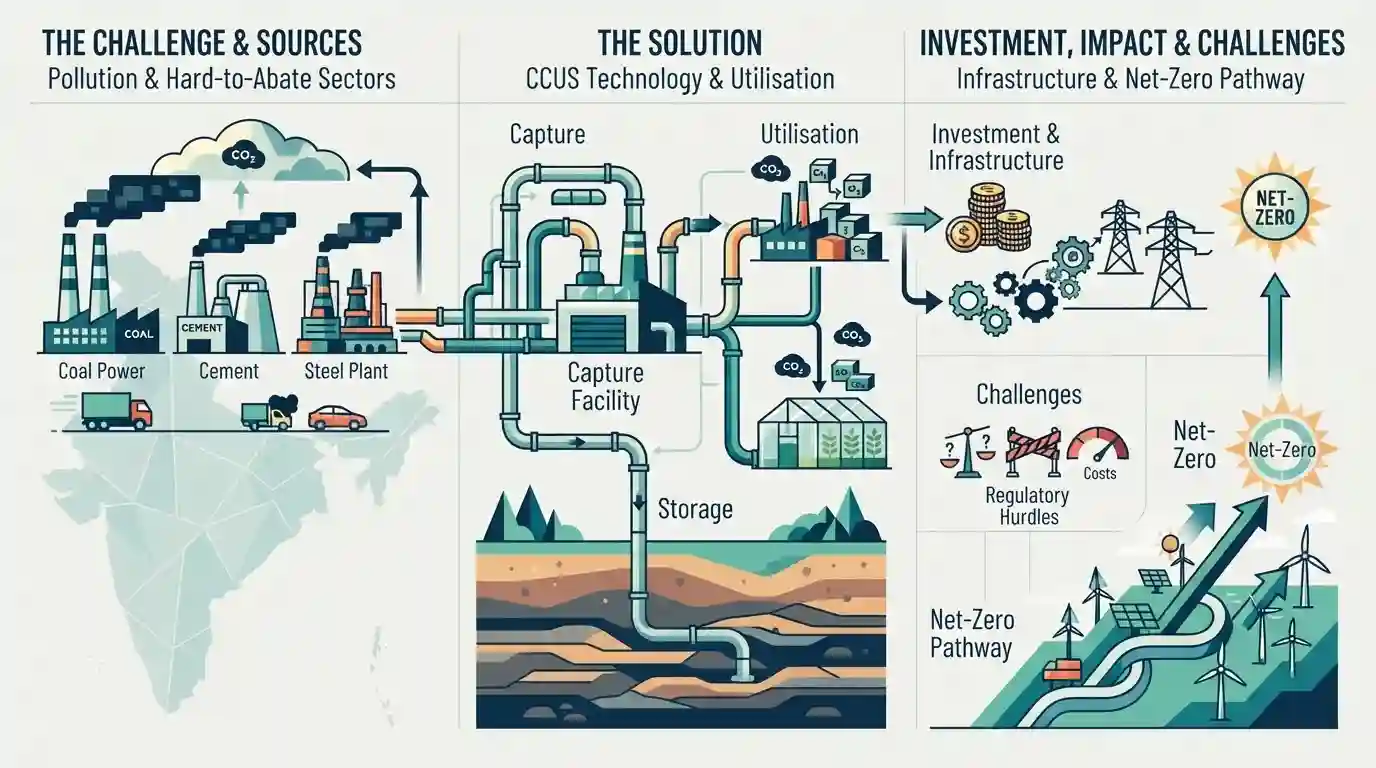
- Capture Stage: Capturing CO2 emissions directly from industrial point sources like steel, cement, and thermal power plants using chemical solvents or membranes.
- Transport Infrastructure: Transporting the compressed carbon dioxide via dedicated pipelines or shipping networks to utilization or permanent storage sites.
- Utilisation Pathways: Converting CO2 into commercial products like urea, green methanol, building materials, or deploying it for Enhanced Oil Recovery (EOR).
- Geological Storage: Permanently injecting captured carbon into deep saline aquifers or depleted oil and gas reservoirs for long-term sequestration.
Cross-Topic Patterns
CCUS Infrastructure vs. Fiscal Deficit Limits
CCUS technology requires massive capital outlays akin to green hydrogen projects, testing fiscal deficit limits while balancing industrial decarbonization commitments under NDCs.
Energy Security and Long-Term Decarbonization Bridge
Carbon capture allows legacy coal and steel units to stay operational, creating a policy bridge between near-term energy security and 2070 net-zero targets.

CCUS bottlenecks, hard-to-abate sectors, and Panchamrit climate goals frequently appear in multi-statement prelims questions.
Linked PYQs · 2
Linked PYQs · 2
- 2025MainsGS3
What is Carbon Capture, Utilization and Storage (CCUS)? What is the potential role of CCUS in tackling climate change?
- 2025MainsGS3
Write a review on India's climate commitments under the Paris Agreement (2015) and mention how these have been further strengthened in COP26 (2021). In this direction, how has the first Nationally Determined Contribution intended by India been updated in 2022?
