Preventive Healthcare Systems and Data Driven Public Health Policy
Source:The Hindu ↗
Why It Matters
The article addresses core GS-2 themes regarding the development and management of social sectors relating to Health, as well as GS-3 themes on the application of technology (AI/data) in public services. Understanding the shift towards preventive healthcare and data-driven systems is crucial for answering questions on health policy, healthcare equity (urban-rural divide), and systemic pandemic readiness.
Summary
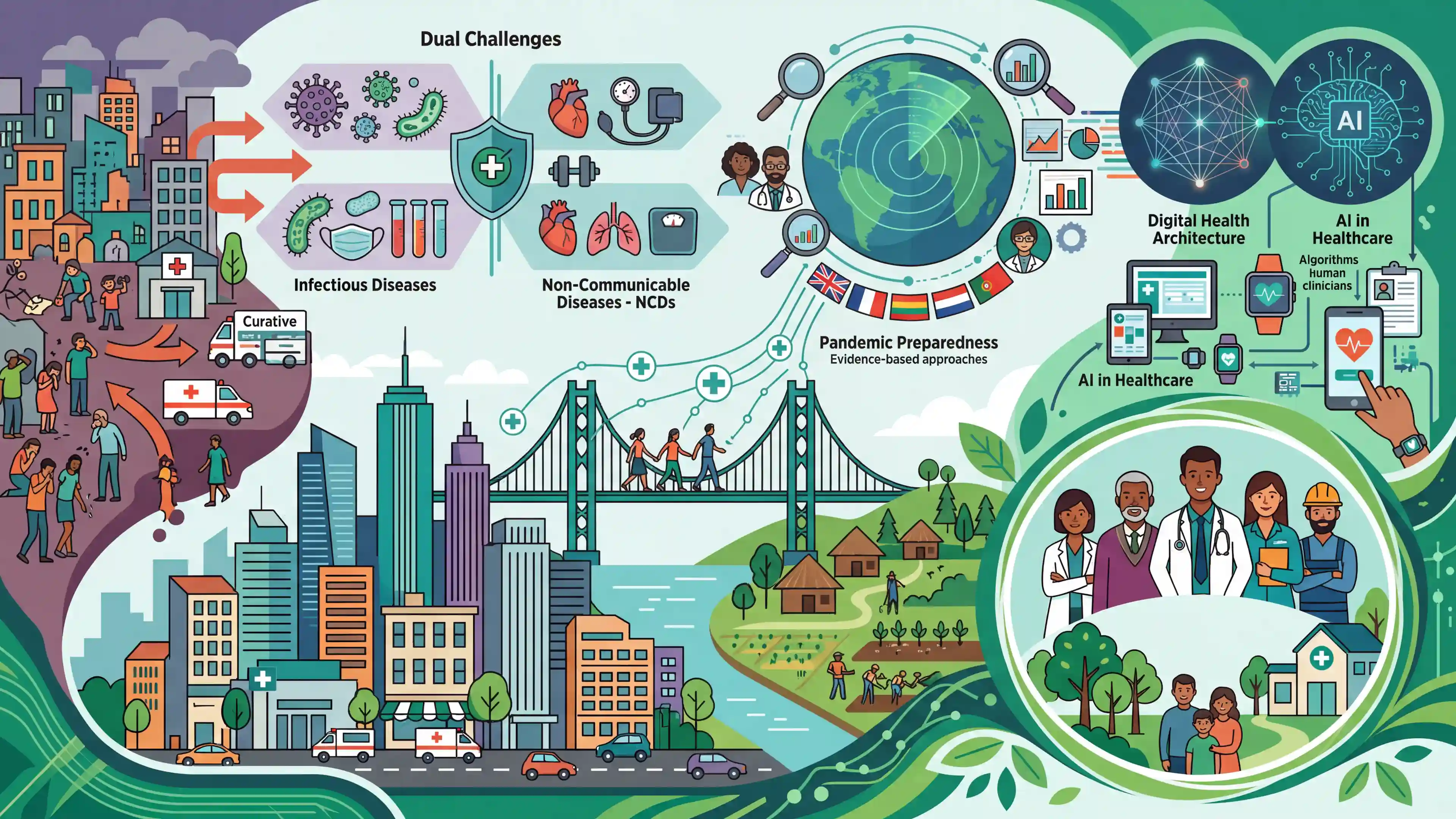
Experts at a recent webinar organized by SRMIST and The Hindu emphasized the critical need for India to transition from a reactive, curative healthcare model to a robust, preventive public health ecosystem. The discussions highlighted the dual challenges of infectious diseases and the rising burden of non-communicable diseases (NCDs), stressing the necessity to bridge the urban-rural divide. Prominent voices, including Dr. Soumya Swaminathan, underscored that pandemic preparedness must rely on evidence-based, data-driven surveillance systems and global cooperation. Additionally, the integration of Artificial Intelligence (AI) and digital health tools was identified as vital for strengthening public health decision-making. Developing an interdisciplinary, empathetic public health workforce is essential to navigating the evolving health landscape effectively.
Key Points
- India needs to shift from a reactive, curative healthcare model to a prevention-led public health ecosystem to tackle both infectious diseases and the rising burden of non-communicable diseases (NCDs).
- Addressing the urban-rural healthcare divide and ensuring inclusive health systems are critical for equitable health outcomes.
- Lessons from the pandemic underscore the need for strong public health infrastructure, global cooperation, and data-driven disease surveillance systems.
- Artificial Intelligence (AI) and digital health tools can significantly enhance public health decision-making when properly integrated into the existing digital health architecture.
- Building a future-ready public health workforce requires interdisciplinary skills, including epidemiology, data analysis, policy understanding, and empathy.
- Consistent policy focus and sustained investment in health, as seen in the Tamil Nadu public health model, are vital for system readiness and better outcomes.
Important Terms
Non-Communicable Diseases (NCDs)

Chronic conditions (e.g., heart disease, diabetes, cancer) that are non-contagious. They result from genetic, environmental, and behavioral factors like poor diet and tobacco use, accounting for ~65% of deaths in India.
UPSC context
GS Paper II (Social Sector/Health); tests understanding of India's epidemiological transition from infectious to lifestyle-related chronic illnesses.
Preventive Healthcare
Proactive healthcare focusing on disease prevention through immunizations, screenings, and lifestyle changes. It aims to reduce the disease burden and catastrophic out-of-pocket expenditure by identifying risks before they become severe.
UPSC context
GS Paper II (Health/Governance); critical for discussions on universal health coverage, public health resilience, and healthcare affordability.
National Tuberculosis Elimination Programme (NTEP)
India's flagship initiative (formerly RNTCP) aiming to eliminate Tuberculosis by 2025. It uses the "Detect-Treat-Prevent-Build" (DTPB) strategy and provides financial/nutritional support through the Nikshay Poshan Yojana.
UPSC context
GS Paper II (Health/Vulnerable Sections); tests knowledge of national health targets, specific disease interventions, and sustainable development goals (SDG 3.3).
Ayushman Bharat Digital Mission (ABDM)
A central initiative to create an integrated, interoperable digital health infrastructure. It includes unique Health IDs (ABHA), digital health records, and registries for facilities and professionals to ensure data-led public health surveillance.
UPSC context
GS Paper II (E-governance) & GS Paper III (S&T); evaluates the role of digital technology and AI in transforming public health management.
M.S. Swaminathan Research Foundation (MSSRF)
A non-profit research institution focusing on sustainable rural development and "nutrition security." It champions a life-cycle approach to health by integrating agriculture, nutrition, and environmental sustainability at the grassroots level.
UPSC context
GS Paper III (Agriculture/Environment) & GS Paper II (Health); relevant for nutrition-sensitive agriculture and food security strategies.
State Planning Commission (Tamil Nadu)
An advisory body in Tamil Nadu (comparable to a state-level NITI Aayog) that formulates long-term development plans, monitors Sustainable Development Goals (SDGs), and advises on urban planning and social welfare policies.
UPSC context
GS Paper II (Federalism/Governance); an example of decentralized planning and state-specific policy frameworks for economic and social growth.
Prelims Trap
Public health and sanitation are under the Concurrent List, enabling the Union to enforce nationwide digital health architectures like Ayushman Bharat.
Public health, sanitation, and hospitals fall strictly under the State List (Entry 6). The Union guides national architecture via funding (Centrally Sponsored Schemes) and concurrent entries like social planning.
Static Concepts Connected
What constitutes the 'Dual Burden of Disease' in India's epidemiological transition?
- Epidemiological Transition: The demographic and social shift from communicable diseases being the primary cause of mortality to non-communicable diseases (NCDs) dominating.
- The Dual Burden: India concurrently faces a persistent high volume of infectious diseases (TB, dengue, malaria) alongside rapidly escalating lifestyle-related NCDs (diabetes, cardiovascular diseases).
- Policy Implication: Forces the healthcare system to stretch resources across two distinct treatment models, demanding a pivot from episodic curative care to continuous preventive screening.
What are the core building blocks of the Ayushman Bharat Digital Mission (ABDM)?
- ABHA Number: A unique 14-digit identifier enabling citizens to seamlessly access, consolidate, and share their longitudinal health records digitally across providers.
- HPR & HFR: Comprehensive, verified digital repositories of all healthcare professionals (HPR) and health facilities (HFR) across both modern and traditional medicine systems.
- PHR Application: Personal Health Record (PHR) applications allow patients to link, store, and manage consent for sharing their medical history with doctors.
Cross-Topic Patterns
Health Data & Privacy (GS2/GS3)
Digitizing health records via ABDM and utilizing AI for predictive surveillance directly intersects with the Digital Personal Data Protection (DPDP) Act 2023 and the fundamental right to privacy (Puttaswamy).
Fiscal Federalism in Healthcare (GS2)
While public health is a State subject (exemplified by TN's successful health cadre), national elimination targets (like TB) rely on Centrally Sponsored Schemes, heavily testing cooperative and fiscal federalism.

Expect a multi-statement prelims question linking Ayushman Bharat Digital Mission (ABHA) interoperability with the DPDP Act 2023.
Linked PYQs · 3
Linked PYQs · 3
- 2024MainsGS2
In a crucial domain like the public healthcare system the Indian State should play a vital role to contain the adverse impact of marketisation of the system. Suggest some measures through which the State can enhance the reach of public healthcare at the grassroots level.
- 2021MainsGS2
“Besides being a moral imperative of a Welfare State, primary health structure is a necessary precondition for sustainable development.” Analyze.
- 2023MainsGS3
Introduce the concept of Artificial Intelligence (AI). How does Al help clinical diagnosis? Do you perceive any threat to privacy of the individual in the use of Al in healthcare?
