Digital Screen Time Effects on Child Neurodevelopment
Source:The Hindu ↗
Why It Matters
As digital device penetration increases, distinguishing between genuine neurodevelopmental disorders and behavioral issues caused by environmental factors like screen time is vital. It informs proper pediatric care, early intervention strategies, and public health awareness campaigns for child development.
Summary
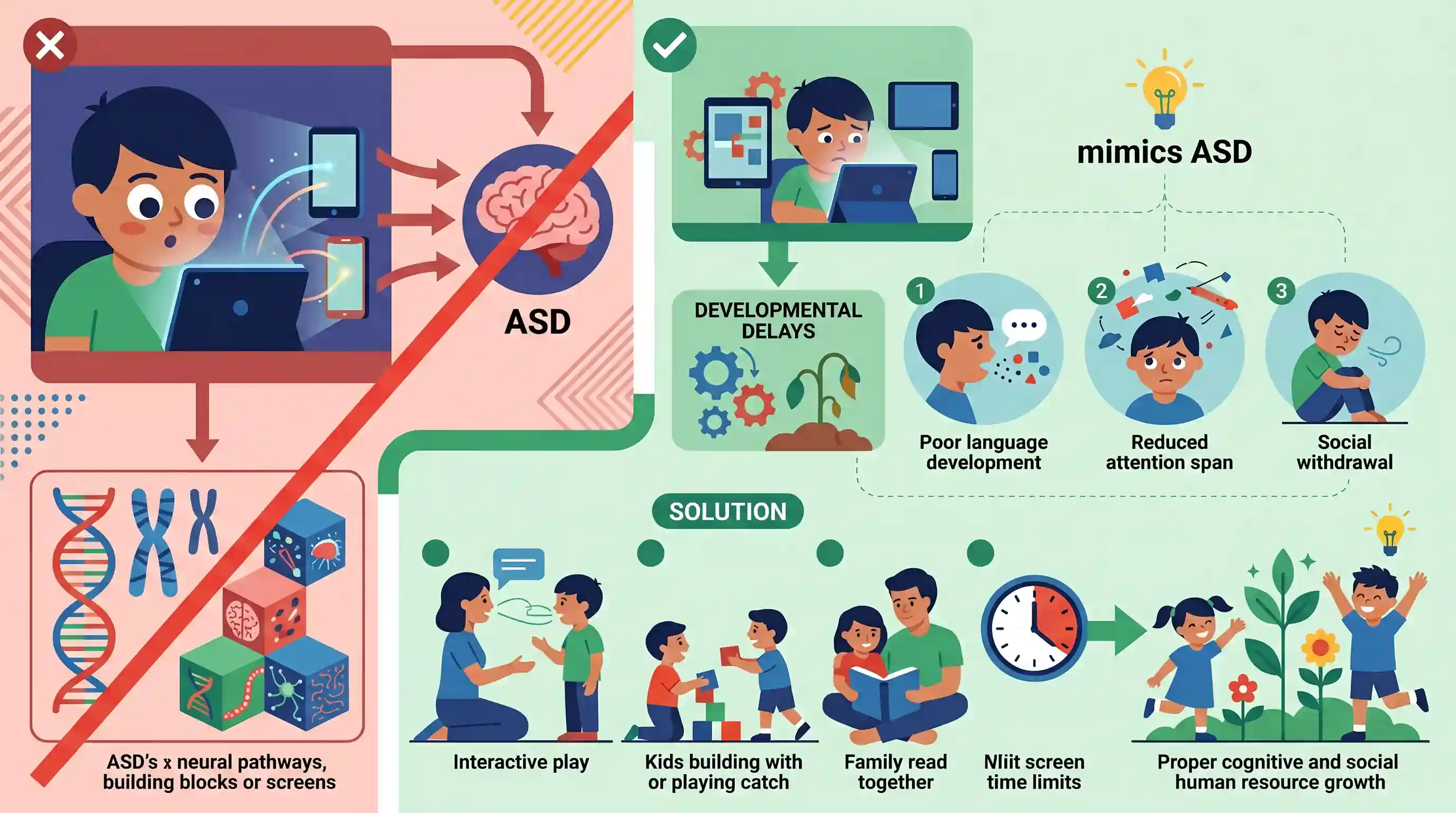
Experts have clarified the widespread misconception linking excessive screen time to the onset of Autism Spectrum Disorder (ASD) in children. While ASD is a biologically and genetically driven neurodevelopmental condition that cannot be caused by digital screens, early overexposure to screens can lead to severe developmental delays. These delays often manifest as poor language development, reduced attention spans, and social withdrawal, symptoms that closely mimic autism. Medical professionals stress the importance of limiting screen time for infants and toddlers in favor of interactive play and interpersonal communication to ensure proper cognitive and social development.
Key Points
- Experts emphasize that Autism Spectrum Disorder (ASD) is a neurodevelopmental disorder with significant genetic and biological roots, and there is no scientific evidence that screen time causes autism.
- Excessive screen time in early childhood can, however, lead to developmental delays, notably in speech, language, and social skills, which sometimes mimic ASD symptoms (a phenomenon colloquially referred to as 'virtual autism').
- The lack of two-way social interaction when consuming digital media prevents young children from developing crucial cognitive and interpersonal abilities.
- Health professionals advocate for strict adherence to screen time guidelines, promoting interactive physical play and active parental engagement to foster healthy brain development in children.
Important Terms
Autism Spectrum Disorder (ASD)

A neurodevelopmental disorder characterized by persistent challenges in social interaction, communication, and restricted or repetitive patterns of behavior. It typically manifests in early childhood and varies in severity across a spectrum.
UPSC context
GS Paper 2 (Health); GS Paper 3 (Science & Tech). Tests understanding of public health issues and disability rights.
World Health Organization (WHO)
A specialized agency of the United Nations responsible for international public health, setting global standards for disease prevention, maternal-infant care, and digital wellness guidelines for children.
UPSC context
GS Paper 2 (International Relations/Health). Tests knowledge of global governance and international healthcare frameworks.
Indian Academy of Pediatrics (IAP)
India's premier association of pediatricians that provides evidence-based health guidelines, including recommended screen time limits for Indian children (e.g., zero screen time for children under 2 years).
UPSC context
GS Paper 2 (Health; Issues related to children). Relevant for policy-making and social development sections.
Neurodevelopmental Condition
A group of conditions, such as ASD and ADHD, that begin during the developmental period and involve significant impairments in personal, social, academic, or occupational functioning.
UPSC context
GS Paper 2 (Health). Important for understanding the biological basis of childhood disabilities and early intervention needs.
Rashtriya Bal Swasthya Karyakram (RBSK)
A central government initiative under the National Health Mission aiming at early identification and intervention for children from birth to 18 years, covering "4Ds": Defects, Deficiencies, Diseases, and Developmental delays.
UPSC context
GS Paper 2 (Welfare schemes; Health). Essential for questions on government interventions in child health and nutrition.
Rights of Persons with Disabilities (RPwD) Act, 2016
A landmark legislation in India that recognizes 21 disabilities, including Autism Spectrum Disorder, and mandates reservations, inclusive education, and equal opportunities for persons with disabilities.
UPSC context
GS Paper 2 (Governance; Welfare of vulnerable sections). Frequently tested in the context of disability rights and legal frameworks.
Prelims Trap
Excessive screen time in early childhood is a proven cause of Autism Spectrum Disorder (ASD).
ASD is a lifelong neurodevelopmental condition with genetic roots. Screen time causes 'virtual autism'—reversible developmental delays that mimic ASD—but does not cause clinical autism itself.
Static Concepts Connected
What is Autism Spectrum Disorder (ASD)?
- Nature: A lifelong neurodevelopmental condition affecting communication, learning, behavior, and social interaction.
- Etiology: Rooted in genetic and biological factors; it is not caused by postnatal habits like screen exposure or vaccines.
- Spectrum: Termed a "spectrum" because it encompasses a wide variation in the type and severity of symptoms experienced.
What are the global screen time guidelines for young children?
- Under 2 years: Both WHO and the Indian Academy of Pediatrics (IAP) recommend zero sedentary screen time for this age group.
- 2 to 4 years: Sedentary screen time should be limited to no more than one hour per day; less is always better.
- Rationale: Screen time deprives children of crucial two-way interpersonal interaction needed for speech and cognitive development.
Cross-Topic Patterns
ASD and Rights of PwD Act 2016
Autism Spectrum Disorder is recognized as one of the 21 specified disabilities under the Rights of Persons with Disabilities (RPwD) Act, 2016, guaranteeing legal protections and welfare.
Digital Well-being & Human Capital
Cognitive delays ('virtual autism') from early digital overexposure impact long-term human resource development, linking pediatric health to GS3 demographic outcomes.

Expect a 2026 prelims statement contrasting reversible 'virtual autism' (environmental/screen-based) with clinical ASD (genetic/lifelong).
Linked PYQs · 3
Linked PYQs · 3
- 2024MainsEssay
Social media is triggering 'Fear of Missing Out' amongst the youth, precipitating depression and loneliness.
- 2020MainsGS2
In order to enhance the prospects of social development, sound and adequate health care policies are needed particularly in the fields of geriatric and maternal health care. Discuss.
- 2023MainsGS2
The crucial aspect of development process has been the inadequate attention paid to Human Resource Development in India. Suggest measures that can address this inadequacy.
