Sea surface temperature rise and tropical cyclones in Bay of Bengal
Source:The Hindu ↗
Why It Matters
Provides concrete, localized data on how ocean warming and climate change directly amplify severe weather events. It highlights the intersection of physical geography (cyclogenesis, SST, IOD) with environmental conservation (mangroves as buffers), which is a recurring theme in UPSC Mains GS1 and GS3.
Summary
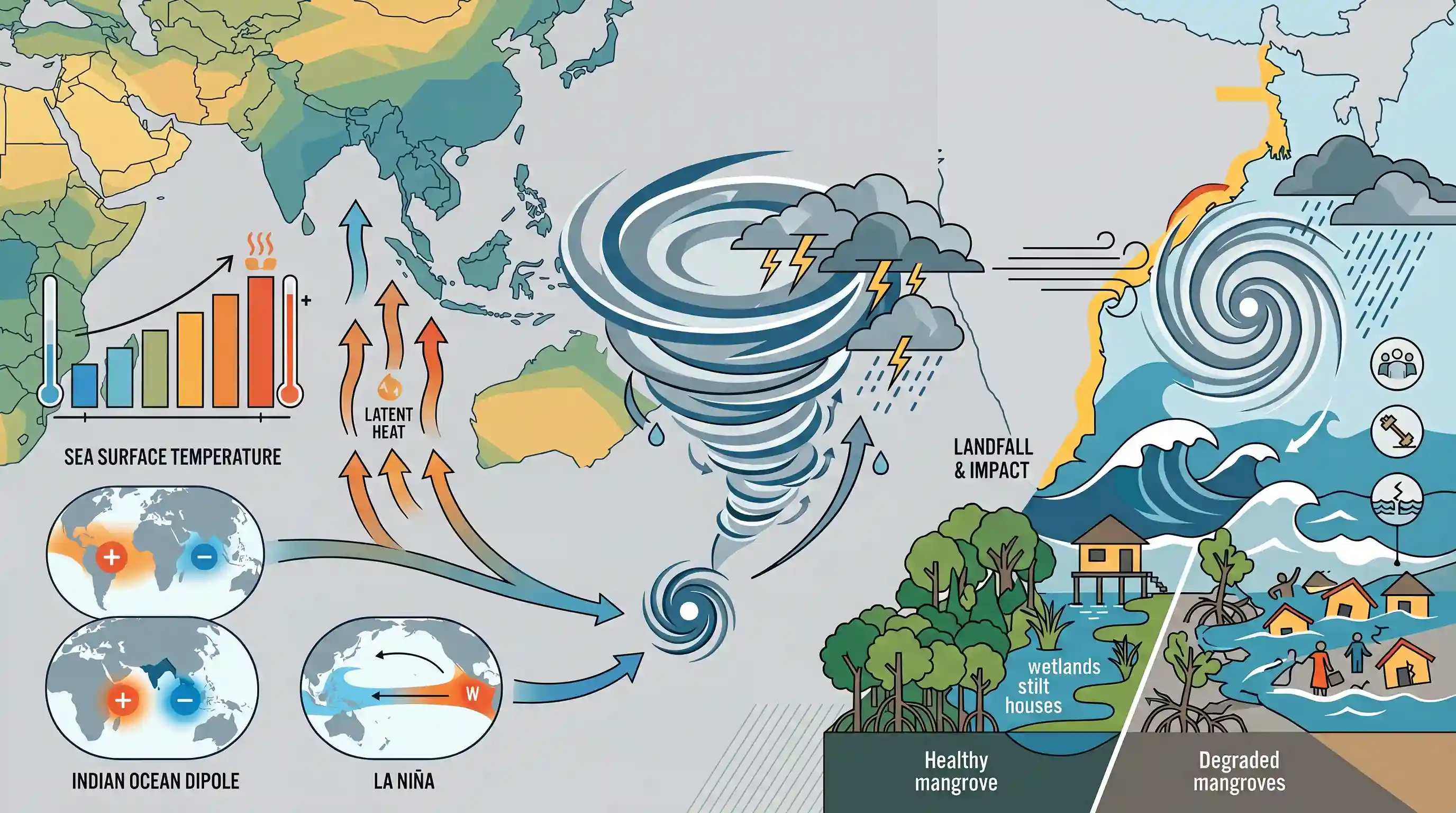
Meteorologists have linked the increasing frequency and intensity of severe tropical cyclones over the Bay of Bengal to rising Sea Surface Temperatures (SST), which have increased by up to 1°C over the past 50 years. This warming increases latent heat energy and atmospheric moisture retention, resulting in extreme wind speeds and heavier rainfall upon landfall along the eastern coast of India. Additionally, global weather patterns like a positive Indian Ocean Dipole (IOD) and La Niña have further favored cyclogenesis. Experts warn that the degradation of natural coastal buffers, such as mangroves and wetlands, is exacerbating the destructive impact of these extreme weather events on vulnerable coastal communities.
Key Points
- Since 2010, the eastern coast of India, particularly Andhra Pradesh, Tamil Nadu, and Odisha, has faced a heightened frequency of severe tropical cyclones.
- Meteorologists attribute this intensity and frequency to a consistent rise in Sea Surface Temperature (SST) over the Bay of Bengal, which has increased by 0.5°C to 1°C in the last 50 years according to IITM Pune.
- Warmer waters elevate latent heat energy, while a warming atmosphere holds more moisture, producing severe cyclonic winds (110-200 kmph) and heavier rainfall.
- Global climate phenomena, including a positive Indian Ocean Dipole (IOD) and La Niña, have created highly favourable conditions for cyclogenesis in the region.
- The destruction is amplified by the widespread degradation of coastal ecosystems, such as mangroves and wetlands, which traditionally act as natural buffers against cyclonic landfalls.
Important Terms
Tropical Cyclone

A rapidly rotating storm system with a low-pressure center and strong winds, forming over warm tropical oceans (>26.5°C).
UPSC context
GS Paper I/III; core geography topic and disaster management risk for India's coasts.
Indian Ocean Dipole (IOD)
An ocean-atmosphere phenomenon characterized by the difference in sea surface temperatures between the western and eastern tropical Indian Ocean.
UPSC context
GS Paper I; tests understanding of regional climate drivers and their impact on Indian monsoon.
La Niña
The cooling phase of the El Niño-Southern Oscillation (ENSO), involving below-average sea surface temperatures in the central/eastern Pacific Ocean.
UPSC context
GS Paper I; critical for explaining variability in Indian rainfall and global weather patterns.
Sea Surface Temperature (SST)
The temperature of the ocean's surface layer, acting as the primary energy source for the formation and intensification of cyclones.
UPSC context
GS Paper I; fundamental concept in oceanography and climate change impact analysis.
Cyclogenesis
The meteorological process of the formation and intensification of a cyclonic circulation in the atmosphere.
UPSC context
GS Paper I; tests technical knowledge of atmospheric pressure systems and storm development.
Mangroves
Salt-tolerant coastal ecosystems that act as natural buffers, reducing the impact of storm surges and coastal erosion during cyclones.
UPSC context
GS Paper III; key to environment conservation and nature-based solutions for disaster resilience.
India Meteorological Department (IMD)
India's national agency under the Ministry of Earth Sciences for weather forecasting, climate research, and cyclone disaster warnings.
UPSC context
GS Paper III; tests knowledge of institutional frameworks for disaster management and early warning.
Prelims Trap
"La Niña and positive IOD conditions suppress tropical cyclone formation in the Bay of Bengal."
La Niña actually lowers vertical wind shear, and a positive IOD creates warmer localized waters—both of which highly favour and amplify cyclogenesis in the Bay of Bengal.
Static Concepts Connected
What are the primary atmospheric conditions required for tropical cyclogenesis?
- SST threshold: Sea surface temperatures exceeding 26.5°C to supply the continuous latent heat of condensation required to fuel the storm.
- Coriolis force: Presence of sufficient Coriolis force (away from the equator) to initiate and maintain a cyclonic vortex.
- Low wind shear: Minimal variations in vertical wind speed to prevent the developing vertical storm structure from being torn apart.
- Initial disturbance: A pre-existing low-level cyclonic circulation or area of low pressure to act as a seed for the storm.
How do mangrove ecosystems function as coastal bio-shields against cyclones?
- Wave attenuation: Complex root networks frictionally dissipate ocean wave energy, significantly reducing the inland reach and height of destructive storm surges.
- Erosion control: Pneumatophores and prop roots trap sediments, binding the coastal soil and stabilizing shorelines against extreme water forces.
- Windbreak effect: Dense canopy structures create aerodynamic drag, effectively reducing the inland velocity and impact of severe cyclonic winds.
Cross-Topic Patterns
IOD, La Niña and cyclogenesis synergy
A positive IOD warms regional waters, while La Niña lowers vertical wind shear. Their simultaneous occurrence acts as a massive multiplier for Bay of Bengal cyclonic intensity and frequency.
Eco-DRR and Sendai Framework alignment
Relying on mangroves as natural buffers illustrates Ecosystem-based Disaster Risk Reduction (Eco-DRR), heavily emphasized by the Sendai Framework to shift focus from reactive relief to proactive, nature-based mitigation.

Expect a 2026 multi-statement Prelims question evaluating the synergistic impact of positive IOD and La Niña on Bay of Bengal cyclogenesis.
Linked PYQs · 3
Linked PYQs · 3
- 2024MainsGS1
What is sea surface temperature rise? How does it affect the formation of tropical cyclones?
- 2022MainsGS1
Discuss the meaning of colour-coded weather warnings for cyclone prone areas given by India Meteorological Department.
- 2022MainsGS3
Explain the causes and effects of coastal erosion in India. What are the available coastal management techniques for combating the hazard?
