Expert teams to study sensitive glacial lakes in Uttarakhand
Source:etvbharat ↗
Why It Matters
Crucial for understanding disaster risks, climate change impacts, and glacial lake management specific to Uttarakhand's ecology, which is a core focus area for state civil services examinations.
Summary
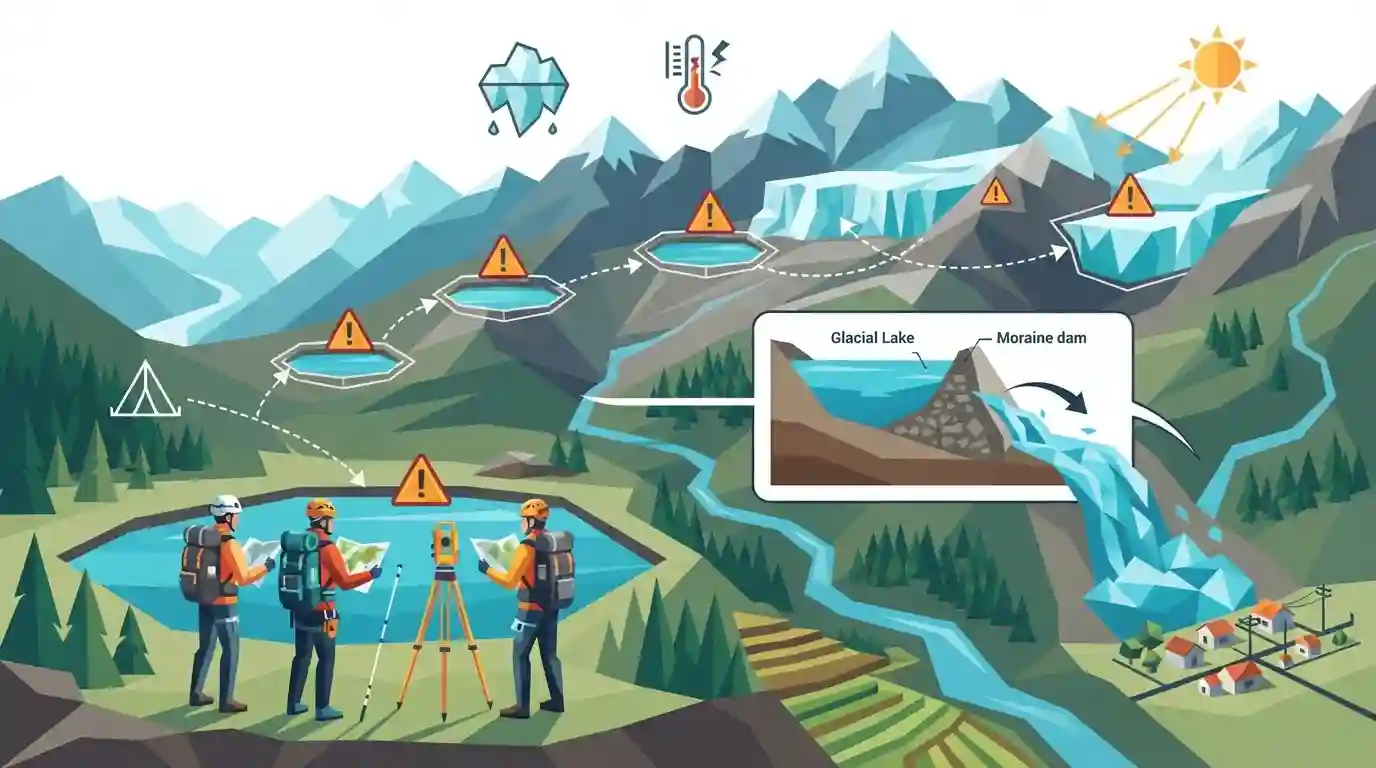
Expert teams are set to visit five highly sensitive glacial lakes in Uttarakhand to study vulnerabilities related to Glacial Lake Outburst Floods (GLOFs), disaster management, and climate change impacts in the Himalayan terrain.
Key Points
- Expert teams are scheduled to visit five highly sensitive glacial lakes in Uttarakhand to assess risks and study potential hazards.
- Glacial Lake Outburst Floods (GLOFs) pose major threats to infrastructure and human lives in the fragile Himalayan region of Uttarakhand.
- The initiative aims to formulate better mitigation strategies and monitoring mechanisms for vulnerable water bodies.
Important Terms
Glacial Lake Outburst Flood (GLOF)

A sudden release of a massive volume of water from a glacial lake due to the breach of its natural moraine dam, posing severe flash flood risks to downstream Himalayan regions.
UPSC context
Crucial for UKPSC General Studies (Paper V/Environment & Disaster Management), focusing on Himalayan ecology, climate change impacts, and vulnerability mapping.
Uttarakhand State Disaster Management Authority (USDMA)
A specialized statutory body under the Uttarakhand government responsible for formulating disaster management policies, mitigation strategies, and coordinating relief operations across disaster-prone districts.
UPSC context
Important for UKPSC administrative structure, governance, and state-specific institutional frameworks for disaster risk reduction.
Wadia Institute of Himalayan Geology (WIHG)
A premier autonomous research institution under the Ministry of Science and Technology, India, specializing in geomorphological, glaciological, and geological studies of the Himalayan region.
UPSC context
Relevant for UKPSC Geography and Science & Technology, highlighting scientific institutions studying Himalayan terrain vulnerabilities.
Prelims Trap
All glacial lakes in Uttarakhand are categorized as highly sensitive to GLOF threats.
All 450 glacial lakes in Uttarakhand are not categorized as equally sensitive; only a specific subset (13 total, with 5 in Category A) face extreme vulnerability.
Static Concepts Connected
What are the primary triggers and mitigation mechanisms for Glacial Lake Outburst Floods (GLOFs)?
- Primary Triggers: Trigger factors include earthquakes, rapid melting, avalanches, and hydrostatic pressure breaches on moraine dams.
- Mitigation Steps: Mitigation relies on early warning systems (EWS), artificial siphoning, channel lowering, and hazard-zonation mapping.
Cross-Topic Patterns
GLOFs and Disaster Management Financing
Glacial retreat and GLOF mitigation strategies intersect with state-level disaster management financing under the SDRF and NDMA guidelines.
Himalayan Ecology and Climate Change Action Plans
Himalayan ecology studies link geographical vulnerability assessments directly with climate change adaptation frameworks under national missions.

Expect a matching or statement-based question on Uttarakhand's Category A glacial lakes, GLOF triggers, and institutional stakeholders.
Linked PYQs · 1
Linked PYQs · 1
- 2025UKPSC_PRELIMSGS1
Consider the following statements and select the correct answer from the options given below : Statement 1 : Uttarakhand is highly vulnerable to climate change. Statement 2 : Climate change is causing water stress and depleting biodiversity in Uttarakhand.
