Expert panel investigates Wayanad debris slip incident
Source:The Hindu ↗
কেন এটি গুরুত্বপূর্ণ
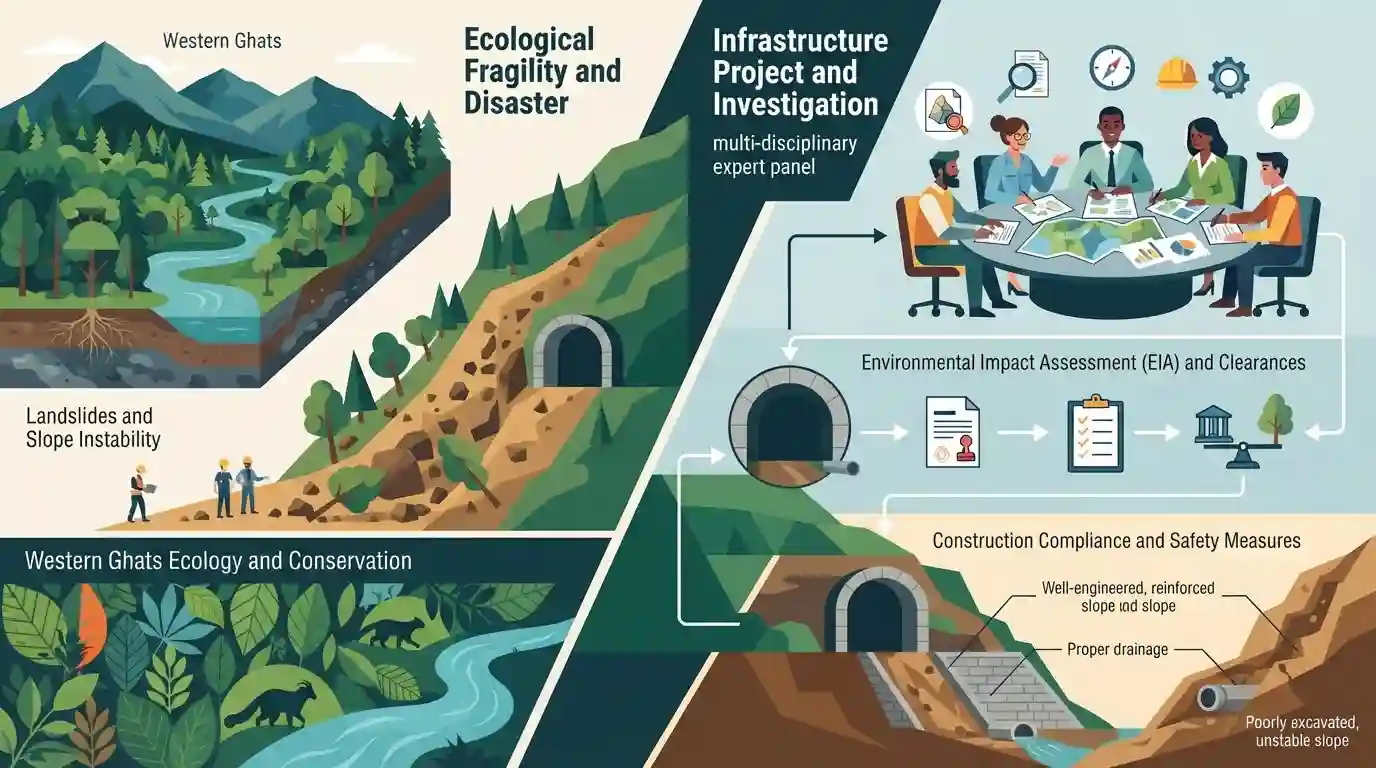
The article highlights the critical policy-ecological dilemma of executing large-scale infrastructure projects (like tunnel roads) in the fragile Western Ghats. It demonstrates how post-disaster forensic expert investigations assess compliance with Environmental Impact Assessment (EIA) norms, structural safety standards, and regional carrying capacities, directly aligning with UPSC syllabus topics on disaster risk reduction and environmental governance.
সারসংক্ষেপ
The Kerala government has formed a multi-disciplinary expert panel to investigate a debris slip near the tunnel road entrance at Kalladi in the ecologically fragile Wayanad region. The probe highlights the conflict between infrastructure development and conservation, as the committee will analyze the environmental clearances, construction compliance, and safety measures of the tunnel road project.
মূল বিষয়
- The Kerala government has constituted an expert committee to probe a debris slip (landslide) near the tunnel road entrance at Kalladi in Wayanad.
- The expert team will visit the site on July 23, 2026, and is expected to submit its comprehensive report within a month.
- The committee's mandate involves identifying the cause of the disaster, assessing environmental clearances issued by state and central governments (specifically MoEFCC), and checking if construction guidelines were bypassed.
- The team will also investigate if there were any technical, structural, or security lapses by the infrastructure company executing the tunnel road project.
- The multi-disciplinary expert panel comprises members across various fields, including Chief Wildlife Warden P. Pugazhendi, geoscientist C.P. Rajendran, and engineering experts from NIT-Karnataka and IIT-Palakkad.
গুরুত্বপূর্ণ শব্দ
Ministry of Environment, Forest, and Climate Change (MoEFCC)

The nodal agency of the Indian Central Government responsible for planning, promoting, coordinating, and overseeing environmental, forestry, and wildlife policies, legislation, and international programs in India.
UPSC context
GS Paper 3 (Environment); critical for understanding national conservation policies, environmental clearances, and EIA regulations.
Kerala Government
The sub-national government administering the state of Kerala, managing regional disaster response, local self-government, state-level environmental regulations, and executing state-level infrastructure projects.
UPSC context
GS Paper 2 (Federalism) and GS Paper 3 (Disaster Management); tests state-center governance and localized disaster mitigation.
Indian Institute of Technology-Palakkad (IIT-Palakkad)
A premier public technical university in Kerala established in 2015 as an 'Institute of National Importance' under the Ministry of Education, providing advanced engineering research and technical consultancy.
UPSC context
GS Paper 2 (Institutions) and GS Paper 3 (S&T); relevant for the role of academic bodies in technical investigations.
National Institute of Technology-Karnataka (NIT-K)
A public technical and research university in Surathkal, Karnataka, designated as an 'Institute of National Importance,' providing engineering education and contributing academic expertise to public safety investigations.
UPSC context
GS Paper 2 (Institutions); tests the application of premier national educational institutions' research in public safety and infrastructure.
প্রিলিমস ফাঁদ
Ecologically Sensitive Areas (ESAs) in the Western Ghats are statutory zones notified under the Forest (Conservation) Act, 1980.
Ecologically Sensitive Areas (ESAs) are not declared under the Forest (Conservation) Act. They are notified by the Central Government under Section 3 of the Environment (Protection) Act, 1986.
সংযুক্ত স্থির ধারণা
What is the difference between Madhav Gadgil and Kasturirangan Committees on Western Ghats?
- Gadgil Commission (WGEEP): The Gadgil Commission recommended designating the entire Western Ghats as Ecologically Sensitive Area (ESA), divided into three levels of sensitivity (ESZ 1, 2, 3).
- Kasturirangan Committee (HLWG): The Kasturirangan Committee adopted a more development-balanced approach, recommending only about 37% of the total Western Ghats area as ESA.
- Key Divergence: Gadgil proposed an overarching statutory authority (WGEA) to democratize environmental decisions, whereas Kasturirangan allowed regulated development within non-ESA zones.
What are the primary triggering factors and classification of Landslides?
- Triggering Factors: Intense rainfall (hydro-meteorological), seismic activity, steep slope angles, and anthropogenic activities like road cutting, tunneling, and deforestation.
- Debris Flow / Slip: A rapid downward movement of unconsolidated, water-saturated debris and soil down a slope, often behaving like a fluid.
- Mitigation Framework: NDMA guidelines focus on Landslide Hazard Zonation (LHZ) mapping, early warning systems (EWS), and bio-engineering measures for slope stabilization.
আন্তঃবিষয় প্যাটার্ন
Infra projects vs disaster vulnerability
Linking Himalayan and Western Ghats tunneling projects highlights how linear infrastructure in fragile terrains directly amplifies landslide frequencies and regional vulnerability.
EIA exemptions vs carrying capacity
Bypassing Environmental Impact Assessments for infrastructure projects exposes structural conflicts between connectivity targets and regional ecological carrying capacities.

Comparative analysis of Western Ghats and Himalayan landslide triggers, combined with ESA guidelines, will likely frame GS3 2026 questions.
সংযুক্ত PYQ · 3
সংযুক্ত PYQ · 3
- 2021MainsGS1
Differentiate the causes of landslides in the Himalayan region and Western Ghats.
- 2021MainsGS3
Describe the various causes and the effects of landslides. Mention the important components of the National Landslide Risk Management Strategy.
- 2019MainsGS3
Disaster preparedness is the first step in any disaster management process. Explain how hazard zonation mapping will help disaster mitigation in the case of landslides.
