Supreme Court Review of Brain Death Protocols and Medical Ethics
Source:Indian Express ↗
Why It Matters
The issue touches upon critical aspects of health governance, medical ethics, and the legal framework regulating organ transplantation in India. Establishing foolproof, scientifically objective criteria for brain death is essential to prevent medical malpractice (such as illegal organ harvesting), protect patients' right to life, and maintain public trust in the organ donation system.
Summary
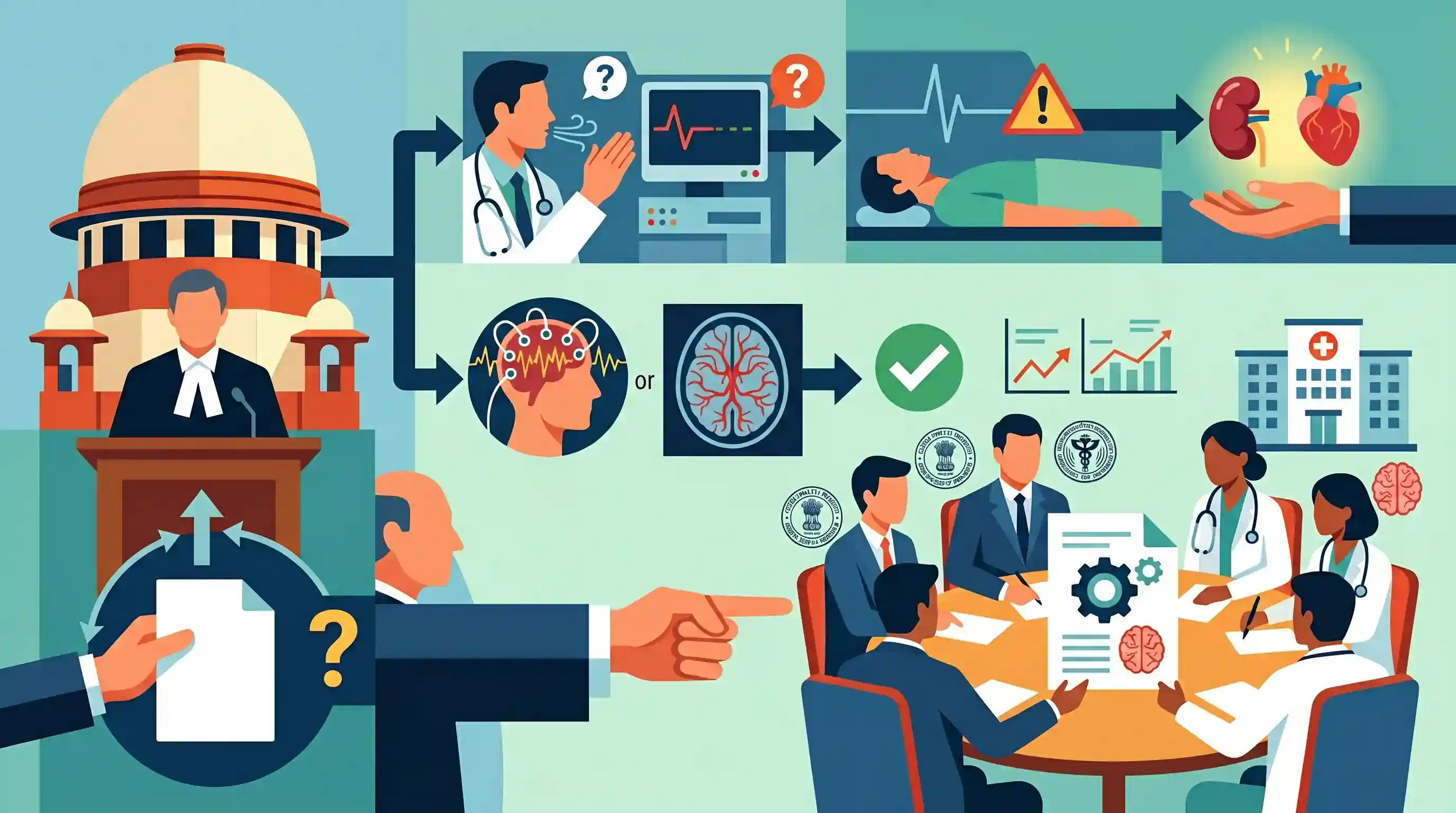
The Supreme Court of India is examining the protocols used to declare a patient 'brain dead' under the Transplantation of Human Organs and Tissues Act, 1994. Acting on a PIL filed by a medical professional, the Court is considering whether the currently mandated Apnea test—criticized for being subjective—should be replaced or supplemented by more objective ancillary tests like Electroencephalograms (EEG) and brain angiograms. The petitioner raised concerns that subjective tests could lead to premature declarations of brain death for organ harvesting. The Court has directed the Union Health Ministry to consult the AIIMS Neurology department to form a specialized committee for updating these crucial medical guidelines.
Key Points
- The Supreme Court has asked the Union Ministry of Health and Family Welfare to seek expert opinion from AIIMS regarding the tests used to declare a person brain dead.
- The current legal standard for determining brain death under the Transplantation of Human Organs and Tissues Act, 1994 is the Apnea test, which the petitioner argues is subjective and relies on observer interpretation.
- The petitioner advocates for mandatory ancillary tests like Brain Angiograms or Electroencephalograms (EEG) to provide objective, foolproof evidence of brain death, thereby preventing premature organ harvesting.
- This judicial intervention underscores the intersection of bioethics, patient rights, and the necessity to update medical governance protocols in alignment with scientific advancements.
Important Terms
Transplantation of Human Organs and Tissues Act (THOTA), 1994

The 1994 Indian law that legalised brain death, regulated organ removal and storage, and penalised commercial dealings in human organs to prevent organ trafficking.
UPSC context
GS Paper II (Governance/Polity); tests understanding of legal frameworks for health and ethical governance in India.
Brain Stem Death
The irreversible cessation of all functions of the brain stem, which is the legal definition of death in India for the purpose of organ donation.
UPSC context
GS Paper II (Health/Ethics); relevant for topics on medical ethics and the legal definition of life/death.
Apnea Test
The mandatory clinical test under Indian law to confirm brain death by observing if a patient on a ventilator can breathe spontaneously when carbon dioxide levels rise.
UPSC context
GS Paper III (Science & Technology); focuses on medical protocols and the intersection of technology and clinical diagnosis.
Ancillary Tests
Secondary medical tests (e.g., EEG, CT Angiography) used to confirm brain death when clinical tests are inconclusive or to provide objective evidence of absent brain activity.
UPSC context
GS Paper III (S&T); tests knowledge of medical advancements and objective diagnostic standards in public health.
NOTTO (National Organ and Tissue Transplant Organization)
The apex national body under the Ministry of Health that coordinates organ and tissue procurement, distribution, and registry across India.
UPSC context
GS Paper II (Statutory/Regulatory Bodies); important for understanding the institutional framework for organ donation.
Article 21
A fundamental right under the Indian Constitution, which the Supreme Court has interpreted to include the right to die with dignity.
UPSC context
GS Paper II (Polity); essential for discussions on judicial interpretations of fundamental rights and bioethics.
Transplantation of Human Organs and Tissues Rules, 2014
A secondary legislation that provides specific forms (e.g., Form 10) and procedures for certifying brain stem death by a four-member medical board.
UPSC context
GS Paper II (Governance); highlights the role of executive rules in implementing parliamentary acts.
Prelims Trap
Under THOTA 1994, an EEG test is legally mandatory to confirm brain-stem death prior to organ harvesting.
Aspirants confuse the petitioner's demands with current law. Currently, the clinical Apnea test is the statutory standard; EEG is not yet mandatory.
Static Concepts Connected
How does Brain Stem Death differ from a Coma?
- Brain Stem Death: Irreversible loss of brain stem function (which controls breathing/heart rate). It is legally recognized as death in India.
- Coma: A state of deep unconsciousness where the brain still shows electrical activity. Recovery is clinically possible.
- Vegetative State: Brain stem functions remain intact (patient breathes independently), but higher cortical functions (awareness, thought) are lost.
What are the core features of the THOTA, 1994?
- Brain-stem Death: It is the first Indian law to formally recognize 'brain-stem death', enabling ethical organ retrieval from deceased donors.
- Commercial Ban: Strictly prohibits and criminalizes any commercial trading of human organs and tissues.
- Authorization Committees: Establishes state-level Authorization Committees to vet and approve living donor transplants to prevent exploitation.
Cross-Topic Patterns
End-of-life Bioethics & Euthanasia
Links brain death guidelines with the Supreme Court's existing jurisprudence on passive euthanasia, right to die with dignity, and advance medical directives (living wills).
Judicialization of Medical Protocols
Highlights a recurring governance pattern: the Supreme Court intervening in highly technical health policy (like surrogacy or Covid protocols) by forming specialized expert committees.

Expect a 2026 Prelims pair-matching question on medical tests (Apnea, EEG, Angiogram) or a Mains question on organ donation bioethics.
Linked PYQs · 4
Linked PYQs · 4
- 2020MainsGS2
In order to enhance the prospects of social development, sound and adequate health care policies are needed particularly in the fields of geriatric and maternal health care. Discuss.
- 2021MainsGS2
“Besides being a moral imperative of a Welfare State, primary health structure is a necessary precondition for sustainable development.” Analyze.
- 2024MainsGS4
“Ethics encompasses several key dimensions that are crucial in guiding individuals and organizations towards morally responsible behaviour.” Explain the key dimensions of ethics that influence human actions. Discuss how these dimensions shape ethical decision-making in the professional context.
- 2023MainsGS3
Introduce the concept of Artificial Intelligence (AI). How does Al help clinical diagnosis? Do you perceive any threat to privacy of the individual in the use of Al in healthcare?
