China foreign policy and historical principles of diplomacy
Source:Indian Express ↗
Why It Matters
Understanding China's strategic mindset and its reliance on historical analogies is essential for decoding its foreign policy moves, the dynamics of US-China competition, and the broader geopolitical shifts that indirectly impact India's strategic calculations and alliances.
Summary
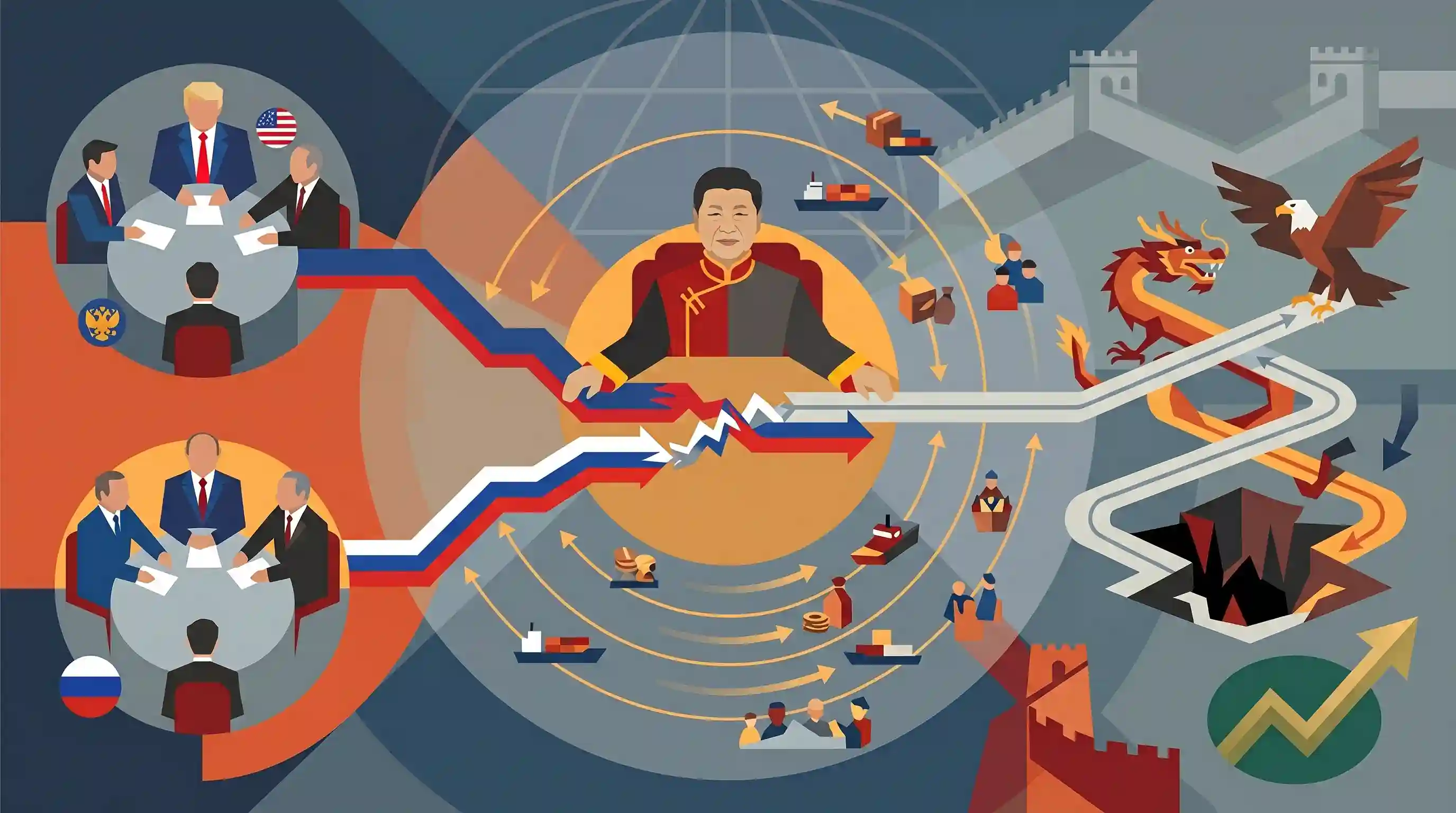
An analysis of Chinese President Xi Jinping’s diplomacy during recent state visits by Donald Trump and Vladimir Putin, highlighting how China employs classical strategic concepts like the 'Tributary System' and 'Yi Yi Zhi Yi' to navigate modern geopolitics, avoid the Thucydides Trap, and manage competition with the United States.
Key Points
- Xi Jinping's diplomacy echoes imperial China’s 'Tributary System,' projecting Beijing as an indispensable central power that receives visiting leaders rather than peers.
- During Donald Trump's visit, Xi invoked the 'Thucydides Trap' to emphasize managing US-China competition and avoiding historical confrontation between a rising and established power.
- Hosting Vladimir Putin highlighted the China-Russia strategic partnership, employing the ancient tactic 'Yi Yi Zhi Yi' (using one rival to counter another) to leverage Moscow against Washington.
- China applies these historical strategies globally, cultivating partnerships in the Global South, West Asia, and Europe to exploit divisions among adversaries and prevent strategic encirclement.
Important Terms
Tributary System

A historical Sinocentric diplomatic framework where neighboring states provided ritual deference and gifts to the Chinese Emperor in exchange for trade rights, protection, and political legitimacy.
UPSC context
GS Paper II: Essential for understanding China's historical 'Middle Kingdom' worldview and its influence on modern initiatives like the Belt and Road.
Thucydides Trap
A geopolitical theory stating that when a rising power (like China) threatens to displace an established superpower (like the USA), the resulting structural stress makes military conflict highly probable.
UPSC context
GS Paper II: A critical framework for analyzing US-China strategic rivalry and the potential for unintended escalation in the Indo-Pacific.
Yi Yi Zhi Yi
A classical Chinese strategic principle meaning 'using barbarians to control barbarians.' It involves leveraging one rival or foreign power to check the influence of another.
UPSC context
GS Paper II: Relevant for studying China's strategic maneuvering, such as using its partnership with Russia to balance American influence.
Prelims Trap
"The 'Thucydides Trap' refers to a macroeconomic stagnation phase where a developing country fails to transition to a high-income economy."
It is a geopolitical theory, not economic. It describes the risk of war when a rising power threatens to displace an established hegemon, originally regarding Athens and Sparta.
Static Concepts Connected
What is the 'Thucydides Trap' in International Relations?
- Origin: Coined by Graham Allison, it stems from the ancient historian Thucydides describing the Peloponnesian War between rising Athens and established Sparta.
- Core Premise: It posits that a rising power threatening to displace a ruling hegemon creates severe structural stress, making war highly likely, though not inevitable.
- Modern Context: Frequently invoked to describe the US-China strategic rivalry and the imperative for both nations to proactively manage competition to avoid military conflict.
Which historical concepts drive China's contemporary diplomatic worldview?
- Middle Kingdom: A Sino-centric worldview where China views itself as the cultural and political center of the world, often treating other states as subordinates rather than sovereign equals.
- Tributary System: An ancient imperial network where foreign rulers offered tribute in exchange for trade/protection, echoing today in China's hierarchical economic diplomacy and Belt and Road Initiative.
- Yi Yi Zhi Yi: A classical stratagem translating to "using barbarians to control barbarians," reflected today in Beijing leveraging Russia or Global South nations to counter Western influence.
Cross-Topic Patterns
Mandala Theory vs Middle Kingdom diplomacy
Ancient statecraft is increasingly relevant. UPSC Mains could ask aspirants to compare Kautilya’s Mandala theory (shifting alliances) with China’s hierarchical Tributary system in dictating modern geopolitics.
Sino-Russian Axis & India's Multi-alignment
China utilizing Russia to counter the US severely complicates India's strategic autonomy, forcing a delicate balance between its traditional defense supplier (Moscow) and Indo-Pacific partner (Washington).

Expect a 2026 Prelims question asking you to match geopolitical terms (Thucydides Trap, Middle Kingdom, Wedge Strategy) with definitions.
Linked PYQs · 3
Linked PYQs · 3
- 2021MainsGS2
“The USA is facing an existential threat in the form of a China, that is much more challenging than the erstwhile Soviet Union.” Explain.
- 2024MainsGS2
‘The West is fostering India as an alternative to reduce dependence on China's supply chain and as a strategic ally to counter China's political and economic dominance.’ Explain this statement with examples.
- 2021MainsGS2
The newly tri-nation partnership AUKUS is aimed at countering China's ambitions in the Indo-Pacific region. Is it going to supersede the existing partnerships in the region? Discuss the strength and impact of AUKUS in the present scenario.
