Determinants of Voting Behavior Beyond Anti-Incumbency in India
Source:Indian Express ↗
Why It Matters
Understanding the multi-dimensional determinants of voting behavior is crucial for analyzing Indian democracy, political accountability, and the impact of welfare policies on electoral outcomes (relevant for GS2 Governance and Polity).
Summary
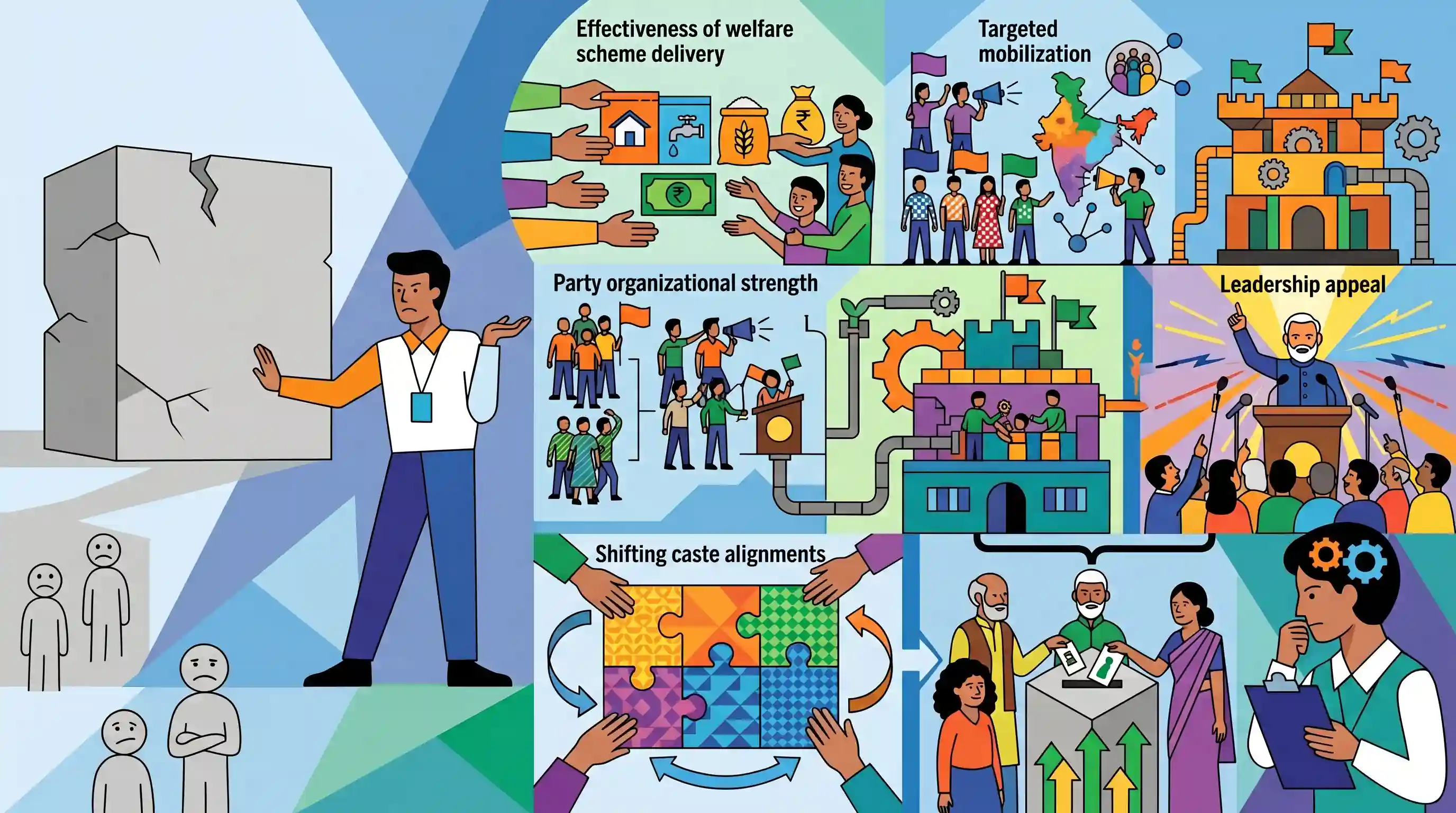
Political scientists and electoral analysts argue that relying solely on "anti-incumbency" as an explanation for election results is analytically lazy. Voting behavior in India is shaped by a complex interplay of factors, including the effectiveness of welfare scheme delivery, targeted mobilization, party organizational strength, leadership appeal, and shifting caste alignments. A deeper understanding of electoral outcomes requires analyzing these multidimensional factors rather than attributing defeats simply to generalized dissatisfaction with the incumbent.
Key Points
- Anti-incumbency is often used as a simplistic, default explanation for an incumbent government's defeat, masking the true underlying causes of electoral outcomes.
- Voting behavior in contemporary India is significantly influenced by proactive welfare delivery mechanisms and the creation of distinct beneficiary ("labharthi") voting blocs.
- The strength of party machinery, targeted voter mobilization, and the appeal of the top leadership can act as strong counterweights, often leading to pro-incumbency trends.
- Analytical frameworks must incorporate changing demographics, identity politics, state capacity in service delivery, and the micro-level issues influencing voters to truly understand democratic choices.
Prelims Trap
Promises of welfare schemes in manifestos constitute 'bribery' under Section 123 of the Representation of the People Act, 1951.
The Supreme Court (Subramaniam Balaji case) ruled that manifesto promises of welfare schemes do not amount to 'corrupt practices' or bribery under the RPA.
Static Concepts Connected
What differentiates clientelism from programmatic welfare in Indian politics?
- Clientelism: Discretionary, targeted distribution of state resources by politicians as patronage in direct exchange for electoral support.
- Programmatic Welfare: Rule-bound distribution based on objective eligibility criteria (e.g., PM-KISAN, PDS), regardless of a citizen's political affiliation.
- Technology's Role: DPI and Direct Benefit Transfers (DBT) reduce intermediary discretion, slowly shifting Indian elections toward programmatic welfare models.
How does the Supreme Court view election manifestos and welfare promises?
- Subramaniam Balaji Case (2013): SC ruled that making promises in election manifestos does not constitute a 'corrupt practice' under the Representation of the People Act.
- ECI Guidelines: Prompted by the SC, the ECI incorporated guidelines in the Model Code of Conduct requiring parties to explain the fiscal rationale of promises.
Cross-Topic Patterns
Labharthi voting + JAM Trinity
Pro-incumbency voting relies heavily on last-mile delivery, made possible by India's Digital Public Infrastructure and JAM Trinity which eliminate middleman leakages.
Beneficiary blocs + Macroeconomic stability
The competitive mobilization of 'labharthis' intersects with the 'freebie' (revdi) debate, raising macroeconomic concerns about state fiscal deficits and Article 293 borrowing limits.

Expect a GS2 Mains question evaluating how DBT and state capacity have shifted voting determinants from identity politics to 'labharthis'.
Linked PYQs · 3
Linked PYQs · 3
- 2022MainsGS2
Besides the welfare schemes, India needs deft management of inflation and unemployment to serve the poor and the underprivileged sections of the society. Discuss.
- 2022MainsGS1
Analyse the salience of 'sect' in Indian society vis-a-vis caste, region and religion.
- 2018MainsGS1
Caste system is assuming new identities and associational forms. Hence, caste system cannot be eradicated in India." Comment.
