Delhi Declaration shapes India strategy for Middle East engagement
Source:Indian Express ↗
Why It Matters
West Asia is the linchpin of India's energy security and the primary source of global remittances. Understanding India's diplomatic balancing act—especially formally articulated through mechanisms like the Delhi Declaration—is crucial for answering GS2 Mains questions on multi-alignment, energy geopolitics, and regional security.
Summary
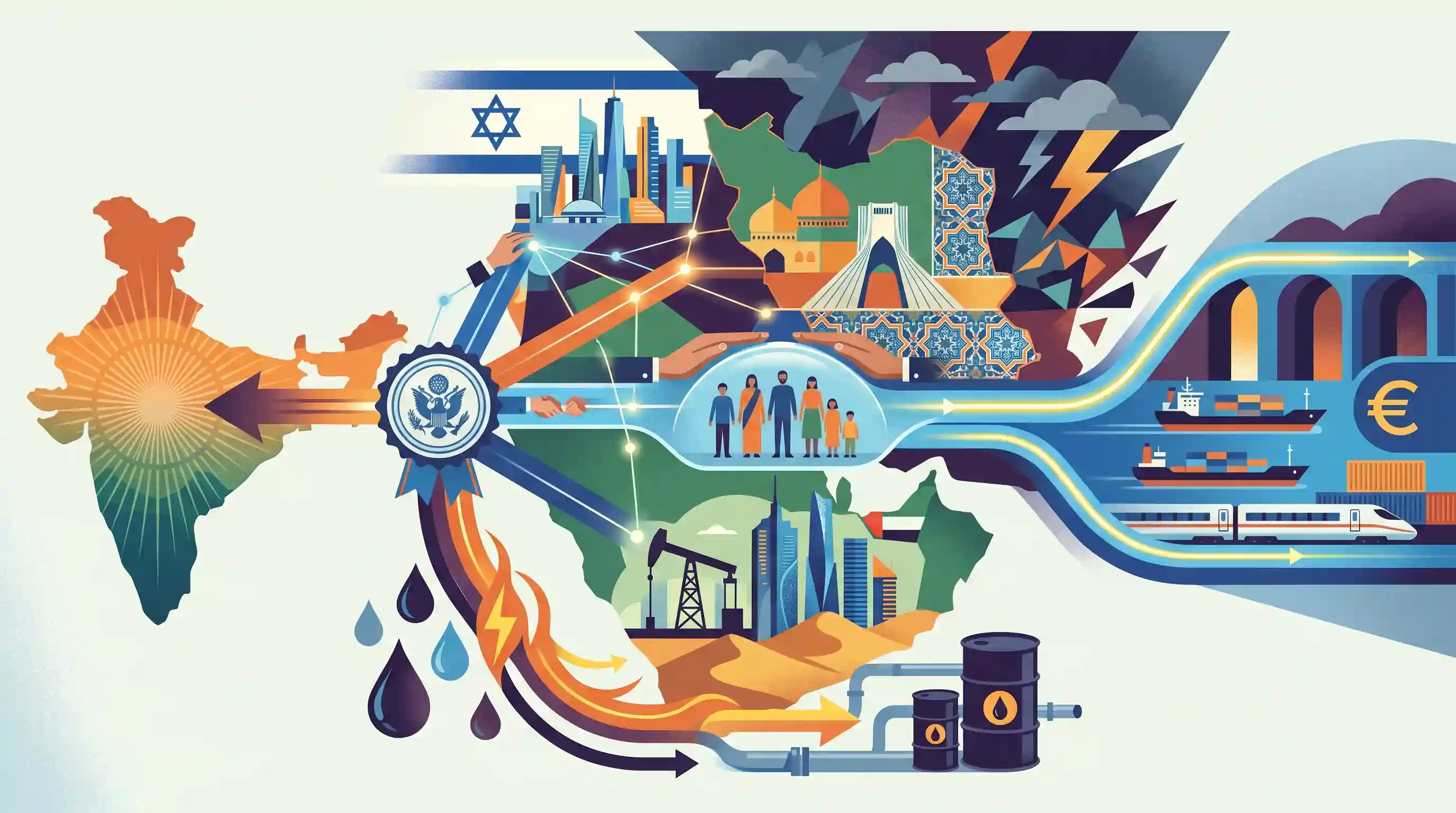
The 2026 Delhi Declaration marks a significant milestone in India's "Think West" policy, articulating a cohesive strategy for engaging with the Middle East. Moving beyond purely transactional energy relationships, the Declaration emphasizes multi-alignment, allowing India to balance complex ties with Israel, Iran, and the Gulf states amidst ongoing regional volatility. It reinforces the indispensability of the Middle East to India's energy security, the safeguarding of its vast expatriate diaspora, and the development of major trade routes like the India-Middle East-Europe Economic Corridor (IMEC). Ultimately, the Declaration signals India's maturation into a major, proactive stakeholder in West Asian geopolitics.
Key Points
- The 2026 Delhi Declaration outlines a comprehensive framework formalizing India's strategic, economic, and geopolitical engagement with the Middle East (West Asia).
- It highlights India's successful transition from historical non-alignment to pragmatic multi-alignment, successfully balancing ties among rival regional actors such as Israel, Iran, and Arab states.
- The framework underscores the critical linkage between West Asian regional stability and India's vital interests, including energy security, maritime trade corridors (like IMEC), and the welfare of the Indian diaspora.
- The Declaration reflects India's growing confidence as a proactive economic partner and potential net security provider in a highly volatile, strategically essential region.
Important Terms
2026 Delhi Declaration

A 2026 joint statement between India and the Arab League focused on regional stability, sovereignty, and multi-aligned cooperation in West Asia.
UPSC context
GS II (International Relations). Analyzes India's shift to a proactive stakeholder and its balancing act between regional rivals.
India-Middle East-Europe Economic Corridor (IMEC)
A multimodal connectivity project linking India, the Middle East, and Europe through rail, shipping, and digital infrastructure to boost trade.
UPSC context
GS II & III (Global Groupings/Infrastructure). Critical for diversifying trade routes and countering China’s Belt and Road Initiative.
Comprehensive Economic Partnership Agreement (CEPA)
A broad trade agreement covering goods, services, and investments, offering deeper economic integration than traditional Free Trade Agreements.
UPSC context
GS III (Economic Development/Trade). Landmark deals like India-UAE CEPA are vital for boosting non-oil trade and service exports.
Gulf Cooperation Council (GCC)
A political and economic alliance of six Gulf states: Saudi Arabia, UAE, Qatar, Kuwait, Oman, and Bahrain.
UPSC context
GS II (Regional Groupings). Key for India’s energy security, trade, and the welfare of the Indian diaspora.
Arab League
A regional organization of 22 Arab nations focused on coordinating political, economic, and social policies.
UPSC context
GS II (International Institutions). Important for India’s high-level engagement and "Think West" policy in the Arab world.
Prelims Trap
IMEC utilizes Iran's Chabahar port to connect Indian goods to European markets.
Chabahar is the linchpin of the INSTC, not IMEC. IMEC bypasses Iran entirely, utilizing ports in the UAE and a rail network through Saudi Arabia.
Static Concepts Connected
How does "Think West" differ from India's historical Middle East policy?
- Multi-alignment: Replaces traditional ideological distancing with de-hyphenated, concurrent engagements (e.g., maintaining strong parallel ties with both Israel and Iran).
- Beyond Energy: Shifts from a purely 'buyer-seller' hydrocarbon relationship to encompassing strategic investments, joint defense exercises, and technology/renewable energy pacts.
- Security Provider: Marks India's transition from a passive regional observer to an active net security provider in the Western Indian Ocean.
What are the geographic components of the IMEC?
- Eastern Corridor: Connects India to the Arabian Gulf via maritime routes (e.g., Mumbai/Mundra to Jebel Ali, UAE).
- Northern Corridor: Connects the Gulf to Europe via a rail network through Saudi Arabia and Jordan, ending at Haifa (Israel), then sea transit to Greece/Europe.
Cross-Topic Patterns
BoP and Gulf Remittances
The GCC hosts over 60% of NRIs, contributing the bulk of India's inbound remittances. These 'invisibles' on the Current Account are critical for offsetting India's structural merchandise trade deficit.
Red Sea Chokepoints & Inflation
Securing sea lines of communication (SLOCs) under 'Think West' directly ties to GS1 Geography maps (Bab-el-Mandeb, Strait of Hormuz) and macroeconomic supply-chain inflation risks.

Expect a 2026 GS2 Mains question evaluating India's 'multi-alignment' in West Asia amidst IMEC's launch and regional instability.
Linked PYQs · 5
Linked PYQs · 5
- 2025MainsGS2
"Energy security constitutes the dominant kingpin of India's foreign policy, and is linked with India's overarching influence in Middle Eastern countries.” How would you integrate energy security with India's foreign policy trajectories in the coming years?
- 2017MainsGS2
The question of India's Energy Security constitutes the most important part of India's economic progress. Analyze India's energy policy cooperation with West Asian countries.
- 2018MainsGS2
“India’s relations with Israel have, of late, acquired a depth and diversity, which cannot be rolled back.” Discuss.
- 2024PrelimsGS1
Consider the following statements : Statement-I : Sumed pipeline is a strategic route for Persian Gulf oil and natural gas shipments to Europe. Statement-II : Sumed pipeline connects the Red Sea with the Mediterranean Sea. Which one of the following is correct in respect of the above statements?
- 2022PrelimsGS1
The term "Levant" often heard in the news roughly corresponds to which of the following regions?
