Kabul Beijing ties deepen amid rising Pakistan Afghanistan tensions
Source:Indian Express ↗
Why It Matters
Understanding the evolving Kabul-Beijing-Islamabad geopolitical triangle is crucial for UPSC aspirants, as it directly influences regional stability, border security, and India's strategic maneuvers to counter a growing Chinese presence in the extended neighborhood.
Summary
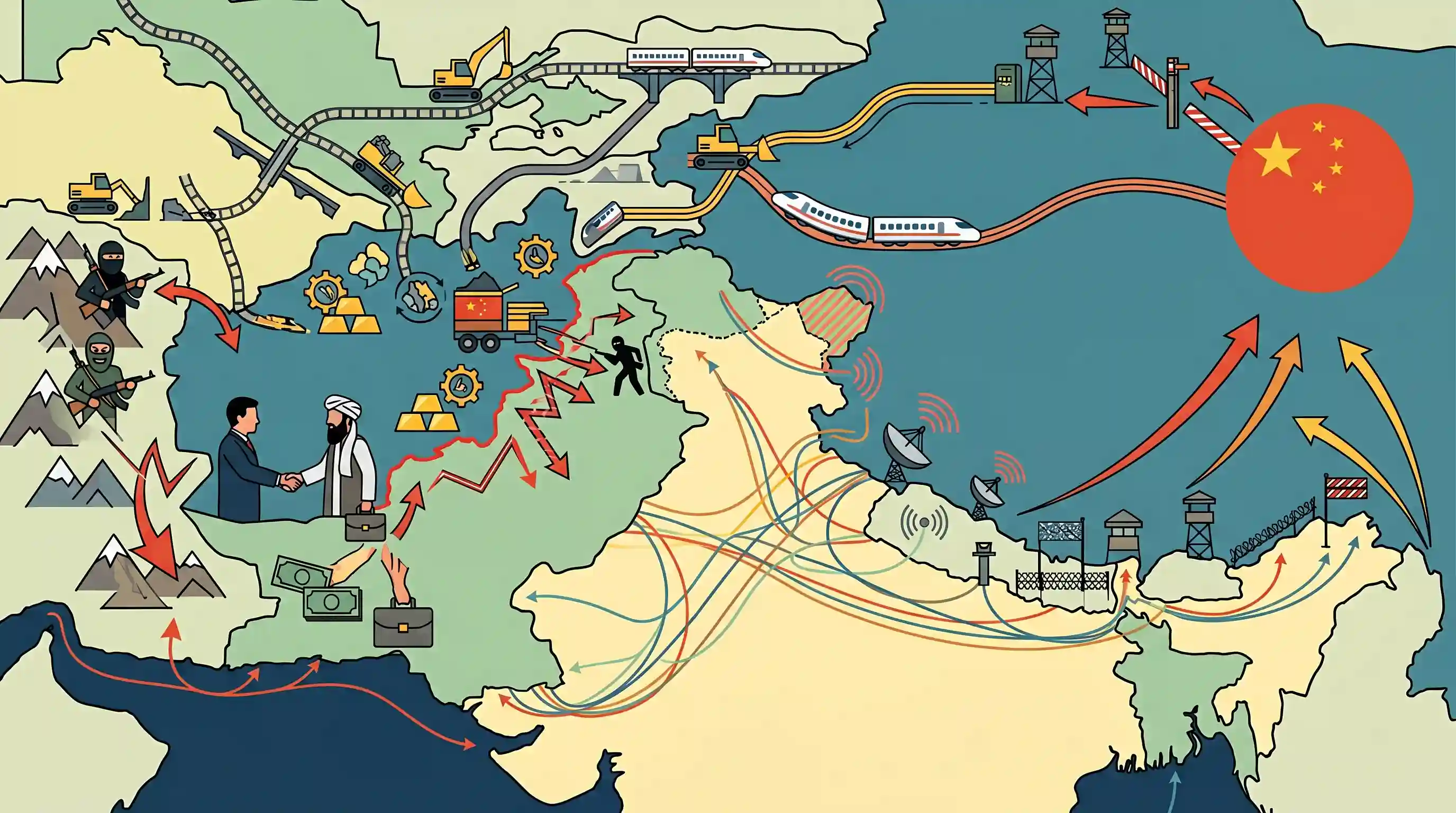
As tensions escalate between Pakistan and Afghanistan over Islamabad's claims that Kabul provides sanctuary to Tehreek-e-Taliban Pakistan (TTP) militants, China is simultaneously deepening its strategic footprint in the region. Beijing is actively pursuing closer diplomatic and economic ties with the Taliban regime to secure access to Afghanistan's lucrative mineral resources and to extend the Belt and Road Initiative (BRI). In return, China seeks assurances that Afghan territory will not harbor Uighur militant groups threatening its Xinjiang region. This complex dynamic of cross-border terrorism and opportunistic economic statecraft significantly alters the geopolitical landscape in India's immediate neighborhood.
Key Points
- Pakistan continues to accuse the Taliban-led Afghan government of providing safe havens to the Tehreek-e-Taliban Pakistan (TTP), increasing security friction along the disputed Durand Line.
- In contrast to the rising Af-Pak tensions, China is pragmatically strengthening its diplomatic and economic relations with Kabul to expand its regional influence.
- Beijing's strategic objectives in Afghanistan focus on securing access to unexploited mineral wealth (such as lithium and copper) and integrating the country into the Belt and Road Initiative (BRI).
- Additionally, China seeks strict guarantees from the Taliban that Afghan territory will not be used by Uighur militants (such as the ETIM) to target its Xinjiang province.
- This evolving Beijing-Kabul nexus amidst Islamabad's terror concerns alters the regional balance of power, closely impacting India's strategic calculations in its neighbourhood.
Important Terms
Belt and Road Initiative (BRI)

A global infrastructure development strategy by China to enhance regional connectivity and trade via land (Silk Road Economic Belt) and sea (21st Century Maritime Silk Road) networks.
UPSC context
GS-II: International Relations; critical for understanding China’s geopolitical influence and India’s sovereignty concerns over the CPEC.
Afghan Taliban
The Deobandi Islamist movement that has been the de facto ruling authority in Afghanistan since 2021, currently navigating complex diplomatic relations with neighbors and China.
UPSC context
GS-II: India and its neighborhood; tests knowledge of regional stability and India’s pragmatic engagement policy.
Tehreek-e-Taliban Pakistan (TTP)
An umbrella organization of various militant factions targeting the Pakistani state, often operating from cross-border sanctuaries in Afghanistan, causing significant regional security friction.
UPSC context
GS-III: Security challenges; important for understanding cross-border terrorism and instability in India’s immediate western neighborhood.
East Turkestan Islamic Movement (ETIM)
A Uighur militant group seeking an independent state in China's Xinjiang region; its presence in Afghanistan is a primary driver of Beijing's engagement with Kabul.
UPSC context
GS-II: Effect of policies of other countries; highlights China’s security-driven foreign policy and counter-terrorism dynamics.
China-Pakistan Economic Corridor (CPEC)
A flagship multi-billion dollar BRI project connecting China's Xinjiang to Pakistan's Gwadar Port, passing through Pakistan-occupied Kashmir (PoK).
UPSC context
GS-II: Sovereignty issues; tests understanding of India-China-Pakistan trilateral tensions and territorial integrity.
Prelims Trap
Afghanistan officially recognizes the Durand Line as the international border with Pakistan.
No Afghan government, including the Taliban, has ever formally recognized the 1893 Durand Line as a permanent international boundary.
Static Concepts Connected
What is the geographical and historical significance of the Durand Line?
- Colonial Origin: Demarcated in 1893 by Sir Mortimer Durand between British India and the Afghan Amir to establish spheres of influence.
- Core Dispute: Kabul rejects the boundary, citing it arbitrarily divided Pashtun tribal areas, leading to persistent border clashes and the Pashtunistan issue.
- India's Stance: India claims the entire UT of J&K/Ladakh, meaning theoretically, India shares a 106-km border with Afghanistan via the Wakhan Corridor.
Why are Afghanistan's mineral reserves strategically significant for global supply chains?
- Untapped Wealth: Estimated $1-3 trillion in unexploited deposits, containing vast reserves of iron, copper (Mes Aynak), and rare earth elements.
- Lithium Focus: Dubbed the "Saudi Arabia of Lithium", these deposits are critical for EV batteries and the global green energy transition.
- Chinese Dominance: Chinese state-owned enterprises are proactively securing mining rights to monopolize these strategic resources and bypass Western supply chains.
Cross-Topic Patterns
Af-Pak terror vs. Xinjiang security diplomacy
China's transactional diplomacy (investments in exchange for suppressing ETIM) contrasts sharply with Pakistan's proxy-war blowback (TTP), linking GS2 Neighborhood relations directly to GS3 border security and terrorism management.
CPEC extension & India's Central Asian access
Beijing's push to extend the China-Pakistan Economic Corridor (CPEC) into Kabul directly threatens India's strategic access to Central Asia via the INSTC and Chabahar Port.

China's Afghan mineral diplomacy + ETIM security + Wakhan corridor geography will likely form a mixed multi-statement Prelims question.
Linked PYQs · 3
Linked PYQs · 3
- 2020MainsGS3
Analyze internal security threats and transborder crimes along Myanmar, Bangladesh and Pakistan borders including Line of Control (LoC). Also discuss the role played by various security forces in this regard.
- 2016MainsGS2
Increasing cross-border terrorist attacks in India and growing interference in the internal affairs of several member-states by Pakistan are not conducive for the future of SAARC (South Asian Association for Regional Cooperation)." Explain with suitable examples.
- 2015MainsGS2
Terrorist activities and mutual distrust have clouded India-Pakistan relations. To what extent the use of soft power like sports and cultural exchanges could help generate goodwill between the two countries? Discuss with suitable examples.
