Geopolitical Consequences of Iran Standoff on Energy Security
Source:Indian Express ↗
Why It Matters
Understanding the vulnerabilities of global oil transit routes (such as the Strait of Hormuz) is crucial for evaluating India's energy security strategy and foreign policy, especially when comparing the distinct risks posed by different oil-producing nations under geopolitical stress.
Summary
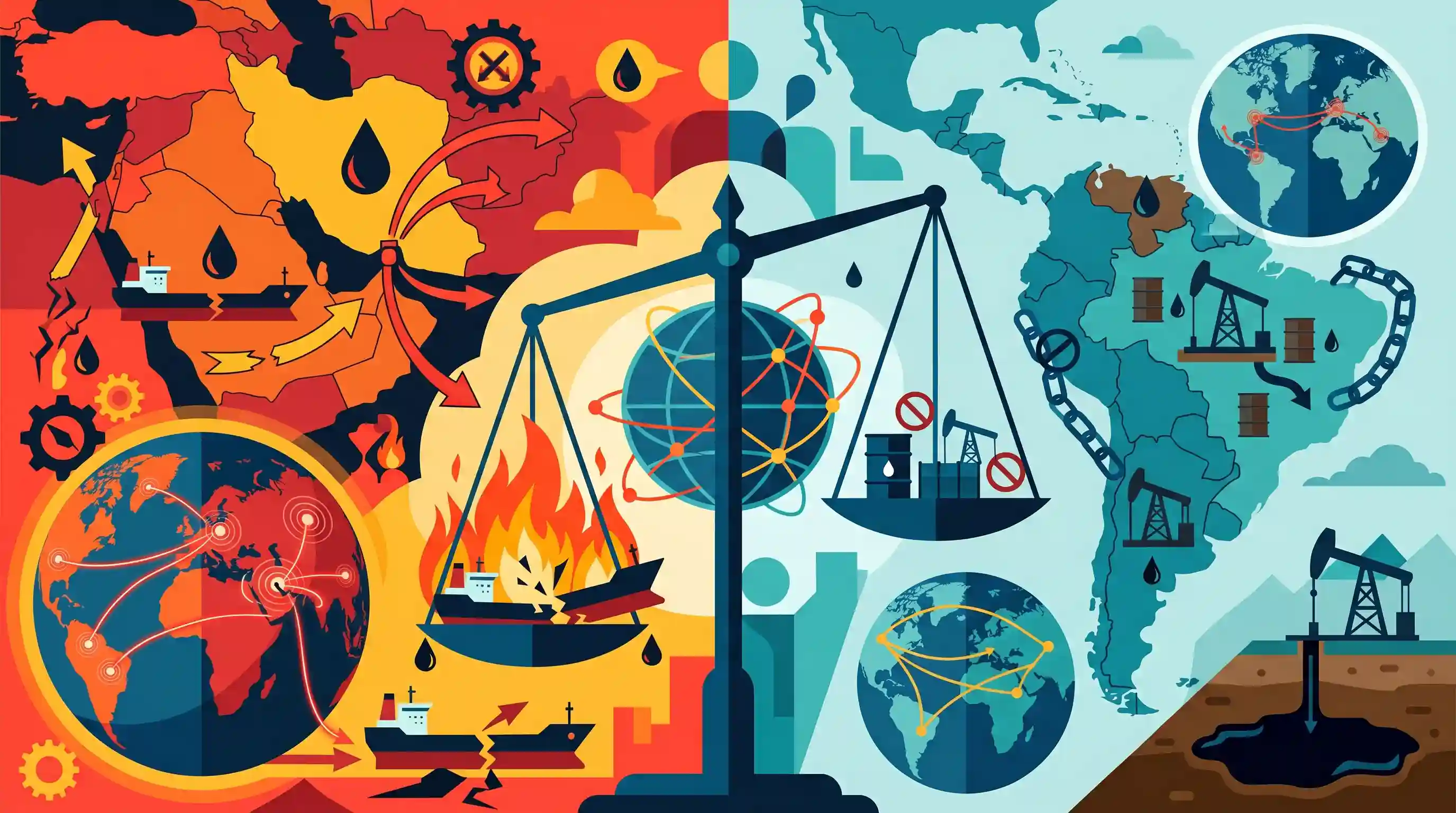
The article provides an expert analysis on why a geopolitical conflict or US standoff with Iran poses a significantly greater threat to global stability and energy security than a similar crisis in Venezuela. It emphasizes that an Iran conflict, particularly one threatening a blockade of the Strait of Hormuz, could severely disrupt global oil transit routes and permanently redraw the energy map. In contrast, although Venezuela holds massive oil reserves and suffers from US sanctions, its crisis is largely contained to domestic production declines and does not jeopardize critical global maritime trade. Thus, the geopolitical and economic consequences of an Iranian escalation are far more severe for global energy markets.
Key Points
- The standoff between the US and Iran carries profound implications for global energy security, potentially 'redrawing the global oil map'.
- A conflict with Iran threatens a potential blockade of the Strait of Hormuz, a critical global chokepoint through which a large portion of the world's oil transit occurs.
- While Venezuela possesses some of the world's largest oil reserves and faces similar US sanctions, its crisis primarily causes supply-side constraints without blocking international transit routes.
- Iran's geographic and strategic location makes its geopolitical stability indispensable for the uninterrupted flow of oil, severely affecting energy-dependent nations like India if disrupted.
- The comparative analysis highlights that transit and chokepoint disruptions (Iran) pose a far more immediate and consequential risk to global markets than localized production declines (Venezuela).
Important Terms
Strait of Hormuz

The world's most critical maritime chokepoint, connecting the Persian Gulf to the Arabian Sea. It handles approximately 20% of global oil and LNG trade.
UPSC context
GS Paper 1 (Geography) and GS Paper 2 (International Relations); essential for understanding global energy lifelines and India's vulnerability.
OPEC
An intergovernmental organization of major oil-exporting nations that coordinates petroleum policies to stabilize global oil prices and ensure a regular supply.
UPSC context
GS Paper 2 (International Groupings) and GS Paper 3 (Economy); tested for its influence on crude prices and global energy politics.
Energy Security
The uninterrupted availability of energy sources at an affordable price. It is measured by availability, accessibility, and affordability of energy to sustain national growth.
UPSC context
GS Paper 3 (Infrastructure/Energy); a recurring theme regarding India’s import dependence and strategic autonomy.
US Sanctions
Economic and trade penalties used as a foreign policy tool to influence or isolate target nations (e.g., Iran and Venezuela) by restricting access to global financial systems.
UPSC context
GS Paper 2 (International Relations); focuses on their extraterritorial impact and effect on India’s bilateral trade and energy imports.
Strategic Petroleum Reserves (SPR)
Large-scale crude oil storages maintained by governments (like India's at Visakhapatnam, Mangaluru, and Padur) to safeguard against sudden supply disruptions and price volatility.
UPSC context
GS Paper 3 (Energy Security); critical for India’s crisis management strategy during West Asian conflicts.
Geopolitical Risk Premium
The price increase in commodities like crude oil caused by potential conflict or political instability, rather than actual supply-demand imbalances.
UPSC context
GS Paper 3 (Economy/Inflation); explains how international tensions lead to immediate domestic fuel price hikes.
Strategic Chokepoint
Strategic maritime passages (like the Strait of Hormuz or Malacca) where traffic is highly concentrated, making them vulnerable to blockades that can paralyze global trade.
UPSC context
GS Paper 1 (World Geography) and GS Paper 2 (IR); central to maritime security and the 'string of pearls' vs 'diamond' strategy.
Prelims Trap
Iran holds the world's largest proven crude oil reserves, making a conflict there highly consequential.
Venezuela holds the largest proven reserves, not Iran. Iran's outsized geopolitical threat stems from its geographical control over a major maritime transit chokepoint (Strait of Hormuz).
Static Concepts Connected
What are the key maritime chokepoints for energy transit in West Asia?
- Strait of Hormuz: Connects the Persian Gulf to the Gulf of Oman and Arabian Sea. Bordered by Iran and Oman. Handles roughly 20% of global oil transit.
- Bab el-Mandeb: Connects the Red Sea to the Gulf of Aden and Arabian Sea. Bordered by Yemen, Djibouti, and Eritrea. Crucial for Suez-bound trade.
- Suez Canal: Artificial waterway connecting the Red Sea to the Mediterranean Sea in Egypt, avoiding the Cape of Good Hope detour.
How does a global crude oil supply shock structurally impact India's macroeconomy?
- Current Account Deficit: Inelastic demand for oil significantly inflates the import bill, widening the trade deficit and subsequently the Current Account Deficit (CAD).
- Imported Inflation: Higher fuel prices drive up transport and production costs across sectors, causing imported inflation and limiting the RBI's ability to cut interest rates.
- Fiscal Revenue Squeeze: The government may be forced to absorb price shocks by cutting excise duties on petroleum products, leading to a reduction in crucial fiscal revenue.
Cross-Topic Patterns
Energy chokepoints and Rupee settlement
Supply shocks from the Persian Gulf historically drive rupee depreciation. This amplifies India's strategic push for INR-denominated oil trade with alternative suppliers (like UAE and Russia) to hedge against dollar-driven import inflation.
IMEC/INSTC as structural de-risking tools
The vulnerability of the Strait of Hormuz underscores the strategic necessity of the India-Middle East-Europe Economic Corridor (IMEC) and INSTC, which seek to bypass volatile maritime chokepoints via multi-modal routes.

Expect a map-based Prelims question matching global oil chokepoints (Hormuz, Bab el-Mandeb) with bordering nations or connected water bodies.
Linked PYQs · 3
Linked PYQs · 3
- 2025MainsGS2
"Energy security constitutes the dominant kingpin of India's foreign policy, and is linked with India's overarching influence in Middle Eastern countries.” How would you integrate energy security with India's foreign policy trajectories in the coming years?
- 2017MainsGS2
The question of India's Energy Security constitutes the most important part of India's economic progress. Analyze India's energy policy cooperation with West Asian countries.
- 2024PrelimsGS1
Consider the following statements : Statement-I : Sumed pipeline is a strategic route for Persian Gulf oil and natural gas shipments to Europe. Statement-II : Sumed pipeline connects the Red Sea with the Mediterranean Sea. Which one of the following is correct in respect of the above statements?
