India Private Corporate Investment Stagnation Factors
Source:Indian Express ↗
Why It Matters
Provides a critical structural diagnosis of why India faces 'jobless growth' and stagnant private capital formation despite massive public capex. The points on industry concentration, internal connectivity, and vocational skill deficits are excellent arguments for GS3 answers on manufacturing and economic growth.
Summary
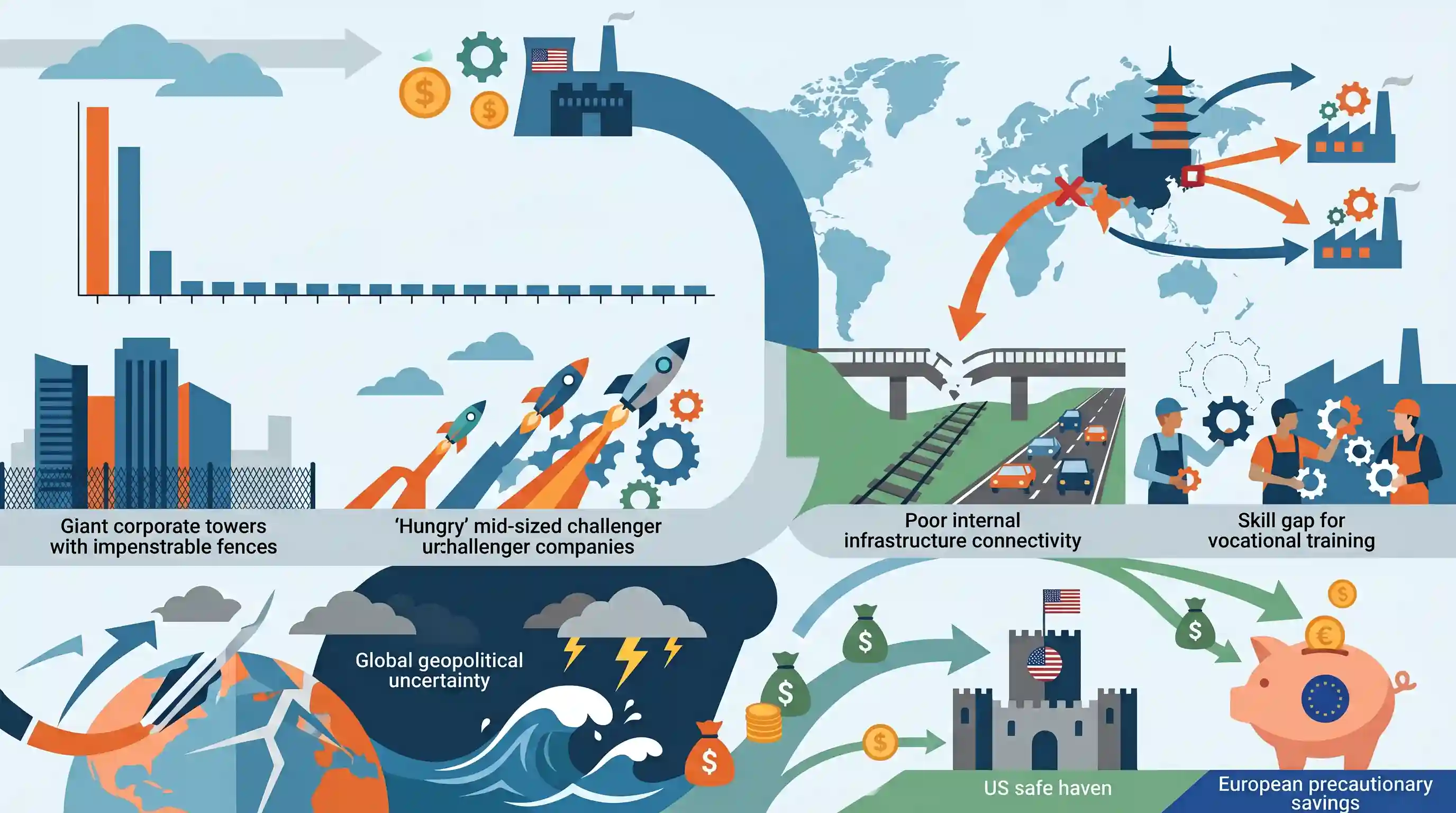
J.P. Morgan's Jahangir Aziz analyzes the structural bottlenecks in India's economy, noting that private corporate investment has flatlined at 10-11% of GDP for over 15 years. This stagnation is attributed to severe industry concentration, where entrenched monopolies face no competition from 'hungry' mid-sized challengers. Additionally, the piece highlights that India is missing out on the 'China Plus One' manufacturing shift due to poor internal connectivity and a lack of vocational skilling for factory workers. Globally, geopolitical uncertainty is driving capital either to US safe havens or into European precautionary savings, further tightening foreign capital availability.
Key Points
- Global capital flows are currently shaped by geopolitical uncertainty, leading to safe-haven investments in US tech (AI) and defensive 'precautionary savings' in Europe.
- India's private corporate investment has flatlined at around 10-11% of GDP for the past 15-16 years, despite various government interventions.
- A major cause of this stagnation is high 'industry concentration'—established leaders in sectors like IT and pharma face little competition from mid-sized challengers, suppressing the need for aggressive capital expenditure.
- India struggles to capitalize on the 'China Plus One' strategy due to significant deficits in internal connectivity (limiting domestic supply chains) and vocational skilling (a shortage of factory machinists and specialized labor).
- Without rectifying the foundational issues of infrastructure and labor productivity, structural bottlenecks will continue to inhibit India's potential GDP growth.
Important Terms
Private Corporate Investment

Capital expenditure by non-government firms on physical assets like factories and machinery to increase production capacity. In India, this has stagnated at roughly 10-12% of GDP since 2011.
UPSC context
GS3 (Investment Models/Growth). Key for analyzing why India's growth hasn't translated into robust job creation or industrial expansion.
China Plus One Strategy
A global business approach where companies reduce over-reliance on China by diversifying manufacturing and supply chains into alternative countries like India or Vietnam.
UPSC context
GS2 (IR) and GS3 (Economy). Tests India's readiness to capture global manufacturing shifts and improve supply chain resilience.
Industry Concentration
A market condition where a small number of large firms hold a dominant share of assets or revenue in an industry, potentially stifling competition and innovation.
UPSC context
GS3 (Industrial Policy). Essential for discussing market distortions, the 'missing middle' in manufacturing, and the health of competition.
Vocational Skilling
Practical, job-specific training that equips the workforce with technical skills required for direct entry into industrial or service sector roles.
UPSC context
GS2 (Social Justice) and GS3 (Economy). Crucial for bridging the employability gap and achieving the 'Make in India' goals.
Gross Fixed Capital Formation (GFCF)
A macroeconomic indicator that measures the net value of fixed assets added to an economy (like infrastructure and machinery) during a specific period.
UPSC context
GS3 (Economy). The primary technical metric used by the government to track investment levels and productive capacity.
Precautionary Savings
Savings made by households or firms specifically as a buffer against future income uncertainty or external economic shocks, often at the expense of current consumption.
UPSC context
GS3 (Macroeconomics). Relevant for understanding global capital flight, domestic demand patterns, and the impact of geopolitical uncertainty.
Prelims Trap
"India's overall Gross Fixed Capital Formation (GFCF) has flatlined at 10% for the last decade."
Aspirants often confuse overall GFCF (which is much higher due to government capex) with private corporate investment, which is the component stagnating.
Static Concepts Connected
What are the components of Gross Fixed Capital Formation (GFCF)?
- Definition: Measures the net increase in physical assets (infrastructure, machinery, equipment) within an economy over a year.
- Three Pillars: It comprises public sector investment, private corporate sector investment, and household sector investment (including residential real estate).
- Current Trend: While public capex has surged recently in India, the private corporate component has persistently stagnated, limiting overall capacity expansion.
How does 'Industry Concentration' affect private capital expenditure?
- Reduced Competition: High concentration creates oligopolies where entrenched market leaders face little threat, reducing their incentive to aggressively invest in new capacity.
- Missing Middle: The absence of aggressive, mid-sized challengers (the 'missing middle') stalls the disruptive investment cycles needed to boost national private capex.
Cross-Topic Patterns
PLI Schemes vs. Structural Realities
While PLI schemes target the 'China Plus One' shift, foundational deficits in vocational skilling and internal freight connectivity act as persistent structural bottlenecks to domestic supply chain integration.
Global Safe Havens vs. Emerging Market FDI
Geopolitical uncertainty is driving foreign capital into US tech and European safe havens, directly tightening the FDI pipeline needed to bridge emerging markets' private investment gaps.

Expect a 2026 mains question contrasting government capex-led growth against structural bottlenecks causing private investment stagnation.
Linked PYQs · 5
Linked PYQs · 5
- 2020MainsGS3
Explain the meaning of investment in an economy in terms of capital formation. Discuss the factors to be considered while designing a concession agreement between a public entity and a private entity.
- 2017MainsGS3
Industrial growth rate has lagged-behind in the overall growth of Gross-Domestic-Product (GDP) in the post-reform period." Give reasons. How far the recent changes in Industrial-Policy are capable of increasing the industrial growth rate?
- 2023MainsGS3
Faster economic growth requires increased share of the manufacturing sector in GDP, particularly of MSMEs. Comment on the present policies of the Government in this regard.
- 2021MainsGS3
“Investment in infrastructure is essential for more rapid and inclusive economic growth.” Discuss in the light of India's experience.
- 2020MainsGS3
Define potential GDP and explain its determinants. What are the factors that have been inhibiting India from realizing its potential GDP?
