India Japan Bilateral Business Ties and Investment Bottlenecks
Source:Indian Express ↗
Why It Matters
This article offers highly practical, corporate-level insights into the bottlenecks in India-Japan economic cooperation, moving beyond generic diplomatic talking points. It provides students with concrete, analytical arguments regarding the divergence between strategic MOUs and actual ground-level business investments, which is directly applicable to GS2 (International Relations) and GS3 (Economic Development/FDI) questions.
Summary
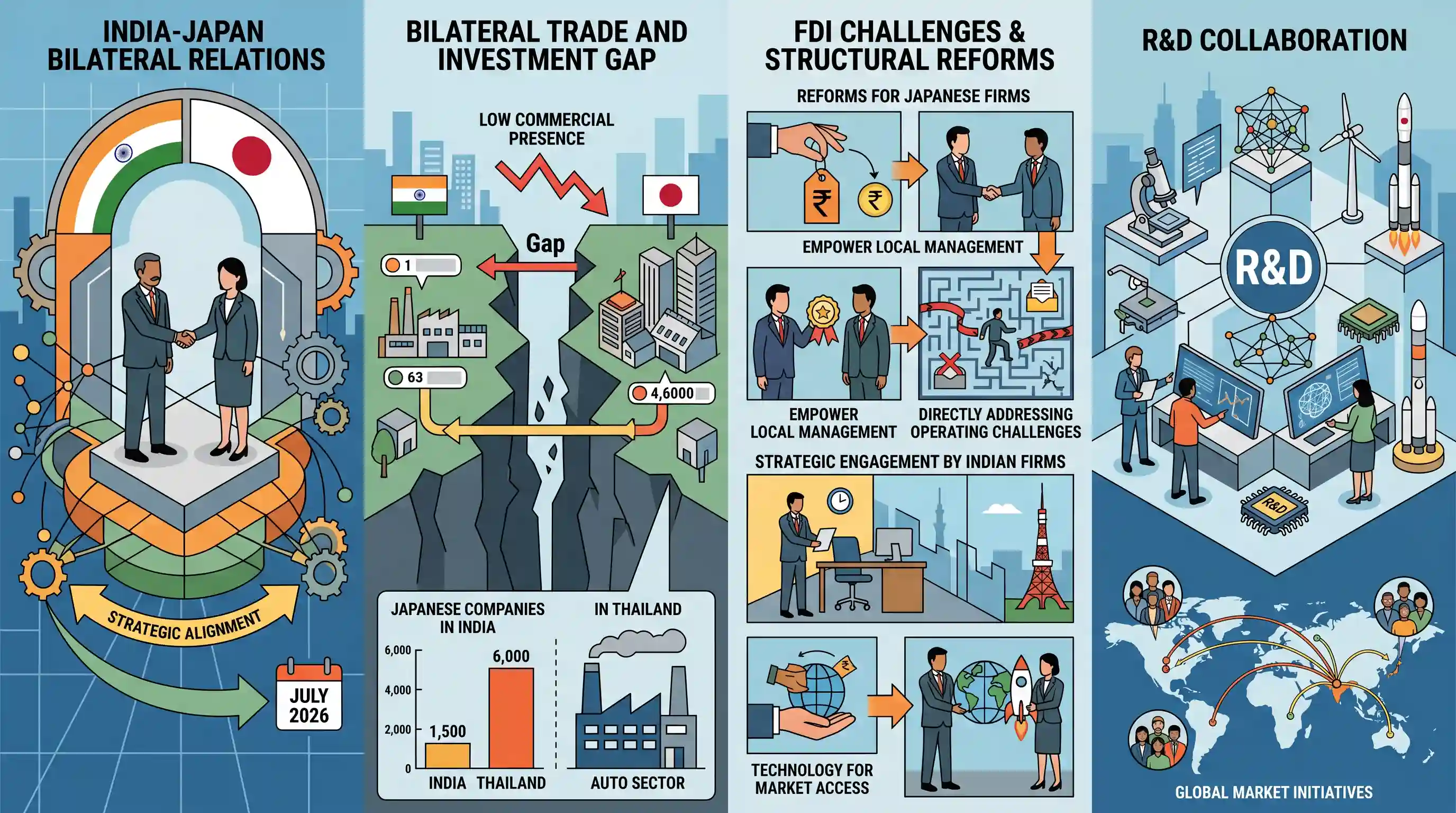
This article, written by a Tokyo-based management advisor in the context of Japanese PM Sanae Takaichi's July 2026 visit to India, critically assesses the persistent gap between India and Japan's strategic alignment and their actual business integration. While political ties are robust, Japanese commercial presence remains low (1,500 companies in India vs. 6,000 in Thailand) and heavily concentrated in the auto sector. To overcome this, the article outlines necessary structural reforms: Japanese firms must adapt to Indian consumer price-sensitivities, empower local Indian management, and navigate local operating challenges directly. Meanwhile, Indian firms must strategically engage in Japan (such as establishing Tokyo offices) and partner in R&D and global market initiatives rather than relying on outdated technology-transfer-for-market-access arrangements.
Key Points
- Despite a highly successful strategic and diplomatic partnership, bilateral business ties between India and Japan remain significantly underperformed, with only 1,500 Japanese firms operating in India compared to 6,000 in Thailand.
- Bilateral business is heavily concentrated, with just 1% of the 1,500 Japanese companies (primarily in the automobile sector, driven by Suzuki since the 1980s) accounting for more than half of all India-Japan corporate business.
- A gradual shift is underway with top-tier Japanese firms deploying capable personnel to explore emerging opportunities in Indian real estate, tech startups, steelmaking, and clean energy collaborations, catalyzed by Japanese PM Sanae Takaichi's visit to India in July 2026.
- Operational rigidity hampers Japanese success in India; companies often insist on applying traditional Japanese product designs and slow decision-making timelines, losing out to more agile competitors.
- Unlike China's highly organized 'plug-and-play' manufacturing environment, operating in India requires foreign firms to actively navigate localized challenges, requiring capable and empowered local staff.
- Japanese MNCs struggle to attract premium Indian talent because, unlike Western multinationals, they rarely promote local executives to head their India operations or take on global leadership responsibilities.
- To bridge this gap, Indian corporations must move away from seeking simple 'technology transfers' for market access; they should establish a physical presence in Tokyo, leverage reciprocal third-country projects, and collaborate with Japanese firms to upgrade R&D (Japan spends over 4% of revenues on R&D, compared to under 1% in India).
Important Terms
Indo-Japanese clean energy partnerships

Bilateral collaborations targeting green hydrogen, battery storage, and emissions reductions via the Joint Crediting Mechanism (JCM) to foster transition to net-zero economies.
UPSC context
GS Paper II: Bilateral Relations. Tests understanding of climate cooperation, energy security, and technology co-development.
Suzuki Motor Corporation
A major Japanese automaker whose landmark 1980s investment in India pioneered the country's modern automotive sector and remains the cornerstone of bilateral trade.
UPSC context
GS Paper III: Industrial Growth. Tests analysis of foreign direct investment, private sector partnerships, and industrial corridor development.
Maruti Suzuki
The joint-venture subsidiary of Suzuki Motor Corporation in India, widely recognized as the most successful model of Indo-Japanese manufacturing integration and local market adaptation.
UPSC context
GS Paper III: Investment Models. Examines joint ventures, 'Make in India' dynamics, and manufacturing supply-chain ecosystems.
Reliance Jio
An Indian telecom leader that disrupted the market through highly affordable, scale-centric services, representing the consumer price-sensitivity that foreign enterprises must adapt to.
UPSC context
GS Paper III: Telecommunications & Infrastructure. Analyzes consumer pricing models, digital transformation, and market adaptability.
Prelims Trap
The private sector is the leading contributor to India's Gross Expenditure on R&D, mirroring Japan's investment structure.
In India, the government contributes roughly 60% of GERD, whereas in Japan and other developed nations, the private sector drives over 70% of R&D expenditure.
Static Concepts Connected
How does a CEPA differ from a traditional FTA?
- Scope: CEPA covers goods, services, investment, intellectual property, and regulatory cooperation, whereas FTAs primarily target tariff reductions on physical goods.
- Integration: It represents a deeper level of economic integration and regulatory alignment than preferential or free trade agreements.
What characterizes India's Gross Expenditure on R&D?
- Low Intensity: India's GERD-to-GDP ratio has stagnated below 0.7% for two decades, far behind Japan's investment of over 3.5%.
- Public Dominated: Government sources fund nearly 60% of India's R&D, whereas private industry contributes only ~36-40%, unlike Western or Japanese models.
Cross-Topic Patterns
Strategic Quad vs asymmetric trade
While India-Japan security cooperation flourishes under the Quad, bilateral trade remains modest, hampered by non-tariff barriers and supply chain rigidities.
R&D funding and technology sovereignty
Transitioning from technology transfers to collaborative co-development is vital for India's indigenous manufacturing goals under the Semiconductor Mission.

2026 Mains may analyze why India-Japan strategic convergence in the Indo-Pacific has not translated into deep bilateral trade integration.
Linked PYQs · 2
Linked PYQs · 2
- 2019MainsGS2
‘The time has come for India and Japan to build a strong contemporary relationship, one involving global and strategic partnership that will have a great significance for Asia and the world as a whole.’ Comment.
- 2016MainsGS3
Justify the need for FDI for the development of the Indian economy. Why there is gap between MOUs signed and actual FDIs? Suggest remedial steps to be taken for increasing actual FDIs in India.
