Global AI Governance and Trusted AI Commons Initiative
Source:Indian Express ↗
Why It Matters
Global AI governance, technology diplomacy, and ethical regulation are high-priority themes for UPSC Mains (GS2, GS3, GS4). The appointment of an Indian expert to a UN panel and India's leadership in the 'Trusted AI Commons' demonstrate India's strategic push to shape the global tech order.
Summary
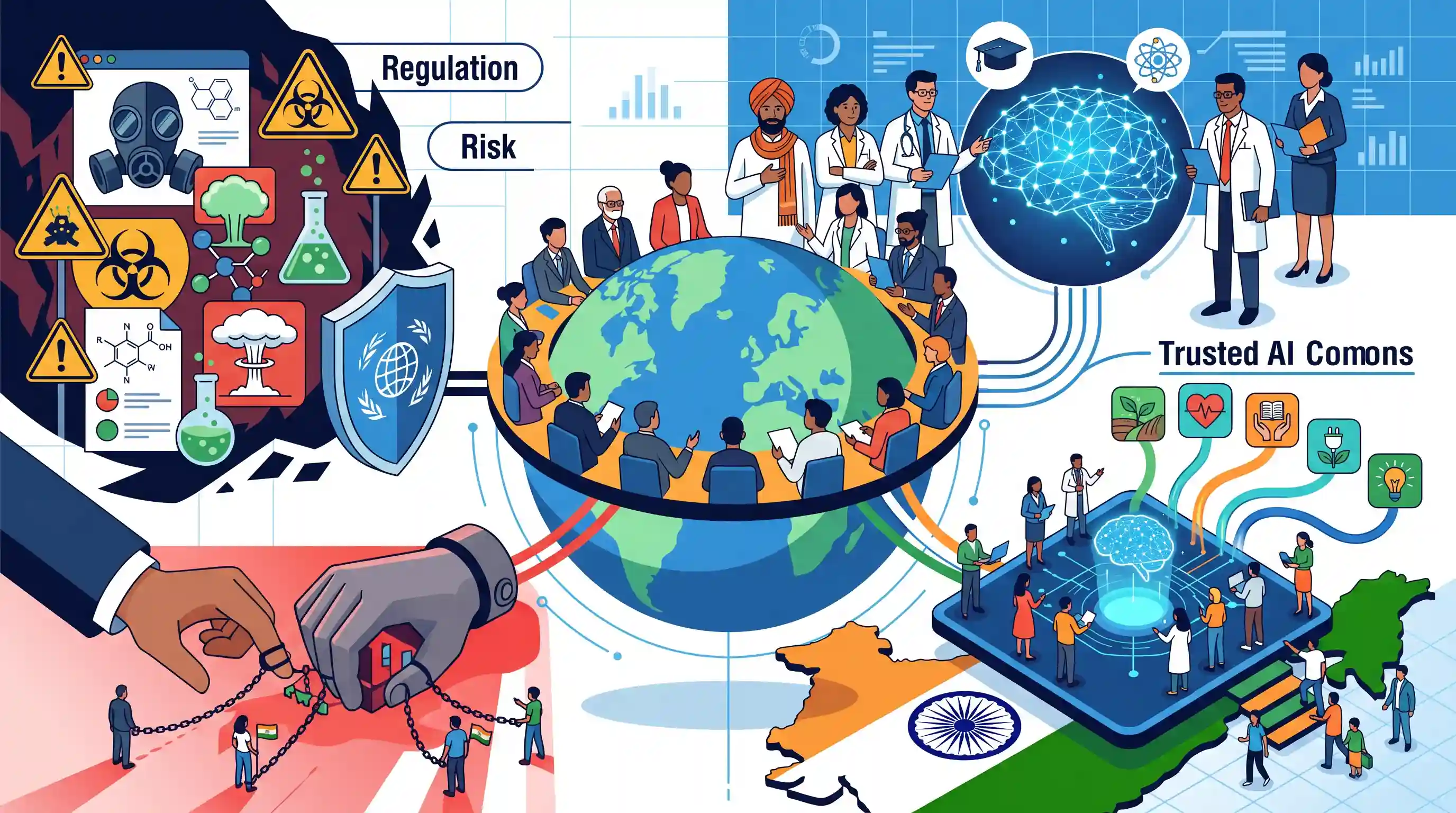
The UN General Assembly has launched a Global Dialogue on AI, backed by an Independent International Scientific Panel that includes Indian expert Prof B Ravindran. The initiative addresses the urgent need for global AI governance to prevent developing nations from becoming 'digital colonies' reliant on foreign AI frameworks. Experts warn of systemic risks, such as AI's potential to facilitate the creation of biological or chemical weapons, highlighting the necessity of international regulation. To prevent a restrictive regime that limits technology to advanced nations, India is spearheading the 'Trusted AI Commons' under the IndiaAI mission—a collaborative platform designed to ensure safe, equitable, and democratic access to AI tools worldwide.
Key Points
- The UN General Assembly initiated a Global Dialogue on AI to create a unified international framework for AI governance, supported by an Independent International Scientific Panel on AI.
- Developing nations lacking domestic regulatory capacities and compute power risk becoming 'digital colonies' reliant on technology norms dictated by Western tech giants.
- AI presents profound dual-use risks, particularly the systemic danger of democratizing knowledge for creating next-generation biological and chemical weapons.
- Rather than a restrictive non-proliferation-style regime that monopolizes AI capabilities, India advocates for equitable access through the 'Trusted AI Commons.'
- Hosted by the IndiaAI mission, the Trusted AI Commons serves as an open repository for safe, responsible models and tools, democratizing AI development for the Global South.
Important Terms
Global Dialogue on AI Governance

A UN General Assembly forum established in 2025 to facilitate inclusive international cooperation, best-practice sharing, and discussions on AI governance among member states and stakeholders.
UPSC context
GS Paper II (International Relations) and GS III (S&T); essential for understanding global efforts to regulate emerging technologies and prevent 'digital colonialism.'
Independent International Scientific Panel on AI
A 40-member expert body established by the UN in 2025 to provide evidence-based scientific assessments of AI’s opportunities, risks, and societal impacts to inform global policy.
UPSC context
GS Paper III (Science & Technology); highlights the role of scientific diplomacy and independent oversight in managing systemic AI risks like biological threats.
Trusted AI Commons
An India-led collaborative repository of open-source tools, datasets, and protocols designed to ensure safe and equitable access to AI technology, particularly for developing nations.
UPSC context
GS Paper III (S&T and Digital Infrastructure); represents India's leadership in the Global South by promoting 'AI for All' through democratized resources.
IndiaAI Mission
A ₹10,372 crore national initiative aimed at building a sovereign AI ecosystem in India through compute infrastructure, indigenous foundational models, and a 'Safe & Trusted AI' pillar.
UPSC context
GS Paper III (Economic Development and S&T); a core government policy for achieving self-reliance (Atmanirbharta) in critical and emerging technologies.
Global Digital Compact (GDC)
A UN framework adopted at the 2024 Summit of the Future to guide global digital cooperation, aiming to close digital divides and ensure a safe, inclusive digital future.
UPSC context
GS Paper II (International Relations); the foundational document for contemporary global digital governance and the establishment of new UN AI mechanisms.
Prelims Trap
India supports a non-proliferation-style global regime to restrict access to frontier AI models.
India actively opposes restrictive non-proliferation regimes for AI. Instead, it advocates for the 'Democratic Diffusion' of AI and equitable access for the Global South.
Static Concepts Connected
What are dual-use technologies and how are they regulated globally?
- Definition: Technologies with both civilian and military or WMD applications, such as artificial intelligence, nuclear materials, and advanced chemicals.
- Wassenaar Arrangement: A multilateral export control regime regulating conventional arms and dual-use goods/technologies, of which India is a member.
- Australia Group: An informal multilateral group aiming to prevent the proliferation of chemical and biological weapons (India is a member).
What is 'Digital Colonization' in the context of data sovereignty?
- Meaning: Occurs when developing nations depend entirely on foreign tech giants for digital infrastructure, foundational AI models, and data frameworks.
- Sovereignty Risk: Results in the loss of control over national data, algorithmic biases, and forced reliance on Western regulatory norms.
Cross-Topic Patterns
AI's intersection with bio-terrorism
AI's dual-use nature democratizes access to synthetic biology, significantly lowering the technical barrier for non-state actors to engineer novel pathogens or toxic weapons.
Global South digital diplomacy
Much like UPI, India is positioning the 'Trusted AI Commons' as an open-source diplomatic tool to prevent digital colonization of the Global South.

Expect a multi-statement question contrasting India's 'Trusted AI Commons' with Western non-proliferation-style AI regulatory regimes.
Linked PYQs · 2
Linked PYQs · 2
- 2023MainsGS3
Introduce the concept of Artificial Intelligence (AI). How does Al help clinical diagnosis? Do you perceive any threat to privacy of the individual in the use of Al in healthcare?
- 2024MainsGS4
The application of Artificial Intelligence as a dependable source of input for administrative rational decision-making is a debatable issue. Critically examine the statement from the ethical point of view.
