China Strategic Interests in Iran Conflict
Source:Indian Express ↗
Why It Matters
Understanding China's strategic calculus in the Middle East provides critical insights into global energy geopolitics. As both India and China depend heavily on Middle Eastern oil, analyzing China's response to regional conflicts helps aspirants understand the broader implications for India's own energy security and foreign policy maneuvering.
Summary
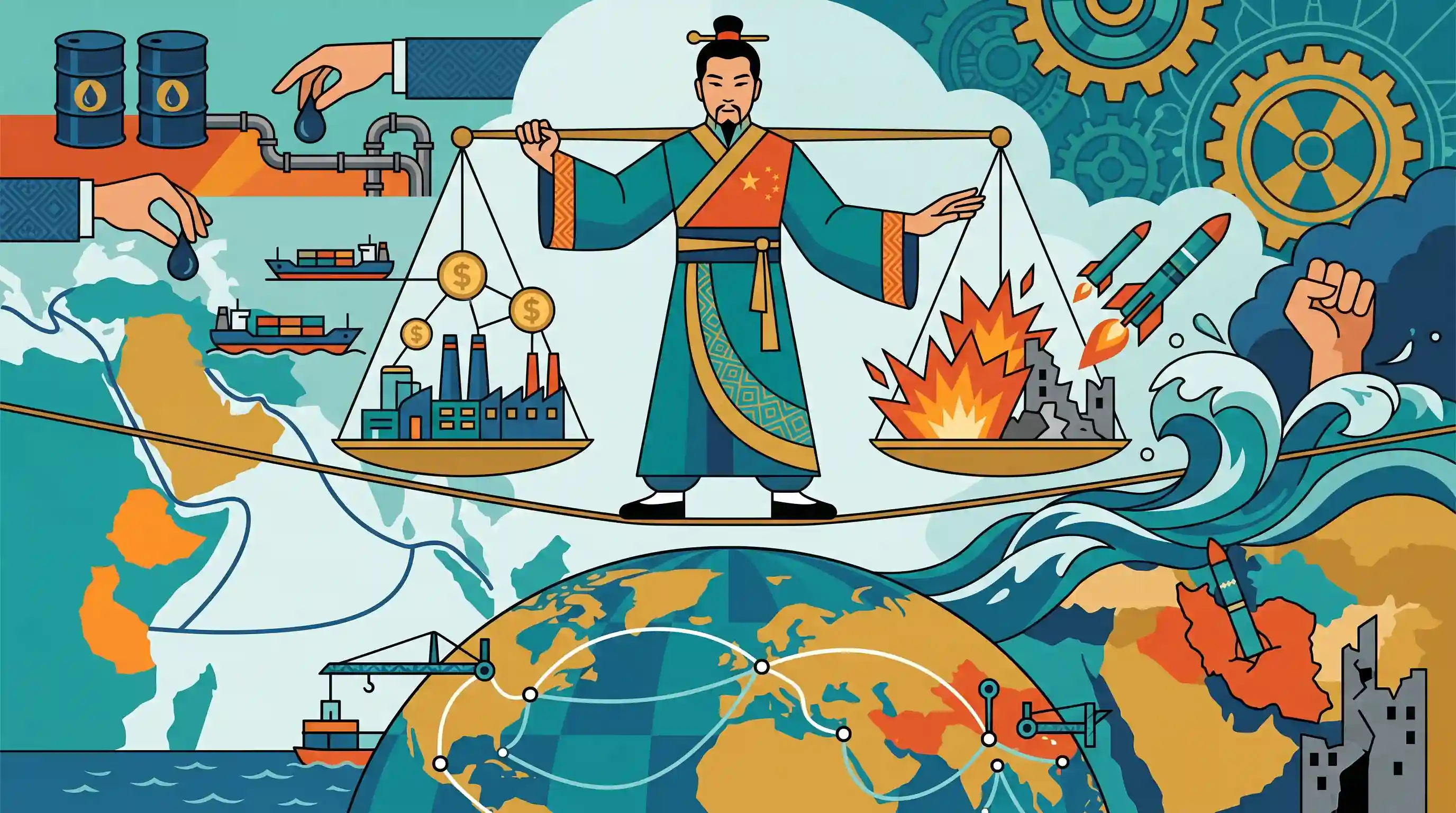
The article analyzes China's cautious approach to the conflict involving Iran, highlighting that Beijing's reaction is primarily shaped by its energy security needs and economic interests. Highly dependent on Middle Eastern oil and heavily invested in the region through its Belt and Road Initiative (BRI), China seeks to avoid regional destabilization. Consequently, Beijing maintains a delicate diplomatic balance, prioritizing de-escalation to protect its supply lines and infrastructure investments rather than engaging in direct military or political confrontation.
Key Points
- China's response to the conflict in Iran is fundamentally driven by its need to protect its energy security, given its heavy reliance on Middle Eastern oil imports.
- The Middle East is a critical region for China's Belt and Road Initiative (BRI), meaning prolonged conflict threatens billions in infrastructure and trade investments.
- Beijing employs a cautious diplomatic strategy, avoiding direct military entanglement while balancing relations between Iran, Arab states, and Israel.
- A broader regional war could severely disrupt global supply chains, adversely affecting China's economy and broader geopolitical ambitions.
Important Terms
Belt and Road Initiative (BRI)

Global infrastructure development strategy launched by China in 2013, aiming to connect Asia, Africa, and Europe through land and maritime networks.
UPSC context
GS II/International Relations; critical for understanding China's regional influence and the 'Debt Trap' diplomacy impacting India's neighbors.
China-Iran 25-Year Strategic Partnership
A 2021 cooperation pact worth ~$400 billion, involving long-term Chinese investment in Iran’s infrastructure and energy in exchange for discounted oil supplies.
UPSC context
GS II/Bilateral Relations; assesses the impact of China's West Asia footprint on India's strategic interests like the Chabahar port.
Strait of Hormuz
A vital maritime chokepoint between Iran and Oman, facilitating approximately 20-30% of global seaborne oil trade and connecting the Persian Gulf to the Arabian Sea.
UPSC context
GS I/Geography & GS II/IR; key for mapping global energy lifelines and analyzing regional conflict's impact on supply chains.
Energy Security
The reliable and affordable availability of energy sources, fundamental for industrial production and national economic stability.
UPSC context
GS III/Economy & GS II/IR; focuses on India’s import dependence and the strategic need for supply diversification.
Non-Interventionist Policy
China’s diplomatic principle of avoiding interference in other nations' internal affairs, often used to position itself as an 'honest broker' in conflicts.
UPSC context
GS II/IR; contrasts Chinese 'peace-broker' diplomacy with Western-style interventionism in the Middle East.
Prelims Trap
"China and Iran share a formal mutual defense treaty obligating military intervention."
China and Iran signed a 25-year 'Comprehensive Strategic Partnership' in 2021 focused on economics, investments, and intelligence. It is not a formal military alliance or mutual defense pact.
Static Concepts Connected
Why is the Strait of Hormuz critical for global energy security?
- Geographic chokepoint: It acts as the primary maritime chokepoint connecting the Persian Gulf to the Gulf of Oman and the Arabian Sea.
- Transit volume: It handles approximately 20% of global oil consumption, with very limited alternative pipeline routes available to bypass it.
- Strategic vulnerability: Any naval blockade or mining disrupts global supply chains, disproportionately threatening the energy security of major Asian importers like China and India.
What are the mechanisms and impacts of currency internationalization?
- Trade settlement: It involves using a domestic currency (like the Yuan or Rupee) for invoicing and settling cross-border trade instead of the US Dollar.
- Sanction shielding: It allows countries to bypass dollar-dominated financial messaging networks like SWIFT, mitigating the impact of Western economic sanctions.
- Reserve status: If highly successful, it leads to foreign central banks holding the currency as part of their official foreign exchange reserves.
Cross-Topic Patterns
India's IMEEC vs China's BRI
While China secures influence via BRI and mediated Iran-Saudi deals, India pushes the Chabahar port and IMEEC to secure strategic and economic footholds without antagonizing Western or Arab partners.
Petroyuan and global De-dollarization
China's purchase of discounted Iranian crude settled in Yuan links energy security directly to macroeconomic de-dollarization, a trend highly relevant to India's own Rupee-trade ambitions.

Expect a Mains question on how China and India's differing West Asia strategies (BRI vs IMEEC) impact their respective energy security.
Linked PYQs · 3
Linked PYQs · 3
- 2025MainsGS2
"Energy security constitutes the dominant kingpin of India's foreign policy, and is linked with India's overarching influence in Middle Eastern countries.” How would you integrate energy security with India's foreign policy trajectories in the coming years?
- 2018MainsGS3
The China-Pakistan Economic Corridor (CPEC) is viewed as a cardinal subset of China's larger 'One Belt One Road' initiative. Give a brief description of CPEC and enumerate the reasons why India has distanced itself from the same.
- 2024MainsGS2
‘The West is fostering India as an alternative to reduce dependence on China's supply chain and as a strategic ally to counter China's political and economic dominance.’ Explain this statement with examples.
