Global AI chip boom presents strategic opportunity for India
Source:Indian Express ↗
આ શા માટે મહત્વનું છે
This topic is critical for understanding India's ambitions in high-tech manufacturing, semiconductor self-reliance, and leveraging the AI revolution for sustainable economic development.
સારાંશ
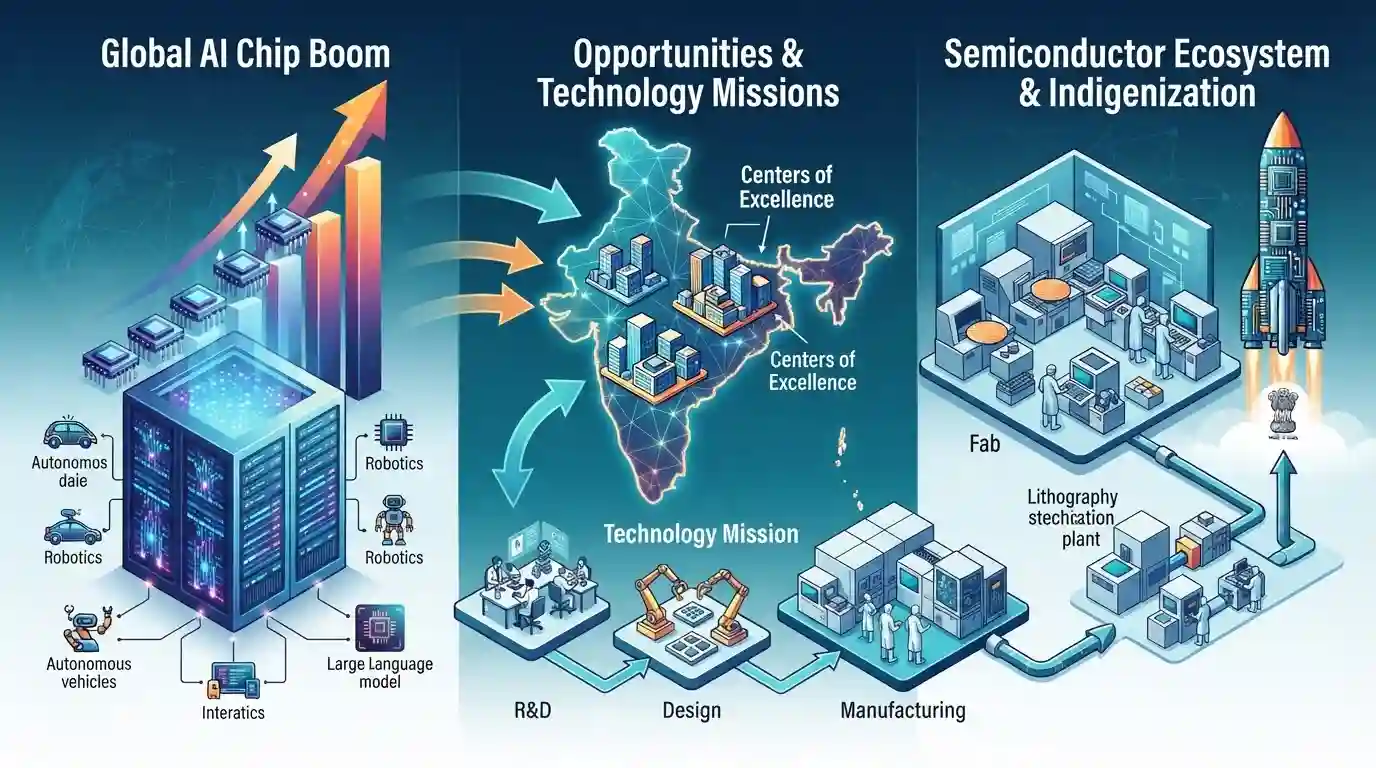
The article examines the global AI chip boom, driven by exponential demands for advanced computing power, and analyses the opportunities and strategic imperatives for India to position itself in the semiconductor and AI hardware ecosystem.
મુખ્ય મુદ્દા
- The global surge in artificial intelligence (AI) has sparked a massive boom in demand for specialised AI chips (like GPUs and custom accelerators).
- India has a unique opportunity to tap into the semiconductor and AI hardware value chain through domestic policy support and initiatives like the India Semiconductor Mission.
- Key challenges in the AI chip and semiconductor sector include high capital requirements, complex global supply chains, technological barriers, and a shortage of specialized talent.
- Building local capabilities in AI infrastructure and chip design can boost India's technological sovereignty, manufacturing sector, and digital economy.
મહત્વપૂર્ણ શબ્દો
India Semiconductor Mission

A specialized nodal agency launched under the Ministry of Electronics and Information Technology to build a vibrant semiconductor and display ecosystem in India through financial incentives and strategic policy support.
UPSC context
Relevant for GS Paper III (Technology, Indigenization, Economic Development). Tests knowledge of government policies for high-tech manufacturing and supply chain resilience.
પ્રિલિમ્સ ટ્રેપ
India Semiconductor Mission provides uniform capital subsidies across both chip fabrication and design startups without distinction.
Aspirants often confuse Design-Linked Incentive (DLI) schemes with fabrication subsidies; DLI targets IP and chip design startups, whereas fabs require massive capital outlays for physical manufacturing.
સંલગ્ન સ્થિર ખ્યાલો
What are the key components and strategic objectives of the India Semiconductor Mission (ISM)?
- Financial Support: Comprehensive support providing fiscal backing for semiconductor fabs, display fabs, and compound semiconductor facilities.
- DLI Scheme: Design Linked Incentive (DLI) scheme to nurture domestic semiconductor design startups and build indigenous IP.
- Ecosystem Building: Building end-to-end domestic ecosystem encompassing chip design, manufacturing, advanced packaging, and testing for tech autonomy.
આંતર-વિષય પેટર્ન
Semiconductor Design Talent + Compute Capacity
India's 20% share of global chip design talent directly complements the IndiaAI Mission's public compute investments, connecting human capital policy with high-tech industrial missions.
Fab Capital Intensity + Strategic Bottlenecks
High capital intensity and long gestation periods in fabrication plants mirror strategic challenges seen in nuclear energy and rare earth refining.

Expect a multi-statement prelims question on ISM 2.0 covering design-linked incentives versus fabrication subsidies and talent pool share.
સંલગ્ન PYQ · 2
સંલગ્ન PYQ · 2
- 2025MainsGS3
India aims to become a semiconductor manufacturing hub. What are the challenges faced by the semiconductor industry in India? Mention the salient features of the India Semiconductor Mission.
- 2023MainsGS3
Introduce the concept of Artificial Intelligence (AI). How does Al help clinical diagnosis? Do you perceive any threat to privacy of the individual in the use of Al in healthcare?
