Expansionary Fiscal and Monetary Policies Face Growth Limits
Source:The Hindu ↗
Why It Matters
The article directly addresses the core GS3 syllabus topics of macroeconomic management, the limitations of monetary policy, and the risks of high fiscal deficits. It provides a real-world case study on the 'liquidity trap' scenario where rate cuts fail to boost credit growth due to depressed aggregate demand and rising unemployment, making it highly relevant for Mains analysis on economic revival strategies.
Summary
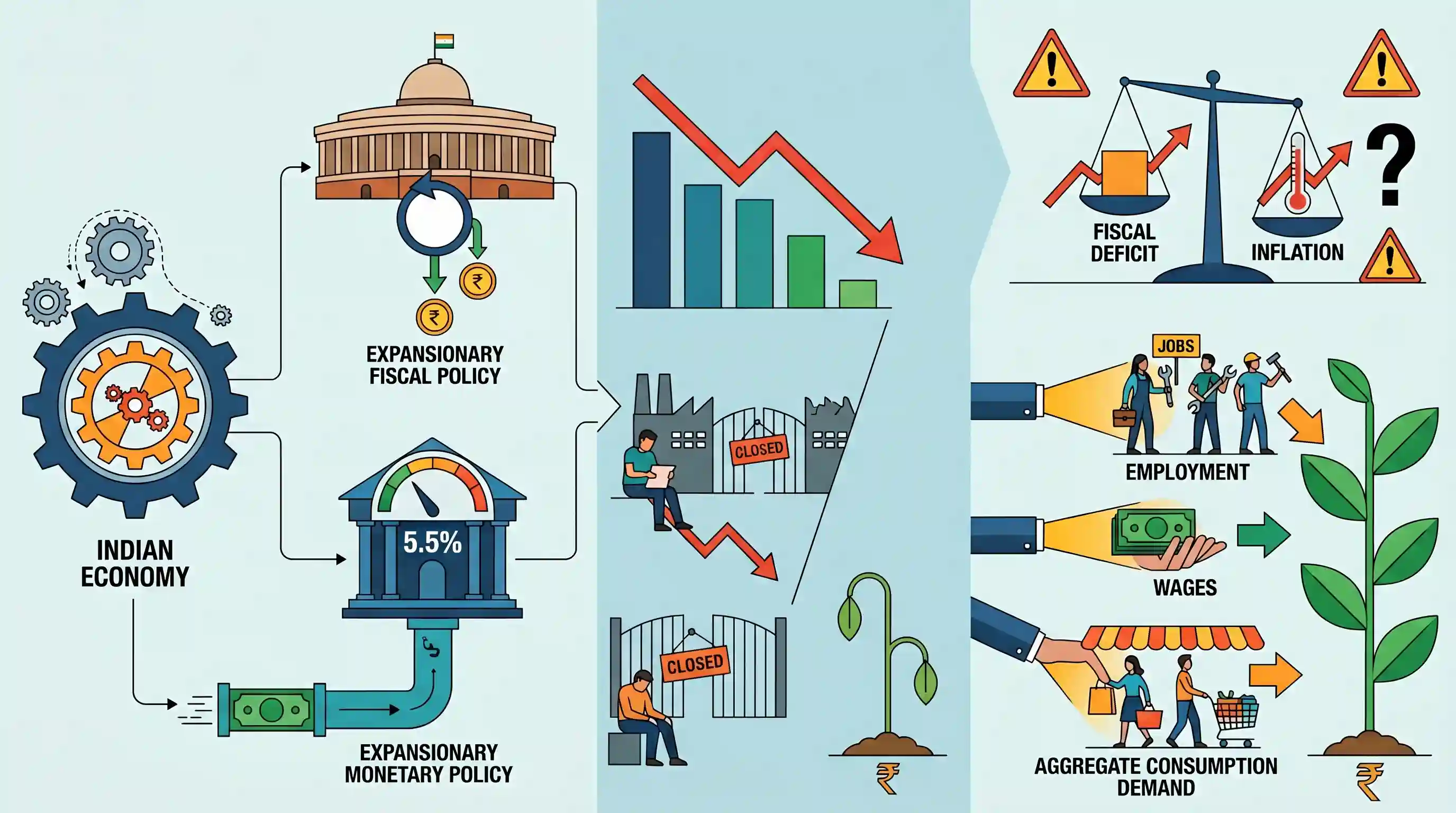
The article analyzes the coordination between India's fiscal and monetary policies amid a pronounced economic slowdown. While the Reserve Bank of India has adopted an expansionary monetary stance by reducing the repo rate to 5.5%, the government has mirrored this with an expansionary fiscal policy through tax cuts. However, these supply-side and liquidity measures have failed to significantly spur growth, as evidenced by plummeting credit growth and rising unemployment. The author warns that simultaneously running expansionary fiscal and monetary policies risks exacerbating the fiscal deficit and triggering inflation if industrial output does not respond adequately. Ultimately, the piece argues that overcoming the slowdown requires targeted government intervention to boost employment, wages, and aggregate consumption demand.
Key Points
- Macroeconomic stability relies heavily on the coordination of both fiscal and monetary policies during an economic slowdown.
- The RBI has pursued an expansionary monetary policy by cutting the repo rate to 5.5% to encourage borrowing and stimulate growth.
- Simultaneously, the government has executed an expansionary fiscal policy through tax cuts, shrinking its revenue base.
- Despite these expansionary measures, credit growth fell to 9% and unemployment rose to 5.6%, indicating weak aggregate demand and risk aversion among banks.
- Pursuing expansionary monetary and fiscal policies concurrently risks widening the fiscal deficit and fueling inflation if production output does not increase to match the expanded money supply.
- The article suggests the economy needs sustained government intervention directed towards generating employment and increasing consumption power to revive aggregate demand.
Important Terms
Fiscal Deficit

The difference between the government's total expenditure and its total receipts (excluding borrowings), indicating the total amount of money the government needs to borrow from the market.
UPSC context
GS Paper 3: Government Budgeting. It is a critical indicator of fiscal health and macroeconomic stability.
Monetary Policy Committee (MPC)
A statutory six-member body, chaired by the RBI Governor, responsible for determining the benchmark interest rate (repo rate) to achieve the inflation target while supporting economic growth.
UPSC context
GS Paper 3: Monetary Policy. Tests knowledge of institutional frameworks for price stability and economic regulation.
Expansionary Fiscal Policy
A policy involving increased government spending or tax reductions to stimulate economic activity and boost GDP growth by increasing aggregate demand during a slowdown.
UPSC context
GS Paper 3: Indian Economy. Relevant for understanding government intervention during recessions or economic stagnation.
Expansionary Monetary Policy
A stance adopted by the central bank to increase the money supply and encourage spending by lowering interest rates and reserve requirements.
UPSC context
GS Paper 3: Monetary Policy. Tests the understanding of how central banks manage liquidity to spur growth.
Repo Rate
The fixed interest rate at which the Reserve Bank of India (RBI) provides short-term liquidity to commercial banks against government securities as collateral.
UPSC context
GS Paper 3: Economic Development. A primary tool for controlling inflation and influencing money supply.
Aggregate Demand
The total value of all finished goods and services demanded by households, businesses, the government, and foreign buyers in an economy at a given price level.
UPSC context
GS Paper 3: Growth and Development. Fundamental for analyzing the effectiveness of fiscal and monetary stimuli.
Prelims Trap
"A reduction in the repo rate by the RBI definitively increases credit growth and investment."
This assumes perfect transmission and ignores the "liquidity trap" scenario, where weak aggregate demand and bank risk aversion block actual lending.
Static Concepts Connected
What is a Liquidity Trap in macroeconomic policy?
- Definition: Interest rates are very low, but consumers and businesses prefer to hold cash, rendering central bank rate cuts ineffective at spurring investment.
- Key Symptoms: Weak aggregate demand, high risk aversion among commercial banks, and flat credit growth despite high systemic liquidity.
- Required Action: Monetary policy loses traction, requiring expansionary fiscal policy—specifically direct government spending—to revive consumption and demand.
How do Supply-side and Demand-side interventions differ during a slowdown?
- Demand-side: Focuses on boosting consumer purchasing power through direct government spending, welfare transfers, or public employment generation.
- Supply-side: Focuses on lowering production costs and incentivizing businesses through measures like corporate tax cuts and regulatory easing.
- Current Context: Supply-side tax cuts often fail during a pronounced slowdown if consumers lack the aggregate demand (income) to absorb increased industrial output.
Cross-Topic Patterns
Monetary Limits & MGNREGA
The failure of rate cuts to spur credit highlights the structural need for direct welfare mechanisms like MGNREGA to revive rural aggregate demand.
Fiscal Deficit & Stagflation
Expanding the fiscal deficit via tax cuts without corresponding output growth risks stagflation—stagnant employment growth coupled with demand-pull inflation.

Expect a 2026 Prelims question testing the failure conditions of expansionary monetary policy (liquidity trap) amid fiscal expansion.
Linked PYQs · 5
Linked PYQs · 5
- 2019PrelimsGS1
Which one of the following is not the most likely measure the Government/RBI takes to stop the slide of Indian rupee?
- 2022PrelimsGS1
In India, which one of the following is responsible for maintaining price stability by controlling inflation?
- 2021PrelimsGS1
Which one of the following is likely to be the most inflationary in its effects?
- 2025PrelimsGS1
Suppose the revenue expenditure is ₹ 80,000 crores and the revenue receipts of the Government are ₹60,000 crores. The Government budget also shows borrowings of ₹ 10,000 crores and interest payments of ₹ 6,000 crores. Which of the following statements are correct? I. Revenue deficit is ₹ 20,000 crores. II. Fiscal deficit is ₹ 10,000 crores. III. Primary deficit is ₹ 4,000 crores. Select the correct answer using the code given below.
- 2023MainsGS3
Most of the unemployment in India is structural in nature. Examine the methodology adopted to compute unemployment in the country and suggest improvements.
