Expanding Tree Cover and Carbon Sinks for India Climate Goals
Source:The Hindu ↗
Why It Matters
Forest conservation and afforestation are recurring themes in UPSC, directly relevant to GS-3 (Environment and Ecology) and GS-1 (Geography). Aspirants must connect tree cover expansion to India's climate commitments (NDCs), carbon sequestration mechanisms, and national initiatives like the Green India Mission and CAMPA.
Summary
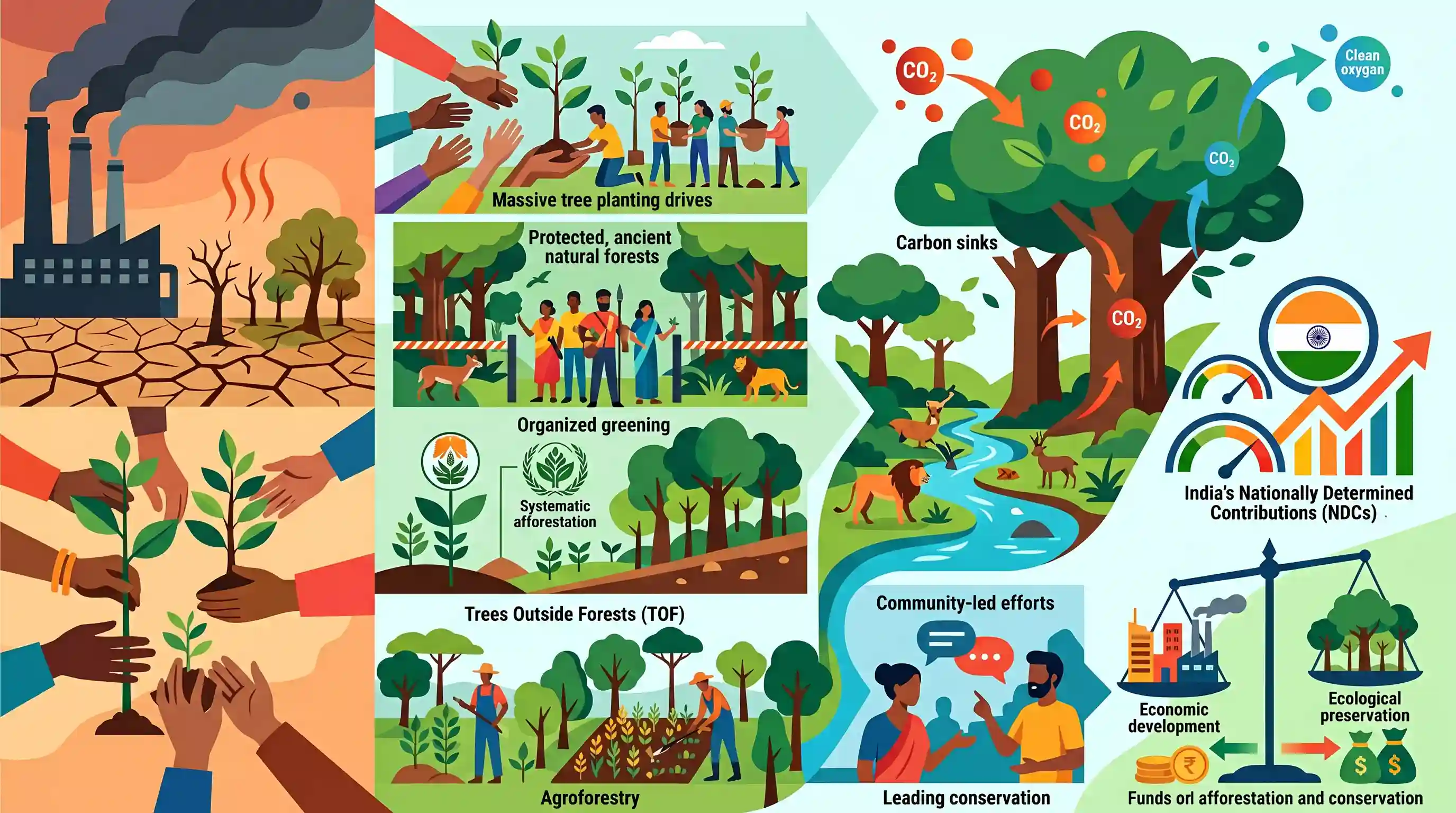
The article underscores the critical necessity of expanding India's tree cover to ensure long-term environmental sustainability and combat climate change. Emphasizing the dual benefits of ecological resilience and climate mitigation, it highlights the importance of creating substantial carbon sinks to meet India's Nationally Determined Contributions (NDCs) under the Paris Agreement. Key strategies include accelerating afforestation drives, protecting existing natural forests, effectively implementing the Green India Mission, and expanding Trees Outside Forests (TOF) through agroforestry. It advocates for community-led conservation efforts and optimal use of compensatory afforestation funds to balance economic development with ecological preservation.
Key Points
- Expanding tree and forest cover is fundamentally required to meet India's ecological security and climate change mitigation targets.
- India has committed to creating an additional carbon sink of 2.5 to 3 billion tonnes of CO2 equivalent by 2030 under its Nationally Determined Contributions (NDCs).
- Initiatives like the National Mission for a Green India (GIM) focus on enhancing diminishing forest cover through a combination of adaptation and mitigation measures.
- Promoting Trees Outside Forests (TOF) and agroforestry are vital strategies for balancing ecological conservation with economic and livelihood opportunities for local communities.
- Adequate funding mechanisms, proper utilization of CAMPA funds, and community participation are necessary to ensure the survival and growth of planted saplings.
Important Terms
Nationally Determined Contributions (NDCs)

Voluntary climate action pledges under the Paris Agreement. India’s targets include reducing emissions intensity and creating an additional carbon sink of 2.5–3 billion tonnes of CO2 equivalent by 2030.
UPSC context
GS Paper III (Environment); tests India’s global climate commitments and progress toward the Net Zero 2070 goal.
Compensatory Afforestation Fund Act (CAMPA)
A 2016 Act establishing funds to manage compensation paid by user agencies for diverting forest land to non-forest purposes. It finances afforestation, wildlife habitat improvement, and forest management.
UPSC context
GS Paper III (Environment); focuses on legal mechanisms for balancing industrial development with ecological restoration.
National Mission for a Green India (GIM)
One of eight missions under India’s National Action Plan on Climate Change (NAPCC). It aims to protect, restore, and enhance forest cover while supporting livelihoods of forest-dependent communities.
UPSC context
GS Paper III (Environment); tests domestic policy frameworks for climate mitigation and social-ecological resilience.
Trees Outside Forests (TOF)
Trees found on lands not officially classified as 'Recorded Forest Areas,' including agroforestry, urban greenery, and private plantations. They are critical for carbon sequestration and industrial timber supply.
UPSC context
GS Paper III (Agriculture/Environment); tests technical metrics in forest reporting and strategies for non-traditional afforestation.
Forest Survey of India (FSI)
An organization under the MoEFCC that periodically assesses India's forest and tree resources. It publishes the biennial 'India State of Forest Report' (ISFR), the nation’s official forest data source.
UPSC context
GS Paper III (Environment); tests understanding of forest classification, remote sensing, and official environmental data monitoring.
Paris Agreement
A 2015 international treaty aiming to limit global temperature rise to well below 2°C. It requires member nations to submit and update NDCs every five years to increase ambition.
UPSC context
GS Paper II & III (International Relations/Environment); tests global climate governance and international treaty obligations.
Prelims Trap
India's NDC under the Paris Agreement mandates achieving exactly 33% forest cover by 2030.
The 33% target is from the National Forest Policy (1988). The Paris NDC target is strictly carbon-based: an additional sink of 2.5–3 billion tonnes of CO2 equivalent.
Static Concepts Connected
What is the Compensatory Afforestation Fund (CAMPA)?
- Origin & Purpose: Formalized by the 2016 Act to manage funds (like Net Present Value) collected when forest land is diverted for non-forest purposes.
- Fund Allocation: 90% of the funds are transferred to State CAMPA authorities, while 10% is retained by the National CAMPA.
- End-use Restrictions: Funds must be used for compensatory afforestation and wildlife management. They cannot be used for administrative expenses, salaries, or vehicles.
What are the key features of the National Mission for a Green India (GIM)?
- Core Mission: It is one of the eight core missions under the National Action Plan on Climate Change (NAPCC).
- Dual Objective: Aims to increase forest/tree cover on 5 million hectares and improve the quality of existing forest cover on another 5 million hectares.
- Holistic Approach: Combines climate adaptation and mitigation, emphasizing decentralized participatory management involving Gram Sabhas and Joint Forest Management Committees.
Cross-Topic Patterns
Agroforestry & Agriculture Mains
Promoting Trees Outside Forests (TOF) intersects with GS3 agricultural diversification, connecting climate mitigation directly to rural livelihood enhancement and alternative farmer income.
Federalism in environmental finance
CAMPA's 90:10 State-Centre fund distribution reflects ecological federalism. However, chronic underutilization by states links environmental policy directly to governance and fiscal capacity debates.
Domestic policy driving international NDCs
India strategically uses legacy domestic frameworks, like the Green India Mission under the NAPCC, to operationalize and achieve its international Paris Agreement commitments.

NDCs, CAMPA fund utilization, and FSI's 'Tree vs Forest Cover' definitions are primed for a complex multi-statement Prelims question in 2026
Linked PYQs · 4
Linked PYQs · 4
- 2016PrelimsGS1
Which of the following best describes/describe the aim of 'Green India Mission' of the Government of India? 1. Incorporating environmental benefits and costs into the Union and State Budgets thereby implementing the 'green accounting' 2. Launching the second green revolution to enhance agricultural output so as to ensure food security to one and all in the future 3. Restoring and enhancing forest cover and responding to climate change by a combination of adaptation and mitigation measures Select the correct answer using the code given below.
- 2023PrelimsGS1
Consider the following activities: 1. Spreading finely ground basalt rock on farmlands extensively 2. Increasing the alkalinity of oceans by adding lime 3. Capturing carbon dioxide released by various industries and pumping it into abandoned subterranean mines in the form of carbonated waters How many of the above activities are often considered and discussed for carbon capture and sequestration?
- 2017PrelimsGS1
In the context of mitigating the impending global warming due to anthropogenic emissions of carbon dioxide, which of the following can be the potential sites for carbon sequestration? 1. Abandoned and uneconomic coal seams 2. Depleted oil and gas reservoirs 3. Subterranean deep saline formations Select the correct answer using the code given below:
- 2021MainsGS3
Describe the major outcomes of the 26th session of the Conference of the Parties (COP) to the United Nations Framework Convention on Climate Change (UNFCCC). What are the commitments made by India in this conference?
