Need for Ecocentric Wildlife Laws in India
Source:The Hindu ↗
Why It Matters
The debate between anthropocentrism and eco-centrism is a core theme in environmental ethics (GS4) and governance. The critique of major environmental laws by the judiciary highlights the need for a cohesive legal philosophy to ensure consistent rulings and better conservation outcomes.
Summary
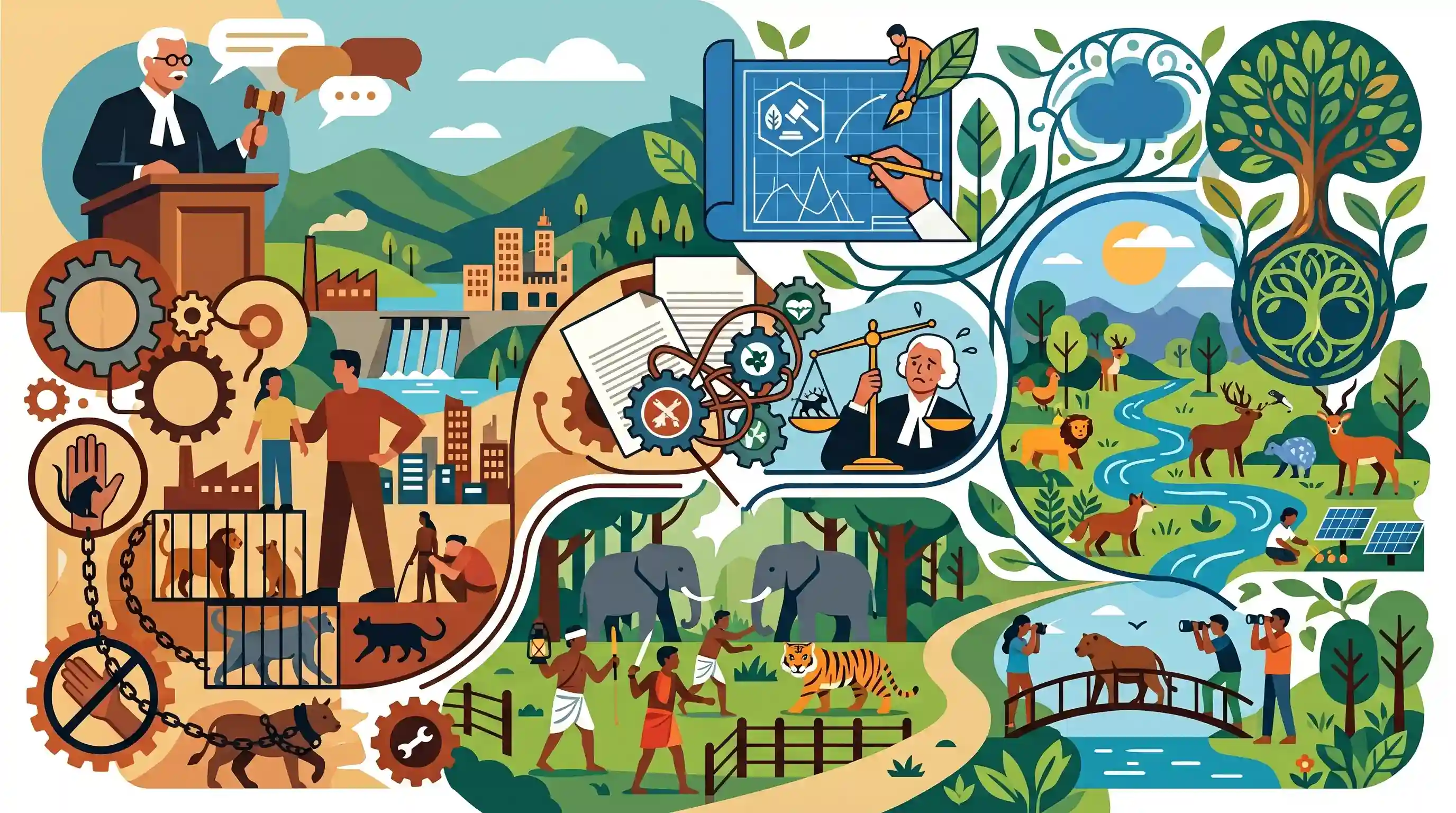
Speaking at the NilgiriScapes Conference, Kerala High Court Justice Jayasankaran Nambiar emphasized the need to transform India's wildlife and animal protection laws from an anthropocentric to an eco-centric philosophical framework. He categorized older laws like the Prevention of Cruelty to Animals Act (1960) and the Wildlife Protection Act (1972) as human-dominated, contrasting them with the eco-centric Biodiversity Act (2002). Addressing the difficulty of interpreting philosophically contradictory laws, he called for comprehensive legislative reimagination. Furthermore, he advocated for understanding wildlife's perspective to resolve ongoing human-animal conflicts.
Key Points
- Kerala High Court Justice Jayasankaran Nambiar argued that India's environmental laws should shift from an anthropocentric (human-centric) to an eco-centric approach for uniform judicial interpretation.
- He highlighted that the Prevention of Cruelty to Animals Act, 1960, and the Wildlife Protection Act, 1972, are anthropocentric, while the Biodiversity Act, 2002, is India's first truly eco-centric legislation.
- He noted that the coexistence of contradictory philosophical approaches (eco-centrism vs. anthropocentrism) in laws leads to divergent judicial interpretations based on individual judges' lived experiences.
- Referencing philosopher Maria Cristina Lugones' concept of 'world travelling,' he emphasized the need to understand 'the other' (wildlife) to effectively mitigate human-animal conflicts.
Important Terms
Wildlife Protection Act, 1972

A landmark 1972 law providing the legal framework for protecting wild animals, birds, and plants. It established protected areas like National Parks and Sanctuaries and categorizes species into schedules based on their conservation status.
UPSC context
GS3: Environment & Conservation. Key for understanding India's legal architecture for biodiversity and species protection.
Biological Diversity Act, 2002
Legislation enacted to meet the UN Convention on Biological Diversity (CBD) goals. It focuses on biodiversity conservation, sustainable resource use, and equitable sharing of benefits with local communities, managed through a three-tier regulatory structure.
UPSC context
GS3: Environment & Biodiversity; GS2: International Treaties. Tests knowledge of sustainable development and community rights.
Ecocentrism
An ethical framework that assigns intrinsic value to all living things and ecosystems regardless of their utility to humans. It shifts focus from human-centric benefit to the preservation of ecological balance and natural systems.
UPSC context
GS4: Environmental Ethics. Essential for discussing the philosophical evolution of environmental jurisprudence and judicial activism.
Prevention of Cruelty to Animals Act, 1960
A 1960 law aimed at preventing 'unnecessary pain or suffering' to animals. It established the Animal Welfare Board of India (AWBI) and regulates animal treatment in transport, experimentation, and entertainment.
UPSC context
GS3: Conservation & Animal Welfare; GS2: Statutory Bodies. Tests understanding of legal safeguards for domestic and captive animals.
Anthropocentrism
A worldview that views humans as the center of the universe and the only entities with intrinsic value. Nature is valued primarily as a resource to be managed for human benefit or survival.
UPSC context
GS4: Ethics. Used to contrast traditional resource-management approaches with modern, sustainable, and eco-centric ethical models.
Human-Wildlife Conflict
Situations where human activities (like agriculture or settlement) overlap with wildlife habitats, leading to negative impacts such as crop damage, livestock loss, or injury/death to both humans and animals.
UPSC context
GS3: Disaster Management & Environment. A critical issue requiring policy intervention and ecological understanding.
Prelims Trap
The Wildlife (Protection) Act, 1972 is India's first purely eco-centric environmental legislation.
While it protects animals, WPA 1972 is philosophically anthropocentric. The Biological Diversity Act (2002) is regarded as India's first truly eco-centric law, recognizing the intrinsic value of ecosystems.
Static Concepts Connected
How does the Indian Constitution mandate environmental and wildlife protection?
- Article 48A (DPSP): Directs the State to protect and improve the environment and to safeguard the forests and wildlife of the country.
- Article 51A(g): Makes it a Fundamental Duty of every citizen to protect the natural environment and have compassion for living creatures.
- Concurrent List: Forests and Protection of Wild Animals and Birds were moved from the State to the Concurrent List via the 42nd Amendment, 1976.
What are the core philosophical approaches in environmental ethics?
- Anthropocentrism: A human-centered approach where nature possesses only instrumental value based on its utility, economic benefit, and usefulness to human beings.
- Ecocentrism: An ecosystem-centered approach recognizing that all living forms, species, and ecosystems possess intrinsic value, entirely independent of their usefulness to humans.
Cross-Topic Patterns
Ethics of Human-Wildlife Conflict
The transition from anthropocentric to eco-centric philosophies offers a strong GS4 case study framework for resolving man-animal conflict, prioritizing empathetic coexistence over culling or strict containment.
Judicial Activism vs. Legislative Lag
The Supreme Court has progressively constitutionalized environmental issues via eco-centric verdicts (e.g., Godavarman case), creating interpretative friction with older, human-dominated laws like the 1960 Cruelty Act.

Expect a GS4 question on eco-centric ethics in wildlife conflict, or Prelims statements contrasting the philosophies of WPA 1972 and BDA 2002.
Linked PYQs · 3
Linked PYQs · 3
- 2022PrelimsGS1
With reference to Indian laws about wildlife protection, consider the following statements : 1. Wild animals are the sole property of the government. 2. When a wild animal is declared protected, such animal is entitled for equal protection whether it is found in protected areas or outside. 3. Apprehension of a protected wild animal becoming a danger to human life is sufficient ground for its capture or killing. Which of the statements given above is/are correct?
- 2015MainsGS4
What is meant by 'environmental ethics'? Why is it important to study? Discuss any one environmental issue from the viewpoint of environmental ethics.
- 2022MainsGS2
“The most significant achievement of modern law in India is the constitutionalization of environmental problems by the Supreme Court.” Discuss this statement with the help of relevant case laws.
