India issues Urgent Advisory for Nationals across West Asia
Source:The Hindu ↗
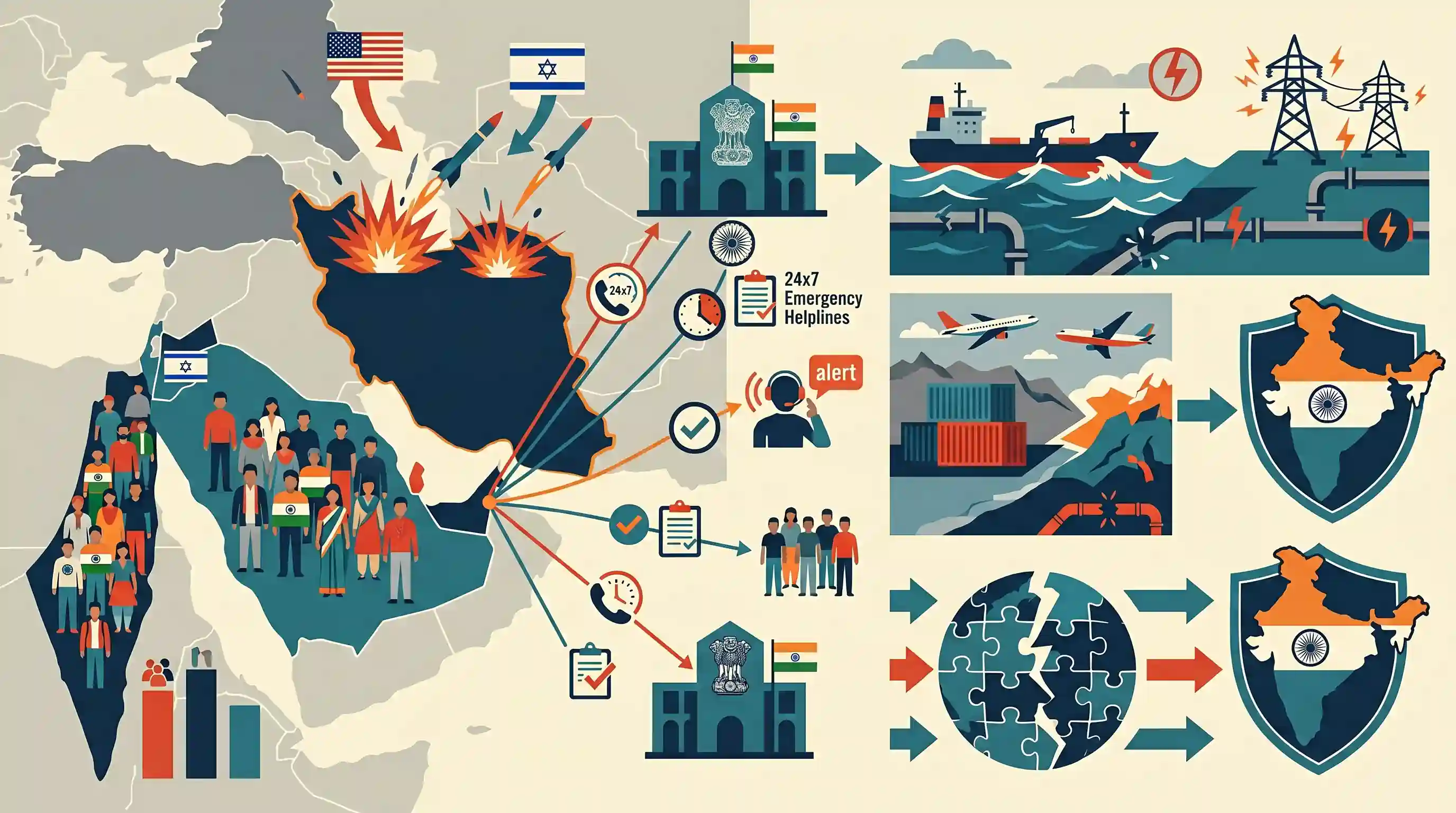
Why It Matters
The safety and well-being of the Indian diaspora in conflict zones are paramount concerns for Indian diplomacy. The Israel-Iran conflict directly affects India's strategic balancing in West Asia, necessitating active crisis management to protect citizens and safeguard broader economic and energy security interests.
Summary
India has issued comprehensive safety advisories to its citizens residing in multiple West Asian countries following a joint preemptive military strike by Israel and the United States against Iran. With over 40,000 Indian nationals in Israel and upwards of 10,000 in Iran, Indian embassies across the region—including in the UAE, Saudi Arabia, Jordan, Bahrain, and Palestine—have activated 24x7 emergency helplines and urged citizens to register for potential assistance. The conflict not only threatens the safety of the Indian diaspora but also raises significant concerns about regional stability and its subsequent impact on India's strategic and energy interests in the Middle East.
Key Points
- The Indian government issued urgent safety advisories for its nationals across West Asia (Israel, Iran, UAE, Saudi Arabia, Jordan, Bahrain, and Palestine) due to escalating conflict.
- The advisories follow a joint preemptive military strike by Israel and the United States on Iran, targeting areas near the Supreme Leader's offices in Tehran.
- Indian citizens, particularly the 40,000+ living in Israel and 10,000+ in Iran, have been urged to register with their embassies, limit non-essential travel, and stay near designated bomb shelters.
- The crisis underscores the vulnerability of the large Indian diaspora in the Middle East and the critical need for proactive diplomatic and evacuation contingencies.
- The escalating geopolitical tensions in West Asia pose significant risks to regional stability, with direct implications for India's strategic interests, including diaspora protection and energy security.
Important Terms
Indian Diaspora

The global community of Non-Resident Indians (NRIs) and Persons of Indian Origin (PIOs). In West Asia, they are a vital source of remittances and a key consular priority during regional conflicts.
UPSC context
GS Paper 2: International Relations; focus on the role of diaspora in Indian foreign policy and their safety in conflict zones.
Home Front Command
An IDF branch responsible for civil defense and civilian safety in Israel. It provides real-time instructions regarding bomb shelters and emergency protocols during missile or drone attacks.
UPSC context
GS Paper 2: International Relations; understanding local security frameworks that impact the safety of the Indian diaspora during crises.
Directorate General of Civil Aviation (DGCA)
India's statutory aviation regulator that oversees safety and airworthiness. It issues travel advisories and flight rerouting orders (NOTAMs) to protect civil aircraft from entering active conflict zones.
UPSC context
GS Paper 3: Infrastructure and Security; role of regulatory bodies in managing civil aviation safety during international geopolitical crises.
West Asia Geopolitics
The complex interplay of political, economic, and military interests in the Middle East. India maintains a 'Strategic Autonomy' approach, balancing ties with rivals like Israel and Iran.
UPSC context
GS Paper 2: Bilateral and regional groupings; focus on India's interests and the effect of foreign policies on national stability.
Strategic Interests
Crucial national objectives including energy security (oil/gas imports), maritime trade through chokepoints like the Strait of Hormuz, and the protection of expatriates in the Middle East.
UPSC context
GS Paper 2/3: Security and International Relations; testing India's vulnerability to global supply chain disruptions and regional instability.
Prelims Trap
Operation Ajay was launched by the Indian government to safely evacuate Indian nationals from Iran.
Operation Ajay was specifically launched to repatriate Indian citizens from Israel, not Iran. UPSC frequently swaps evacuation operation names and destinations to create false statements.
Static Concepts Connected
Which key maritime chokepoints dictate West Asian energy security?
- Strait of Hormuz: Connects the Persian Gulf to the Gulf of Oman. Bordered by Iran, Oman, and the UAE. It is the world's most critical chokepoint for global oil transit.
- Bab-el-Mandeb: Connects the Red Sea to the Gulf of Aden. Bordered by Yemen on the Arabian Peninsula, and Djibouti and Eritrea in Africa.
What are India's key strategic minilateral and connectivity initiatives in West Asia?
- I2U2 Framework: The 'West Asian Quad' comprising India, Israel, UAE, and the US, focusing on joint investments in water, energy, transport, space, health, and food security.
- Chabahar & INSTC: Strategic Iranian port providing India bypass access to Afghanistan/Central Asia, acting as a critical node in the International North-South Transport Corridor (INSTC).
- IMEC Corridor: India-Middle East-Europe Economic Corridor, a massive connectivity project aimed at linking India to Europe via the UAE, Saudi Arabia, Jordan, and Israel.
Cross-Topic Patterns
Diaspora Remittances & Balance of Payments
West Asia accounts for a massive share of India's inward remittances. Conflict-driven mass evacuations threaten this forex inflow, impacting India's Balance of Payments (BoP) and currency stability.
Strait of Hormuz & Imported Inflation
Supply chain disruptions in the Persian Gulf spike Brent crude prices, directly translating into imported inflation, higher subsidy bills, and a widening Current Account Deficit (CAD) for India.

Mains 2026 will likely test the dual impact of West Asian escalation on India's strategic assets (Chabahar) and minilaterals (I2U2).
Linked PYQs · 3
Linked PYQs · 3
- 2023MainsGS2
Indian diaspora has scaled new heights in the West. Describe its economic and political benefits for India.
- 2017MainsGS2
The question of India's Energy Security constitutes the most important part of India's economic progress. Analyze India's energy policy cooperation with West Asian countries.
- 2025MainsGS2
"Energy security constitutes the dominant kingpin of India's foreign policy, and is linked with India's overarching influence in Middle Eastern countries.” How would you integrate energy security with India's foreign policy trajectories in the coming years?
