Pokhran Range Hosts Counter Drone Air Force Exercise Rotor Clap III
Source:gktoday ↗
Why It Matters
Military and airforce exercises held within the geographical limits of Rajasthan (especially at strategic ranges like Pokhran or Mahajan) are high-probability current affairs questions for the RPSC RAS Prelims. Further, counter-drone systems represent emerging defense technologies frequently tested under Science and Technology.
Summary
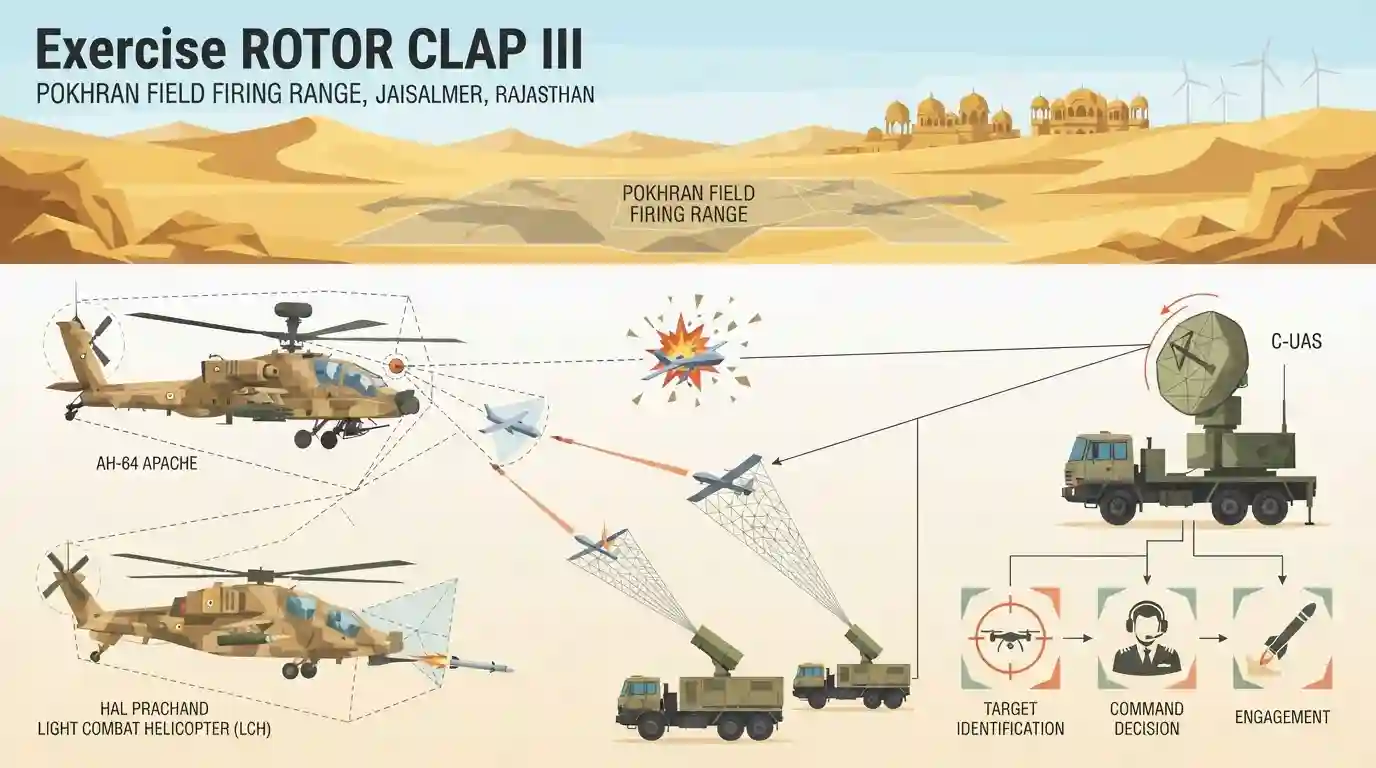
Exercise ROTOR CLAP III was a specialized Indian Air Force military drill held at the Pokhran Field Firing Range in Jaisalmer, Rajasthan. Focused heavily on Counter-Unmanned Aerial Systems (C-UAS) operations, the exercise aimed to enhance rotary-wing combat capabilities against modern drone threats. It saw participation from a variety of advanced and indigenous helicopter platforms including the AH-64 Apache and the HAL Prachand, successfully demonstrating real-time threat detection and live missile firing.
Key Points
- Exercise ROTOR CLAP III was conducted by the Indian Air Force at the Pokhran Field Firing Range in Jaisalmer, Rajasthan on 1-2 August 2026.
- The primary theme of the drill was Counter-Unmanned Aerial Systems (C-UAS), focusing on neutralizing drone and unmanned aerial threats.
- The exercise demonstrated rotary-wing air operations utilizing platforms like AH-64 Apache, HAL Prachand, Mi-25/35, Chinook, Mi-17, and Dhruv helicopters.
- It featured live firing of missiles and guns, validating real-time detection, tracking, and elimination of aerial targets.
Important Terms
Exercise ROTOR CLAP III

A specialized Indian Air Force helicopter exercise focused on countering low-altitude unmanned aerial systems. It validates rotary-wing tactics, real-time threat detection, and live-fire missile engagements against modern drone incursions.
UPSC context
GS Paper 3 (Security). Highlights India's evolving military preparedness against asymmetric aerial threats and drone warfare.
Counter-Unmanned Aerial Systems (C-UAS)
Technologies and tactical methods deployed to detect, track, intercept, and neutralize hostile drones. Systems employ electronic jamming, directed-energy weapons, and kinetic interception to defend against rogue UAVs and drone swarms.
UPSC context
GS Paper 3 (Internal Security). Vital for understanding border management, infrastructure protection, and modern asymmetric warfare tactics.
HAL Prachand
India's first indigenous multi-role Light Combat Helicopter developed by Hindustan Aeronautics Limited. Designed for high-altitude deployment, it features stealth capabilities, advanced armor, and air-to-air/air-to-ground combat systems for extreme terrains.
UPSC context
GS Paper 3 (Indigenization of Technology). A key example of 'Make in India' defense manufacturing and military modernization.
Pokhran Field Firing Range
A major military testing and live-fire practice range located in the Thar Desert, Jaisalmer. Historically significant as the site of India's 1974 and 1998 nuclear tests, it hosts advanced military drills.
UPSC context
GS Prelims & Paper 3. Important for mapping questions and recognizing key strategic military installations in India.
AH-64 Apache
An advanced multi-role attack helicopter renowned for its close air support and anti-armor capabilities. The IAF utilizes these heavily armed platforms for high-intensity precision strikes and integrated combat operations.
UPSC context
GS Paper 3 (Defence). Relevant to India's military capabilities, strategic defense acquisitions, and operational readiness.
Prelims Trap
Exercise ROTOR CLAP III is a bilateral military drill between the Indian Air Force and the US Air Force.
It is an entirely domestic Indian Air Force exercise. UPSC often uses foreign-sounding exercise names to trick aspirants into marking them as bilateral drills.
Static Concepts Connected
What are the unique capabilities of the HAL Prachand helicopter?
- Indigenous LCH: India's first indigenously designed and developed multi-role Light Combat Helicopter (LCH), reflecting major progress in defense indigenization.
- High Altitude: It holds the record as the world's only attack helicopter capable of taking off and landing at altitudes exceeding 5,000 meters.
How do Counter-UAS (C-UAS) defense systems neutralize threats?
- Soft-kill methods: Non-kinetic mitigation of drones using electronic warfare, such as GPS spoofing, radio-frequency jamming, and cyber-takeovers.
- Hard-kill methods: Physical destruction of hostile drones using kinetic weapons like anti-aircraft guns, laser systems, missiles, or specialized capture nets.
Cross-Topic Patterns
C-UAS tech & Border Security
Countering rogue drones dropping narcotics and arms in border states makes C-UAS capabilities a vital internal security priority, linking IAF tech to border management.
High-Altitude Warfare & Indigenization
Deploying the HAL Prachand addresses India's unique high-altitude security needs along the LAC, highlighting self-reliance in extreme-terrain defense tech.

UPSC 2026 may test C-UAS tech (soft vs hard kill) matched with indigenous platforms like HAL Prachand in a multi-statement Prelims question.
Linked PYQs · 4
Linked PYQs · 4
- 2024RPSC_PRELIMSGS1
Which of the following group of districts/cities of Rajasthan are arranged in ascending order as per their distance from the border with Pakistan?
- 2025RPSC_PRELIMSGS1
What is the name of the human portable air defense system developed by DRDO to neutralize air threats?
- 2016RPSC_PRELIMSGS1
Which of the following aircraft of the Indian Air Force performs the air-to-air refueling function?
- 2024RPSC_PRELIMSGS1
Which of the following is NOT capable of: (i) Akash-NG (ii) QRSAM (iii) Pralay (iv) THOSAND
