Deployment of School Teachers for Non Academic Election Duties
Source:Indian Express ↗
Why It Matters
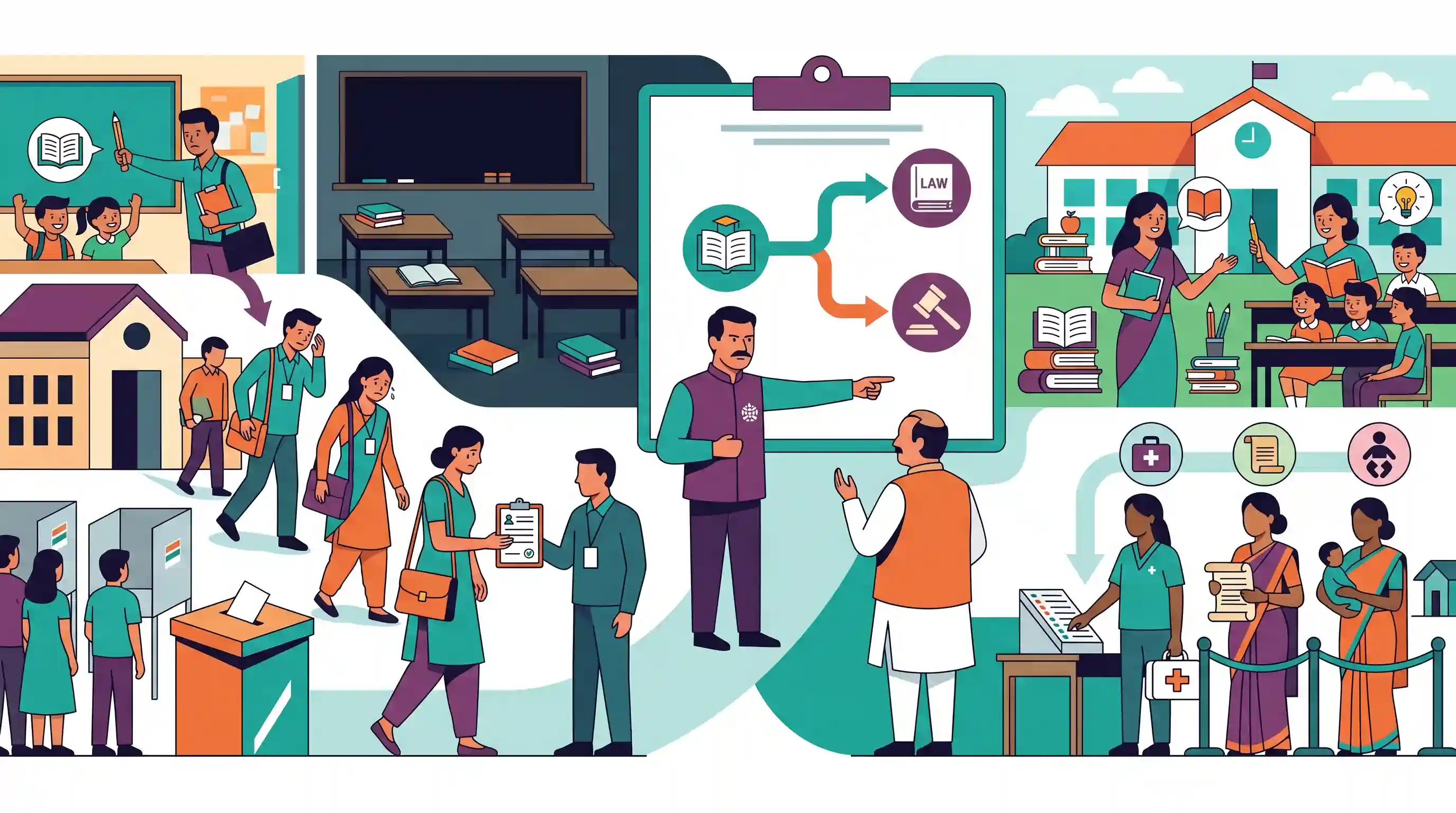
The deployment of teachers for non-academic duties like election work is a recurring administrative issue that pits the mandate of conducting elections against the fundamental right to education. It highlights the real-world governance challenges in human resource allocation and the effective implementation of the RTE Act.
Summary
Maharashtra's School Education Minister Dada Bhuse has urged Deputy Chief Minister Devendra Fadnavis to exempt school teachers from Block Level Officer (BLO) and other election-related duties. Bhuse highlighted that assigning these non-academic responsibilities to teachers adversely affects the quality of education and leads to academic loss for students. While Section 27 of the Right to Education (RTE) Act allows the deployment of teachers for census, disaster relief, and election duties, their primary mandate remains teaching. The minister proposed utilizing manpower from other government departments, such as Anganwadi workers, Talathis, gram sevaks, and health workers, to fulfill election machinery requirements without compromising educational objectives.
Key Points
- Maharashtra School Education Minister requested the CM to relieve teachers from BLO and election duties to prevent academic loss.
- The Right to Education (RTE) Act emphasizes teaching as the primary duty of teachers, though it legally permits their deployment for census, disaster relief, and election duties.
- Assigning non-academic responsibilities to teachers has been criticized for impacting the quality of education and causing syllabus delays.
- The minister recommended utilizing alternative personnel such as Anganwadi workers, ASHA workers, Talathis, and gram sevaks for election-related tasks.
Important Terms
Right to Education (RTE) Act, 2009

Enacted under Article 21A, it mandates free and compulsory education for children aged 6–14. It outlines standards for school infrastructure, teacher-pupil ratios, and prohibits non-academic work for teachers.
UPSC context
GS Paper 2: Social Justice and Education. Tests understanding of fundamental rights and statutory governance in human development.
Section 27 of RTE Act
A specific clause in the RTE Act that prohibits the deployment of teachers for non-educational work, except for decennial census, disaster relief, and duties related to local, state, or national elections.
UPSC context
GS Paper 2: Governance/Education. Crucial for discussing the balance between administrative needs and educational quality.
Booth Level Officer (BLO)
A grassroots-level official, typically a local government employee, appointed by the Election Commission to maintain accurate electoral rolls and facilitate voter registration at the polling station level.
UPSC context
GS Paper 2: Election Process. Tests knowledge of the decentralized administrative machinery used for democratic exercises.
Election Commission of India (ECI)
An autonomous constitutional body established under Article 324, responsible for administering election processes in India at the union and state levels, including the requisitioning of public staff for duties.
UPSC context
GS Paper 2: Constitutional Bodies. Essential for understanding the management of free and fair elections.
Anganwadi Workers
Community-based frontline workers under the Integrated Child Development Services (ICDS) who provide basic healthcare, nutrition, and pre-school education in rural and urban slum areas.
UPSC context
GS Paper 2: Welfare Schemes and Social Justice. Relates to the role of community workers in rural administration.
Prelims Trap
The RTE Act strictly prohibits the deployment of teachers for any non-educational purposes including elections.
Section 27 of the RTE Act explicitly permits deploying teachers for three non-educational tasks: the decennial population census, disaster relief, and election duties.
Static Concepts Connected
What non-academic duties can teachers perform under the RTE Act, 2009?
- General prohibition: Section 27 prohibits the deployment of teachers for non-educational purposes to protect academic continuity.
- Statutory exceptions: The Act explicitly lists only three exceptions: decennial population census, disaster relief duties, and duties relating to elections.
- Judicial safeguard: The Supreme Court (St. Mary's School case) ruled that election duty shouldn't disrupt active teaching days and hours.
How does the Election Commission requisition staff for election duties?
- Statutory backing: Section 159 of the Representation of the People Act, 1951 grants the legal mandate to requisition staff.
- Obligated bodies: Staff can be drafted from local authorities, universities, and government-funded companies, who are legally obligated to comply.
- Grassroots execution: Booth Level Officers (BLOs) are appointed under Section 13B(2) of RoPA 1950 to update electoral rolls at the booth level.
Cross-Topic Patterns
Balancing Article 324 and Article 21A
The friction between the EC's mandate to conduct elections (Article 324) and the fundamental right to education (Article 21A) highlights the structural shortage of dedicated administrative cadres at the grassroots.
Overburdening parallel grassroots cadres
Shifting BLO duties from teachers to ASHA or Anganwadi workers risks overburdening an already underpaid 'volunteer' workforce, threatening primary healthcare and ICDS nutrition targets.

Expect a 2026 Prelims question testing the exact statutory exceptions under RTE Act Section 27 alongside EC's requisition powers.
Linked PYQs · 2
Linked PYQs · 2
- 2018PrelimsGS1
Consider the following statements: 1. As per the Right to Education (RTE) Act, to be eligible for appointment as a teacher in a State, a person would be required to possess the minimum qualification laid down by the concerned State Council of Teacher Education. 2. As per the RTE Act, for teaching primary classes, a candidate is required to pass a Teacher Eligibility Test conducted in accordance with the National Council of Teacher Education guidelines. 3. In India, more than 90% of teacher education institutions are directly under the State Governments. Which of the statements given above is/are correct?
- 2022MainsGS2
The Right of Children to Free and Compulsory Education Act, 2009 remains inadequate in promoting incentive-based system for children's education without generating awareness about the importance of schooling. Analyse.
