Agricultural Equipment GST Exemption and Farmers Demands
Source:The Hindu ↗
Why It Matters
It highlights the ongoing grassroots concerns of Indian farmers regarding the dual burden of high input costs (taxation on equipment) and inadequate remunerative prices (MSP). It also draws attention to the critical need for robust post-harvest infrastructure and sustainable water management practices to secure agricultural livelihoods.
Summary
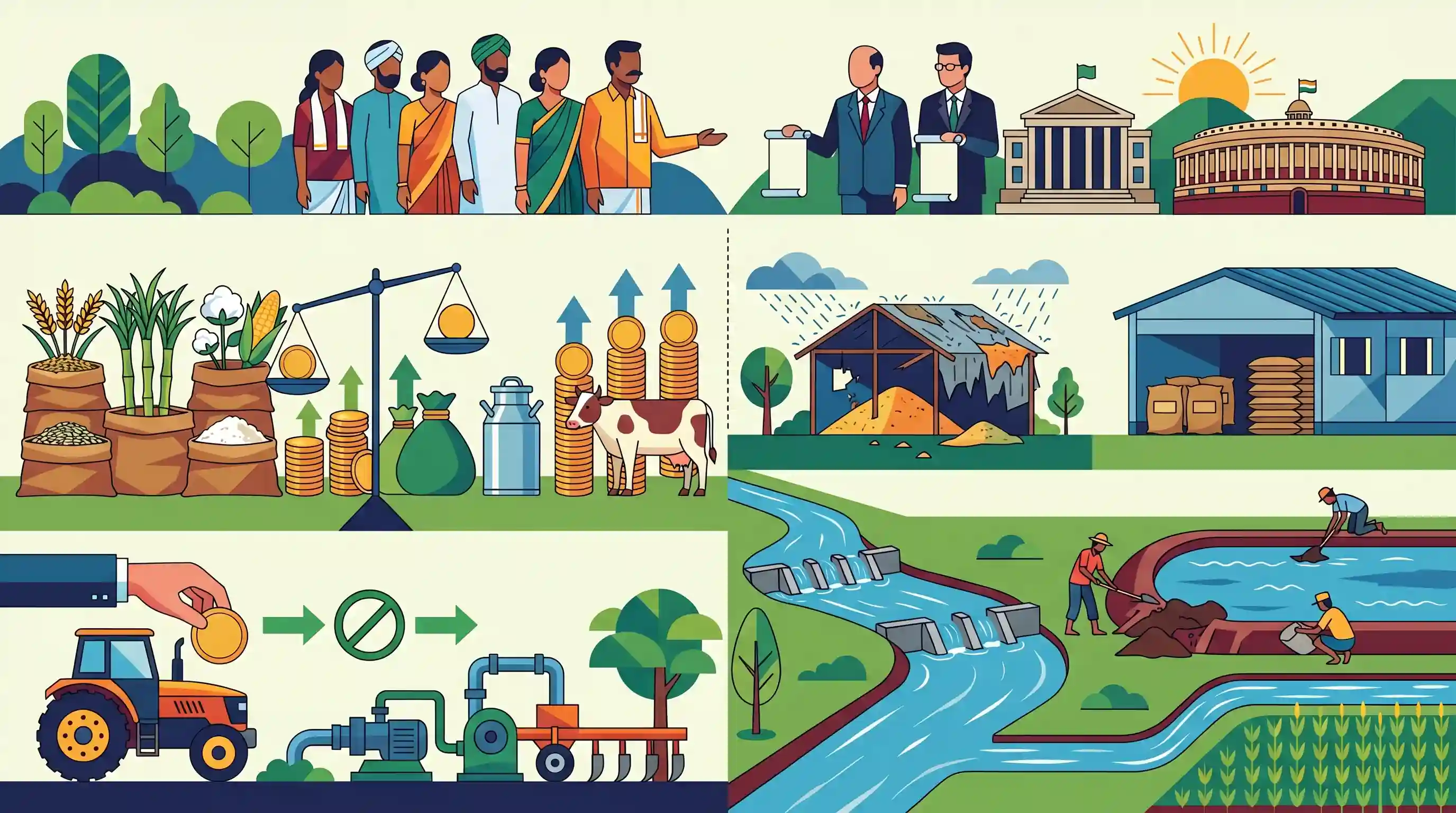
A farmers' association in Tiruchirapalli, Tamil Nadu, has appealed to the State and Union governments to address several pressing agricultural challenges. The primary demands include exempting farm machinery from GST to reduce input costs and substantially increasing the Minimum Support Price (MSP) for key crops like paddy, sugarcane, cotton, and maize. The association also called for higher milk procurement prices, permanent infrastructure at Direct Purchase Centres to prevent crop spoilage during monsoons, and extensive water conservation measures, including the construction of check dams and the rejuvenation of water bodies across the state.
Key Points
- A farmers' association in Tamil Nadu has urged the government to exempt essential agricultural equipment, such as tractors and power tillers, from GST and SGST.
- The association demanded a significant increase in the Minimum Support Price (MSP) for paddy (₹3,500/quintal), sugarcane (₹4,500/tonne), cotton (₹12,000/quintal), and maize (₹3,000/quintal).
- They also sought an increase in the procurement price of milk to support dairy farmers.
- A key infrastructure demand includes establishing permanent structures at Direct Purchase Centres to protect harvested paddy from rain.
- The farmers emphasized the need for better water conservation by constructing check dams across major rivers and rejuvenating all water bodies for rainwater harvesting.
Important Terms
Minimum Support Price (MSP)

A guaranteed price from the government for specific crops, protecting farmers against sharp price drops. It is recommended by the CACP and approved by the CCEA.
UPSC context
GS III: Agriculture/Economic Development. Tests understanding of farm subsidies, price volatility, and food security mechanisms.
Goods and Services Tax (GST)
A comprehensive, multi-stage, destination-based indirect tax that replaced most other indirect taxes in India to create a unified national market.
UPSC context
GS III: Indian Economy. Tests knowledge of fiscal policy, indirect tax reforms, and impact on sector-specific input costs.
Direct Purchase Centres (DPC)
State-operated hubs (like those under TNCSC in Tamil Nadu) where farmers sell produce directly to the government at MSP, bypassing middlemen and syndicates.
UPSC context
GS III: Marketing of agricultural produce. Tests knowledge of procurement systems, supply chain bottlenecks, and infrastructure needs.
Check Dams
Small, often temporary barriers constructed across streams or drainage ditches to slow water velocity, reduce soil erosion, and enhance groundwater recharge.
UPSC context
GS I/III: Geography/Environment. Tests awareness of water conservation techniques, watershed management, and drought-proofing in agriculture.
Pressure Groups
Organizations that attempt to influence public policy and government decisions without seeking to hold political office themselves, often representing specific sectoral interests like agriculture.
UPSC context
GS II: Polity. Tests the role of formal/informal associations and their impact on the democratic policy-making process.
Prelims Trap
"Agricultural machinery like tractors and power tillers are entirely exempted from GST to lower farm input costs."
False. Essential farm machinery (like tractors) falls under the 5% or 12% GST slabs. Total exemption breaks the input tax credit (ITC) chain.
Static Concepts Connected
How does sugarcane pricing (FRP/SAP) differ from standard MSP?
- FRP vs MSP: The Centre announces a Fair and Remunerative Price (FRP) based on CACP recommendations, not an MSP.
- State Advised Price: Major producing states announce a State Advised Price (SAP), which is legally binding on mills and generally higher than the central FRP.
- Statutory Backing: FRP is statutorily governed by the Sugarcane (Control) Order, 1966, under the Essential Commodities Act.
What role do check dams play in watershed management?
- Velocity Reduction: They are constructed across drainage channels to slow down surface water runoff and significantly reduce topsoil erosion.
- Groundwater Recharge: The temporarily impounded water facilitates percolation, acting as an artificial recharge mechanism for depleted groundwater aquifers.
Cross-Topic Patterns
GST structure & agricultural input costs
Demands for zero-rating farm equipment clash with GST Council mechanics. Complete exemptions break the Input Tax Credit (ITC) chain, which can perversely increase final costs due to embedded taxes on raw materials.
Climate anomalies & post-harvest infrastructure
Unseasonal rainfall frequently destroys procured paddy at temporary Direct Purchase Centres. This directly connects climate change unpredictability with critical agricultural supply chain and infrastructure deficits.

Expect a Prelims 2026 multi-statement question contrasting MSP for crops, FRP for sugarcane, and state/cooperative pricing models for milk.
Linked PYQs · 5
Linked PYQs · 5
- 2018MainsGS3
What do you mean by Minimum Support Price (MSP)? How will MSP rescue the farmers from the low income trap?
- 2019MainsGS3
Enumerate the indirect taxes which have been subsumed in the Goods and Services Tax (GST) in India. Also, comment on the revenue implications of the GST introduced in India since July 2017.
- 2020PrelimsGS1
Consider the following statements: 1. In the case of all cereals, pulses and oil-seeds, the procurement at Minimum Support Price (MSP) is unlimited in any State/UT of India. 2. In the case of cereals and pulses, the MSP is fixed in any State/UT at a level to which the market price will never rise. Which of the statements given above is/are correct?
- 2020PrelimsGS1
Which of the following factors/policies were affecting the price of rice in India in the recent past? 1. Minimum Support Price 2. Government's trading 3. Government's stockpiling 4. Consumer subsidies Select the correct answer using the code given below:
- 2018MainsGS1
The ideal solution of depleting ground water resources in India is water harvesting system." How can it be made effective in urban areas?
