Uttar Pradesh Economy Growth Rate and USD 1 Trillion Target
Source:indiatoday ↗
Why It Matters
Uttar Pradesh is India's most populous state and its economic transformation plays a critical role in national development goals. For UPPSC PCS Prelims, specific state-level economic indicators, ranking improvements, budget profiles, and flagship schemes like ODOP are highly frequent sources of direct questions.
Summary
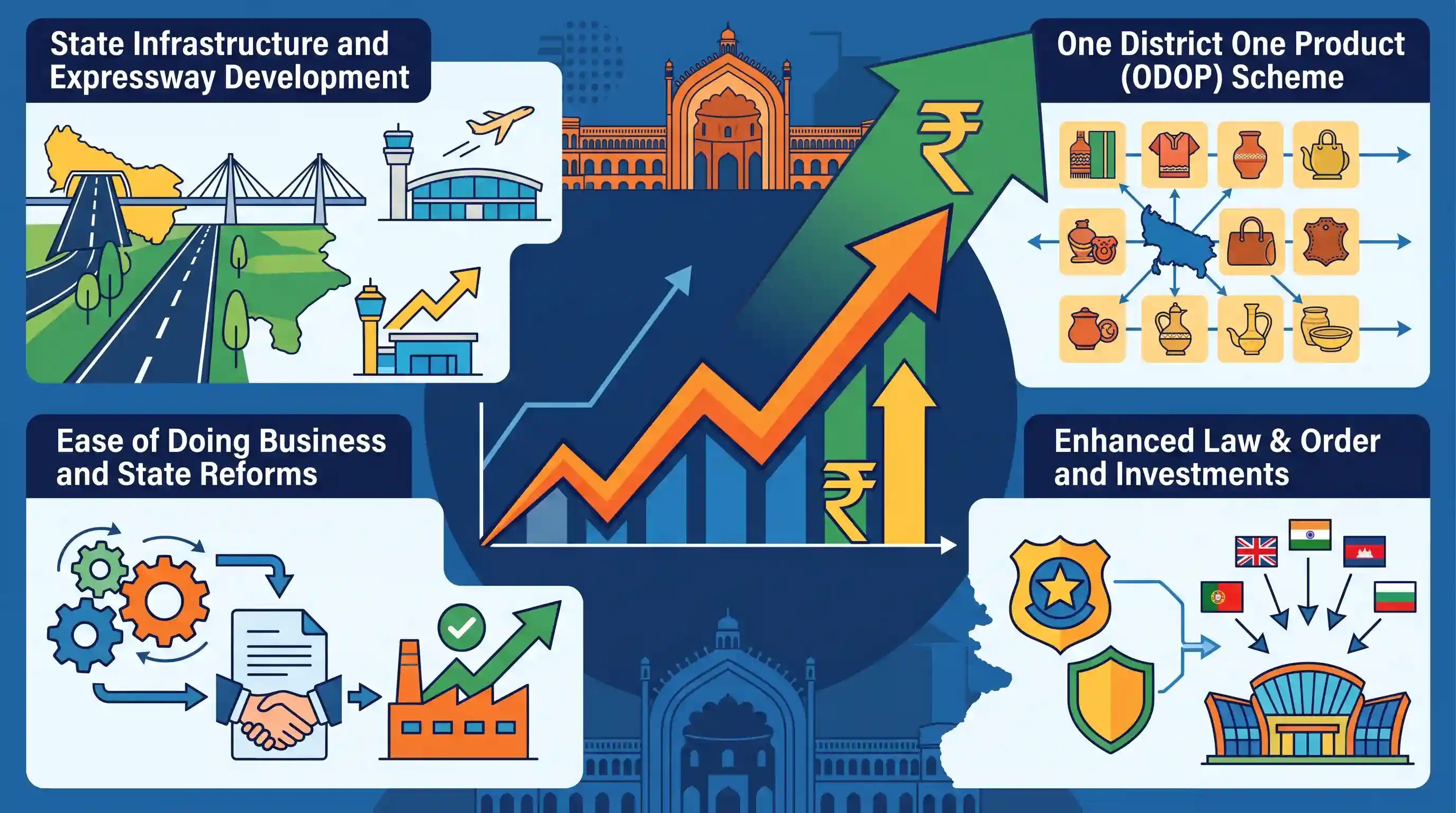
Uttar Pradesh Chief Minister Yogi Adityanath highlighted that the state's economy experienced a massive three-fold rise under the 'double engine' BJP government. Key structural reforms, enhanced law and order, large-scale infrastructure projects (such as expressways and airports), the UP Global Investors Summit, and the One District One Product (ODOP) scheme have catapulted Uttar Pradesh to become the second-largest state economy in India, on track to achieve a target of USD 1 trillion.
Key Points
- CM Yogi Adityanath asserted that Uttar Pradesh's economy witnessed a near three-fold nominal rise under the 'double engine' BJP government.
- Uttar Pradesh has risen to become India's second-largest state economy in terms of share in national Gross Domestic Product (GDP).
- The state is actively pursuing an ambitious economic roadmap to become a USD 1 trillion economy by 2027, complementing India's national growth targets.
- Key growth drivers include industrial corridors, massive infrastructure such as being the 'Expressway State', high Ease of Doing Business rankings (rising from 14th to 2nd), and the flagship One District One Product (ODOP) scheme.
Important Terms
One District One Product (ODOP)

A flagship government scheme (initiated by UP in 2018) identifying and promoting a unique product from each district to foster local crafts, boost rural entrepreneurship, and drive balanced regional growth.
UPSC context
GS Paper II & III: Government schemes and regional development; tests policy implementation and micro-enterprise promotion.
Business Reform Action Plan (BRAP)
An annual ranking and reform framework by the DPIIT that assesses Indian states and UTs based on their implementation of reforms enhancing Ease of Doing Business.
UPSC context
GS Paper III: Ease of doing business and federalism; tests knowledge of sub-national regulatory reforms and competitive federalism.
NITI Aayog
A premier policy think tank of the Indian government, established in 2015 to replace the Planning Commission, designed to foster cooperative federalism and design long-term strategic policies.
UPSC context
GS Paper II: Statutory, regulatory and quasi-judicial bodies; tests understanding of planning mechanisms and federal policy-making.
UP Global Investors Summit (UPGIS)
A flagship investment summit hosted by the Uttar Pradesh government to showcase industrial opportunities and attract global investments, aligned with its target of becoming a USD 1 trillion economy.
UPSC context
GS Paper III: Investment models and state-level economic growth; tests strategies for sub-national industrialization and infrastructure development.
Prelims Trap
The Business Reform Action Plan (BRAP) state rankings are formulated and released annually by NITI Aayog.
While NITI Aayog ranks states on many indices, the BRAP (Ease of Doing Business) is released by DPIIT under the Ministry of Commerce and Industry.
Static Concepts Connected
What is the Business Reform Action Plan (BRAP) framework?
- Nodal Authority: Spearheaded by the Department for Promotion of Industry and Internal Trade (DPIIT) under the Ministry of Commerce and Industry.
- Reform Areas: Evaluates states based on regulatory parameters like single-window systems, labor reforms, tax payments, and property registration.
- Dynamic Classification: Ranks states under performance bands like 'Top Achievers' and 'Achievers' to foster healthy competitive federalism.
How does NITI Aayog's Aspirational Districts Programme (ADP) function?
- Core Philosophy: Driven by the '3 Cs'—Convergence of schemes, Collaboration between administrations, and Competition among districts to drive development.
- Core Sectors: Focuses on 49 indicators across 5 areas: Health, Education, Agriculture, Financial Inclusion, and Basic Infrastructure.
- Real-time Tracking: Monitored via NITI Aayog's 'Champions of Change' dashboard, enabling transparent, data-driven local administration.
Cross-Topic Patterns
Cooperative Federalism vs. Competitive Fiscalism
Sub-national competitive federalism, visible in states setting independent $1-trillion targets, shifts regional development from central grants dependency to aggressive investment-destination marketing.
ODOP & WTO subsidy compliance
By structuring ODOP around localized GI tags and traditional crafts, India fosters decentralized export promotion without attracting WTO actionable subsidy disputes.

Expect a comparison of state-level single-window systems (e.g., Nivesh Mitra) and the National Single Window System (NSWS) in 2026.
Linked PYQs · 4
Linked PYQs · 4
- 2022UPPSC_PRELIMSGS1
With reference to Budget of Uttar Pradesh for the Financial Year 2020 - 21, which of the following statement(s) is/are true ? 1. The size of the budget was Rs. 5,12,860.72 crores. 2. Certain new schemes were also included in this budget amounting to Rs. 10,967.87 crores. Select the correct answer from the code given below.
- 2025UPPSC_PRELIMSGS1
As per the One District One Product (ODOP) scheme of Uttar Pradesh, Moonj products are associated with which of the following districts? 1. Amethi 2. Sultanpur 3. Sant Kabir Nagar Select the correct answer from the code given below:
- 2022UPPSC_PRELIMSGS1
On the basis of 'one district one product' programme in Uttar Pradesh, which one of the following pairs is NOT correctly matched ?
- 2020UPPSC_PRELIMSGS1
When is India expected to achieve the target of becoming the 5th largest dollar economy?
