Lothal Archaeological Site: Field Safety and Institutional Norms
Source:Indian Express ↗
Why It Matters
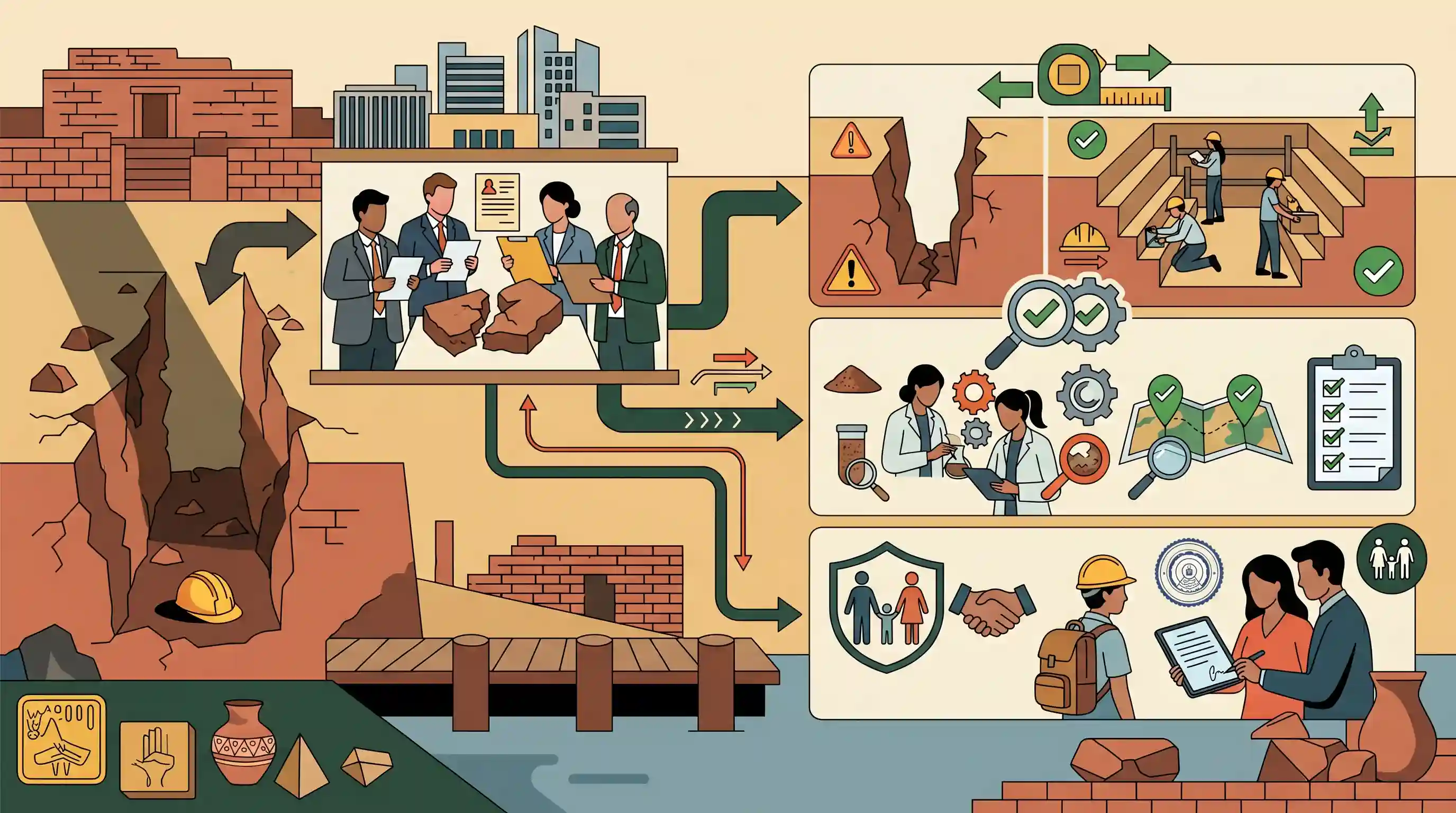
This incident brings attention to the often-overlooked aspect of workplace safety and occupational hazards in academic fieldwork and archaeological excavations. It intersects GS1 (Harappan sites like Lothal), GS3 (hazard mitigation and safety protocols), and GS4 (institutional responsibility and ethical duty of care towards students).
Summary
An IIT Delhi probe panel has proposed new safety guidelines and Standard Operating Procedures (SOPs) following the tragic death of a PhD scholar in a trench collapse at the Lothal archaeological site. The recommendations focus on enhancing occupational safety during academic field visits by mandating wider trench designs, rigorous site selection procedures, and mandatory parental consent prior to fieldwork. The incident highlights the critical need for institutional accountability and robust disaster mitigation protocols in academic and archaeological field research.
Key Points
- An IIT Delhi probe panel was constituted to investigate the death of a PhD scholar caused by a trench collapse at the Lothal archaeological excavation site.
- The panel recommended the formulation of strict Standard Operating Procedures (SOPs) to ensure the safety of researchers during field visits.
- Key safety recommendations include designing wider trenches to prevent structural collapses during excavations.
- The panel also proposed making parental consent mandatory before students undertake field visits.
- Enhanced site selection procedures and prior hazard assessments were emphasized to prevent future occupational tragedies.
Important Terms
Lothal

A major port city of the Indus Valley Civilization located in Gujarat. It features the world’s earliest known artificial dockyard, a bead-making industry, and advanced urban planning.
UPSC context
GS Paper 1: Ancient History/Culture. Tests knowledge of Harappan urban planning, maritime trade, and archaeological discoveries.
Archaeological Survey of India (ASI)
The premier government agency under the Ministry of Culture responsible for archaeological research and heritage conservation. It regulates all excavations under the Ancient Monuments and Archaeological Sites and Remains Act.
UPSC context
GS Paper 1: Heritage Management; GS Paper 2: Statutory Bodies. Tests understanding of cultural conservation frameworks and institutional roles.
Standard Operating Procedures (SOPs)
Standardized, step-by-step instructions for routine operations. In field research, they mandate safety protocols such as trench-widening, soil stability checks, and shoring to prevent occupational hazards and mishaps.
UPSC context
GS Paper 3: Disaster Management/Occupational Safety. Tests administrative accountability and risk mitigation in hazardous research environments.
Paleoclimatology
The scientific study of past climates using geological proxies like soil layers, sediments, and tree rings. It provides insights into how environmental shifts influenced the rise and fall of civilizations.
UPSC context
GS Paper 3: Science & Technology/Environment. Tests awareness of climate research methods and historical ecological impacts.
Bharatiya Nyaya Sanhita (BNS)
The primary criminal code of India that replaced the Indian Penal Code (IPC) in 2024. It governs offenses, including causing death by negligence (Section 106) and endangering life.
UPSC context
GS Paper 2: Governance/Judiciary. Tests understanding of recent legal reforms and the framework of India’s criminal justice system.
Prelims Trap
Lothal was the exclusive and only port city of the Indus Valley Civilization.
While Lothal is the most famous for its artificial dockyard, other sites like Sutkagen Dor, Balakot, and Allahdino also served as IVC port or coastal trading nodes.
Static Concepts Connected
What are the distinct archaeological findings unique to Lothal?
- Artificial Dockyard: Features the world's earliest known artificial dockyard, previously connected to the Sabarmati river system.
- Trade Hub Artifacts: Evidence of a bead-making factory and the discovery of a Persian Gulf seal indicate robust overseas trade.
- Unique Town Planning: Unlike other IVC sites, its citadel and lower town were not separated by an internal wall.
- Agriculture & Burials: One of the rare IVC sites showing evidence of rice cultivation (rice husks) and double burials.
How are archaeological excavations legally regulated in India?
- AMASR Act: Governed by the Ancient Monuments and Archaeological Sites and Remains (AMASR) Act, 1958.
- ASI Licensing: The Archaeological Survey of India (ASI) grants licenses to universities, research bodies, and state departments to conduct field excavations.
- Safety Void: Traditionally focused on antiquities preservation rather than explicit occupational safety, which is why academic institutions are now drafting internal SOPs.
Cross-Topic Patterns
IVC decline & paleo-climate
Lothal's excavation highlights how Harappan urban centers adapted to shifting river courses (Bhogava) and eventually declined due to climatic shifts, linking ancient history with geography.
Institutional ethics and occupational hazards
The IIT Delhi probe links GS4 (institutional accountability) and GS3 (disaster mitigation), shifting the occupational hazard focus from industrial labor to academic field research.

Expect a match-the-following Prelims question pairing IVC sites (Lothal, Dholavira, Rakhigarhi) with their unique architectural findings.
Linked PYQs · 5
Linked PYQs · 5
- 2019PrelimsGS1
Which one of the following is not a Harappan site?
- 2025MainsGS1
Discuss the salient features of the Harappan architecture.
- 2014MainsGS1
To what extent has the urban planning and culture of the Indus Valley Civilization provided inputs to the present day urbanization? Discuss.
- 2024MainsGS4
“Ethics encompasses several key dimensions that are crucial in guiding individuals and organizations towards morally responsible behaviour.” Explain the key dimensions of ethics that influence human actions. Discuss how these dimensions shape ethical decision-making in the professional context.
- 2019MainsGS3
Vulnerability is an essential element for defining disaster impacts and its threat to people. How and in what ways can vulnerability to disasters be characterized? Discuss different types of vulnerability with reference to disasters.
