Goa Police seeks delegation of National Security Act powers to DMs
Source:Indian Express ↗
Why It Matters
The National Security Act and preventive detention laws are recurring themes in UPSC, testing the balance between fundamental rights (like Article 22) and the state's duty to maintain internal security. Understanding the administrative delegation of these powers to District Magistrates is relevant for both Polity (GS2) and Security (GS3).
Summary
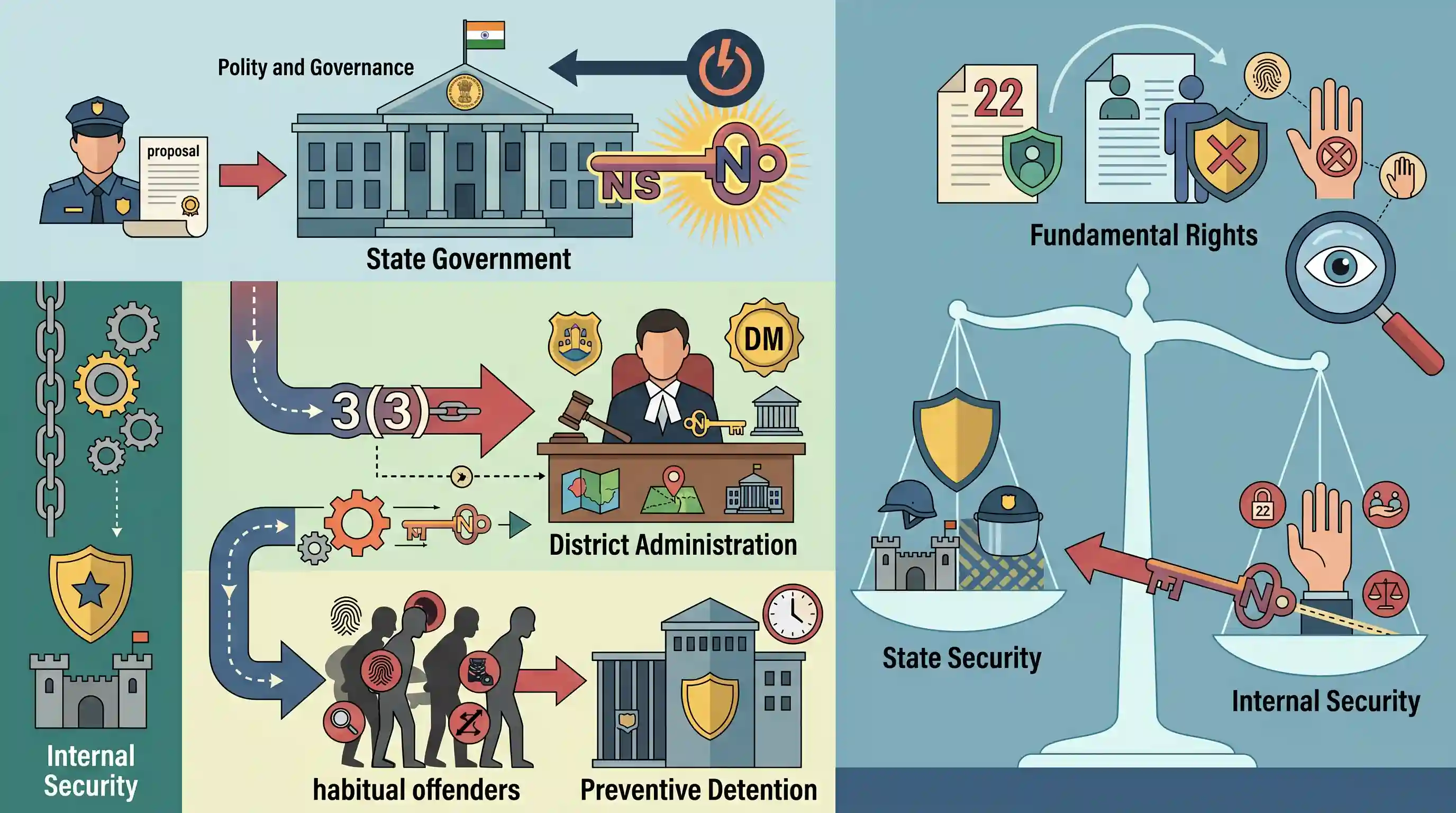
The Goa Police has written to the state government proposing the delegation of powers to invoke the National Security Act (NSA), 1980, to District Magistrates. Currently, the state government holds this authority, but Section 3(3) of the NSA allows for its delegation to DMs or Police Commissioners to maintain public order and state security. By empowering DMs, the police aim to expedite the preventive detention of habitual offenders and those threatening law and order, thereby streamlining security responses. However, expanding the use of preventive detention laws also brings into focus the delicate balance between state security imperatives and constitutional safeguards against arbitrary arrest under Article 22.
Key Points
- The Goa Police has formally requested the state government to empower District Magistrates (DMs) with the authority to invoke the National Security Act (NSA).
- The NSA allows for the preventive detention of individuals who are perceived as a threat to national security or public order, enabling authorities to detain them for up to 12 months without formal charge.
- Under Section 3(3) of the NSA, the state government holds the power to delegate detention authority to District Magistrates or Commissioners of Police for specific periods.
- This move is aimed at enabling quicker administrative action against habitual offenders and elements threatening peace, bypassing the lengthy standard criminal justice procedures.
- The delegation of such powers brings up the ongoing debate regarding the balance between maintaining internal security and upholding fundamental rights against arbitrary detention (Article 22).
Important Terms
National Security Act (NSA), 1980

A 1980 law empowering Central and State governments to preventively detain individuals for up to 12 months without trial to maintain public order and state security.
UPSC context
GS Paper II (Polity) and III (Internal Security); tests state authority versus individual liberties and preventive detention legalities.
Article 22, Constitution of India
A Fundamental Right providing safeguards against arbitrary arrest; clauses (3) to (7) specifically regulate the state's power to use preventive detention laws like the NSA.
UPSC context
GS Paper II (Polity); essential for understanding constitutional limits on executive power and protection of personal liberty.
District Magistrate (DM)
The administrative head of a district responsible for law and order; the Goa Police proposal seeks to delegate specific NSA detention powers to this executive office.
UPSC context
GS Paper II (Governance/District Administration); tests the role of field officers in maintaining law, order, and internal security.
Preventive Detention
Detention of an individual without trial to prevent the commission of future crimes that might threaten public peace, essential services, or national security.
UPSC context
GS Paper II (Polity); tests the legal framework and judicial scrutiny of detention without conviction in a democracy.
Section 3(3), National Security Act 1980
A specific provision in the National Security Act allowing State Governments to delegate detention powers to District Magistrates or Police Commissioners for a renewable period of three months.
UPSC context
GS Paper II (Polity/Governance); tests knowledge of administrative delegation of stringent legal powers to maintain local public order.
Prelims Trap
"Orders under the National Security Act can only be passed by the Union or State Home Ministries."
Section 3(3) of the NSA explicitly permits state governments to delegate preventive detention powers directly to District Magistrates or Commissioners of Police.
Static Concepts Connected
What constitutional safeguards apply to Preventive Detention under Article 22?
- Advisory Board limit: Detention cannot exceed three months unless an Advisory Board (comprising persons qualified to be High Court judges) reports sufficient cause.
- Grounds communication: The detaining authority must communicate the grounds of detention to the individual as soon as may be, unless it harms the public interest.
- Right to represent: The detenu must be afforded the earliest opportunity to make a representation against the detention order.
How does the Supreme Court distinguish "law and order" from "public order"?
- Concentric circles doctrine: The SC defines them as concentric circles: 'law and order' is the largest circle, 'public order' is smaller, and 'security of state' is the smallest core (Ram Manohar Lohia case).
- Community impact test: 'Law and order' breaches affect specific individuals, whereas 'public order' breaches disturb the even tempo of life for the community at large.
- Strict application: Preventive detention under laws like the NSA can only be justified for threats to 'public order', not for routine 'law and order' criminal problems.
Cross-Topic Patterns
Preventive Detention + Concurrent List
Both Parliament and State Legislatures have concurrent powers to make laws on preventive detention for reasons connected to state security, public order, or the maintenance of essential supplies.
District Administration + Internal Security
Delegating NSA powers emphasizes the modern District Magistrate's evolving role, shifting from traditional revenue administration to serving as the linchpin for internal security and crisis management at the district level.

Expect a Prelims question testing the SC's exact legal distinction between "public order" and "law and order" in the context of Art 22.
Linked PYQs · 1
Linked PYQs · 1
- 2023PrelimsGS1
Consider the following statements: 1. According to the Constitution of India, the Central Government has a duty to protect States from internal disturbances. 2. The Constitution of India exempts the States from providing legal counsel to a person being held for preventive detention. 3. According to the Prevention of Terrorism Act, 2002, confession of the accused before the police cannot be used as evidence. How many of the above statements are correct?
