Digital Agriculture Platform and AI Advisory Services
Source:Indian Express ↗
Why It Matters
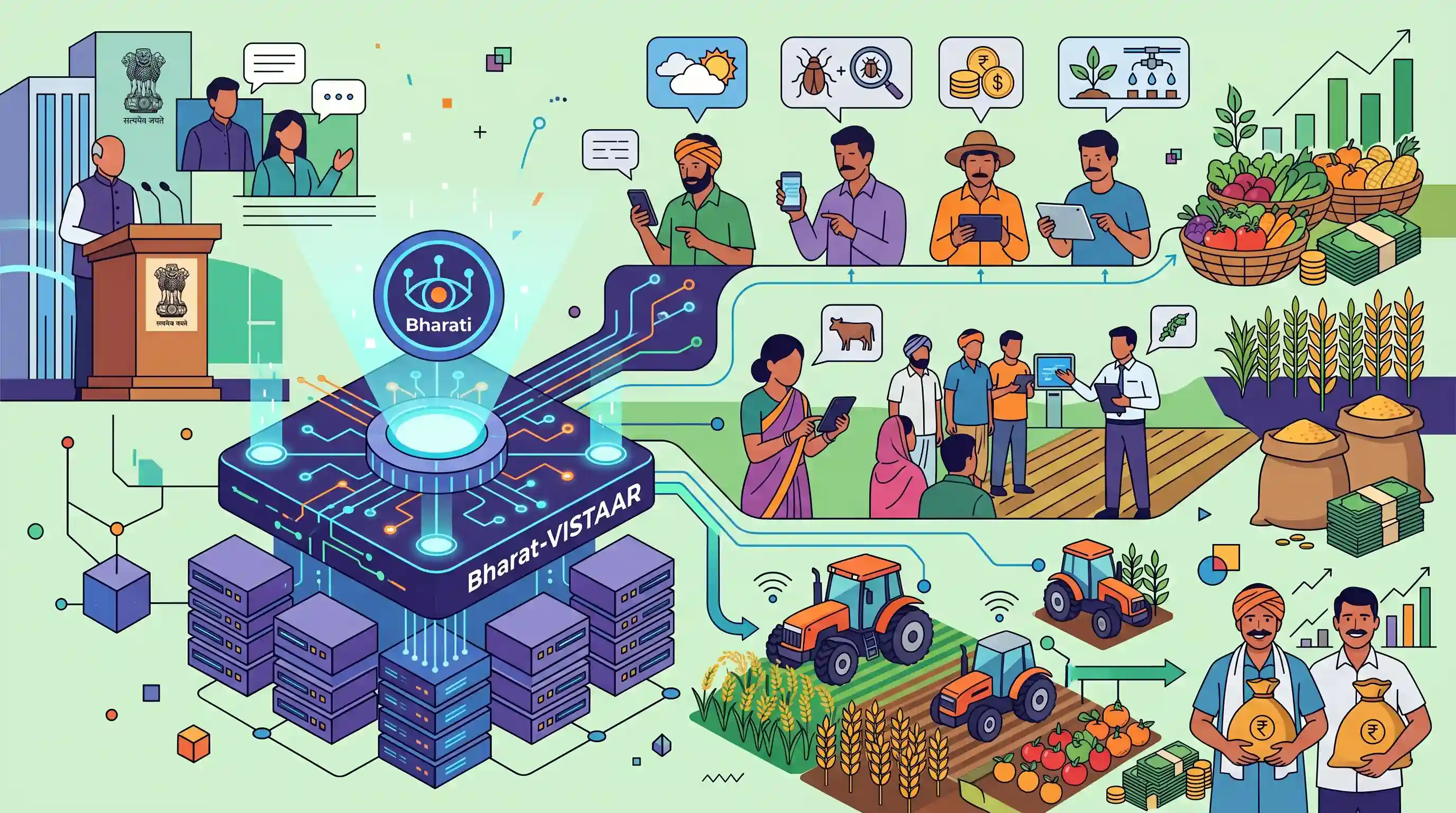
The integration of AI in agriculture (like the Bharati tool under Bharat-VISTAAR) is highly relevant for GS-3, touching upon digital public infrastructure (DPI), e-governance in agriculture, and measures to double farmers' income through technology.
Summary
The Government of India is set to launch Bharat-VISTAAR, an AI-powered agricultural initiative announced in the Union Budget. The platform includes a dedicated AI tool named 'Bharati' intended to assist farmers with real-time information, advisory, and extension services. This development marks a significant push towards integrating artificial intelligence and digital public infrastructure (DPI) into India's agricultural framework to enhance farmer incomes and farm productivity.
Key Points
- Bharat-VISTAAR is a newly announced initiative from the Union Budget focused on digital agricultural extension.
- It features an AI-powered tool named 'Bharati' designed specifically to assist farmers.
- The platform aims to bridge the information gap by providing timely, tech-driven advisory services to improve agricultural productivity.
- This initiative highlights the government's focus on integrating Artificial Intelligence (AI) and Digital Public Infrastructure (DPI) into the agriculture sector.
Important Terms
Bharat-VISTAAR

An AI-powered agricultural advisory platform (Virtually Integrated System to Access Agricultural Resources) launched to provide farmers with real-time, multilingual guidance on crop planning, pests, and government schemes.
UPSC context
GS Paper III (Technology in aid of farmers); tests knowledge of digital agriculture and government-led AI adoption for rural development.
Bharati (AI Assistant)
The specific multilingual AI conversational assistant within the Bharat-VISTAAR platform, accessible via a dedicated helpline (155261) to answer farmer queries using natural language processing.
UPSC context
GS Paper III (Artificial Intelligence); highlights the practical application of NLP and voice-based AI in solving last-mile delivery challenges.
AgriStack
A foundational digital infrastructure for agriculture comprising a federated Farmers’ Registry, Geo-referenced village maps, and a Crop Sown Registry to provide farmers a unique digital identity.
UPSC context
GS Paper III (Agricultural E-technology); tests understanding of the core data framework supporting digital public service delivery in farming.
Digital Public Infrastructure (DPI)
A set of shared digital systems (like Aadhaar or UPI) that are open, interoperable, and scalable, used to deliver essential services to citizens at scale.
UPSC context
GS Paper II (Governance) and III (Economy); a recurring theme regarding India’s digital transformation and financial inclusion strategies.
Agricultural Extension
The application of scientific research and new knowledge to agricultural practices through farmer education, now increasingly delivered via e-technology (e-extension) to reach remote areas efficiently.
UPSC context
GS Paper III (Issues related to direct and indirect farm subsidies and MSP); crucial for increasing farm productivity and resource efficiency.
Union Budget
The annual financial statement of the Government of India, presented under Article 112, outlining estimated receipts and expenditure for a specific fiscal year.
UPSC context
GS Paper III (Government Budgeting); tests understanding of fiscal policy, resource allocation, and new flagship scheme announcements.
Prelims Trap
Farmers must have a smartphone and an active internet connection to access the Bharati AI assistant under Bharat-VISTAAR.
Bharati is intentionally designed to bypass the digital divide, accessible 24/7 via simple toll-free voice calls using basic feature phones without internet access.
Static Concepts Connected
What are the traditional institutional pillars of agricultural extension in India?
- Krishi Vigyan Kendras (KVKs): District-level farm science centers established by ICAR for frontline demonstration of agricultural technologies and capacity building.
- ATMA Scheme: A decentralized, district-level extension system that integrates research and extension activities, bringing together various allied departments.
- Kisan Call Centres: Existing toll-free telephonic advisory services for farmers, which represent the legacy infrastructure now being augmented by conversational AI.
What are the core foundational pillars of India's AgriStack?
- Farmer Registry: A federated registry providing a unique ID to farmers, seamlessly linked with Aadhaar and state land records.
- Village Land Maps: Digitized, geo-referenced maps of farm plots to enable spatial planning, targeted subsidies, and precise satellite monitoring.
- Crop Sown Registry: A dynamic digital survey of crops sown in real-time to track production estimates and trigger proactive policy measures.
Cross-Topic Patterns
India's DPI diplomacy + Global South agriculture
Just like UPI and Aadhaar, India's agricultural DPI (AgriStack + Bharat-VISTAAR) is emerging as a potential blueprint for Global South diplomacy to ensure food security through scalable technology.
AI bridging structural manpower deficits
Bharat-VISTAAR shifts AI from corporate utilities to grassroots public goods, using technology to bypass severe human resource deficits (extension worker-to-farmer ratio of 1:5000).

Expect a multi-statement Prelims question combining AgriStack, Bharat-VISTAAR, and their structural prerequisites (internet vs voice).
Linked PYQs · 2
Linked PYQs · 2
- 2023MainsGS3
How does e-Technology help farmers in production and marketing of agricultural produce? Explain it.
- 2015MainsGS3
How can the 'Digital India' programme help farmers to improve farm productivity and income ? What steps has the Government taken in this regard?
