Madhya Pradesh Excise Department to Amend Century Old Act
Source:freepressjournal ↗
Why It Matters
This legislative reform is highly relevant for MPPSC Prelims and Mains as it intersects state-level statutory frameworks, historical colonial-era laws, socio-economic empowerment of Scheduled Tribes through heritage liquor, and public health governance against spurious liquor tragedies.
Summary
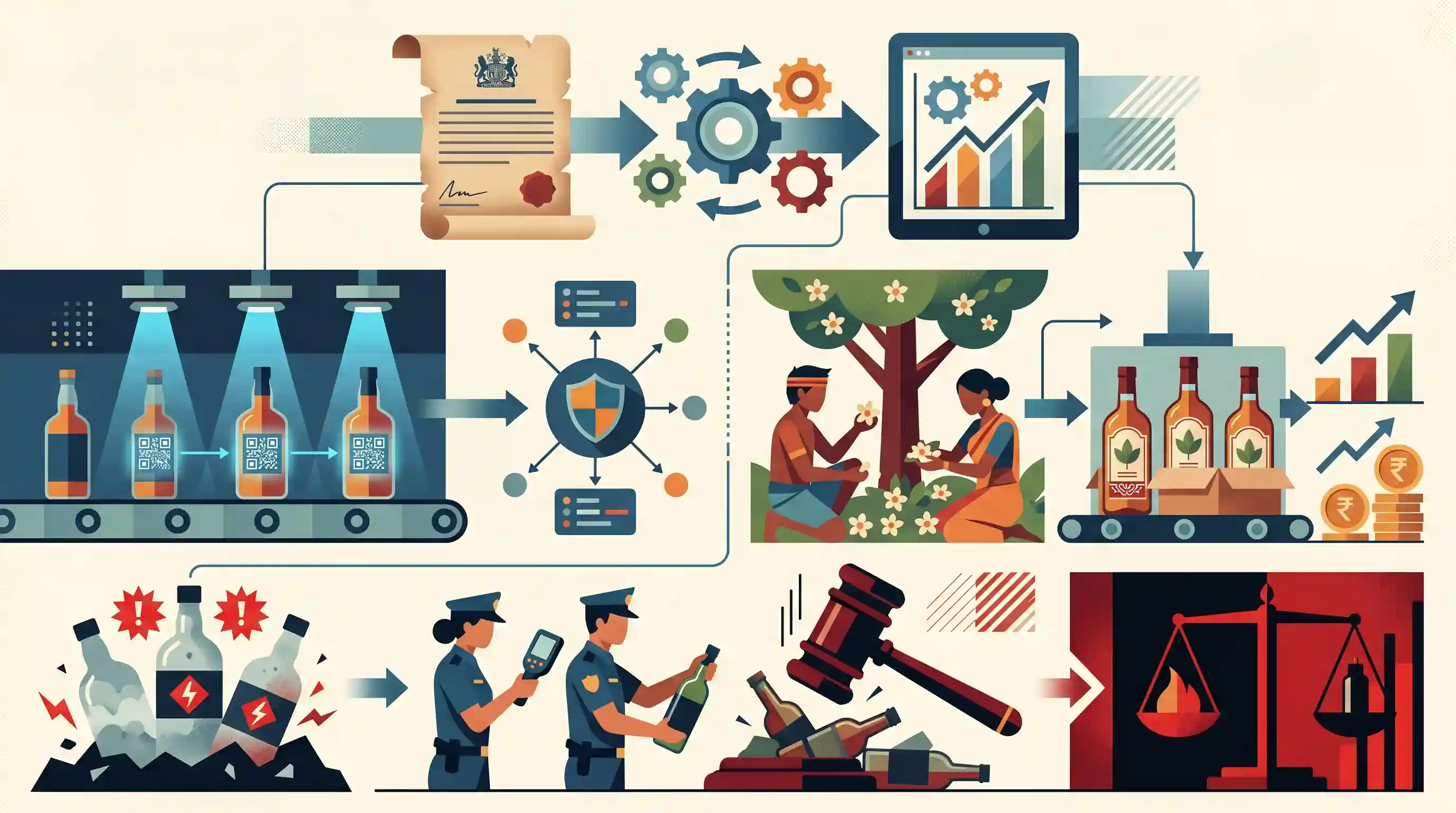
The Madhya Pradesh Excise Department is set to carry out comprehensive reforms and amend the century-old Madhya Pradesh Excise Act, 1915. The proposed amendments aim to modernize British-era provisions, introduce digital track-and-trace mechanisms to check liquor smuggling and duty evasion, formalize Mahua-based tribal heritage liquor, and enforce severe punishments (including the death penalty) for the manufacture and sale of spurious liquor.
Key Points
- The Madhya Pradesh Excise Act, originally enacted in 1915 during the British colonial era, is being comprehensively amended by the state excise department to modernize its century-old provisions.
- A major focus of the amendments is addressing public health and safety by introducing stringent punishments, including the death penalty or life imprisonment and fines up to Rs 20 lakh, for selling spurious or adulterated liquor (hooch) that leads to death.
- The amendment legally structures the state's 'Heritage Liquor Policy', which formalizes the manufacturing, packaging, and commercial sale of traditional tribal liquor made from Mahua (Madhuca longifolia) flowers to promote tribal entrepreneurship through Self-Help Groups (SHGs).
- It incorporates modern digital systems, such as a QR code-based 'Track and Trace' supply chain management system, to prevent excise duty evasion, regulate micro-breweries, and stop illicit liquor smuggling.
- The reform seeks to simplify the licensing regime, regularize pub and bar operations, and introduce compounding options for minor, technical violations of excise rules to reduce the judicial burden on courts.
Important Terms
Madhya Pradesh Excise Act, 1915

A colonial-era state legislation regulating the import, export, transport, manufacture, sale, and possession of intoxicating liquors and drugs in Madhya Pradesh, establishing state monopoly over the alcohol trade.
UPSC context
GS Paper II: State Legislature and Governance. Tests understanding of Seventh Schedule legislative powers and modernizing obsolete British-era legal frameworks.
Madhya Pradesh Excise (Amendment) Bill
Draft legislation seeking to modernize the century-old Excise Act, introducing stringent penalties like death penalty for spurious liquor deaths, digital tracking, and heritage liquor regulations.
UPSC context
GS Paper II: Governance and Criminal Law. Tests comprehension of law enforcement measures, deterrence, and socioeconomic impacts of severe penal provisions.
Heritage Liquor Policy
A regulatory framework that legalizes, standardizes, and commercializes traditionally brewed alcoholic beverages (like Mahua) by tribal groups, ensuring quality control, livelihood support, and cultural preservation.
UPSC context
GS Paper II & III: Tribal Welfare and Economic Empowerment. Tests analytical ability regarding inclusive growth, forest produce, and traditional livelihood formalization.
Prelims Trap
Alcohol for human consumption is taxable under GST but currently kept at a 0% rate by the GST Council.
Alcohol for human consumption is not 'zero-rated' under GST; it is constitutionally excluded from the definition of GST under Article 366(12A), leaving tax powers exclusively with the states.
Static Concepts Connected
How does the Constitution divide taxing and regulatory powers over alcohol between Union and States?
- State List Entry 51: Allows states to levy excise duties on alcoholic liquors manufactured for human consumption.
- State List Entry 8: Grants states exclusive legislative control over the production, manufacture, possession, transport, purchase, and sale of intoxicating liquors.
- Article 366(12A): Explicitly excludes alcoholic liquor for human consumption from the ambit of Goods and Services Tax.
What are the botanical and legal classifications of the Mahua tree (Madhuca longifolia)?
- Taxonomy & Ecology: Deciduous tree belonging to the Sapotaceae family, characterized by nocturnal-blooming flowers adapted for bat pollination.
- Legal Classification: Classified as a Minor Forest Produce (MFP) under the Forest Rights Act, 2006, granting ownership and collection rights to forest-dwelling tribes.
Cross-Topic Patterns
Tribal SHGs & Excise Economy
Formalizing Mahua liquor through women-led SHGs bridges Fifth Schedule tribal development with state excise models, turning traditional practices into legal, standardized livelihoods.
Capital Punishment vs Regulatory Offenses
States prescribing death penalties for spurious liquor distribution (non-traditional homicide) tests the 'rarest of rare' sentencing doctrine under Article 21.

Constitutional boundaries of state excise under Entry 51 vs GST exclusions will likely be framed alongside tribal Minor Forest Produce rights.
Linked PYQs · 2
Linked PYQs · 2
- 2016MPPSC_PRELIMSGS1
Mineral policy was declared in Madhya Pradesh in the year
- 2025MPPSC_PRELIMSGS1
How many total major and medium Integrated Tribal Development Projects are in existence in Madhya Pradesh in 2023-24?
