India External Trade Vulnerability and Tariff Shocks on Exports
Source:The Hindu ↗
Why It Matters
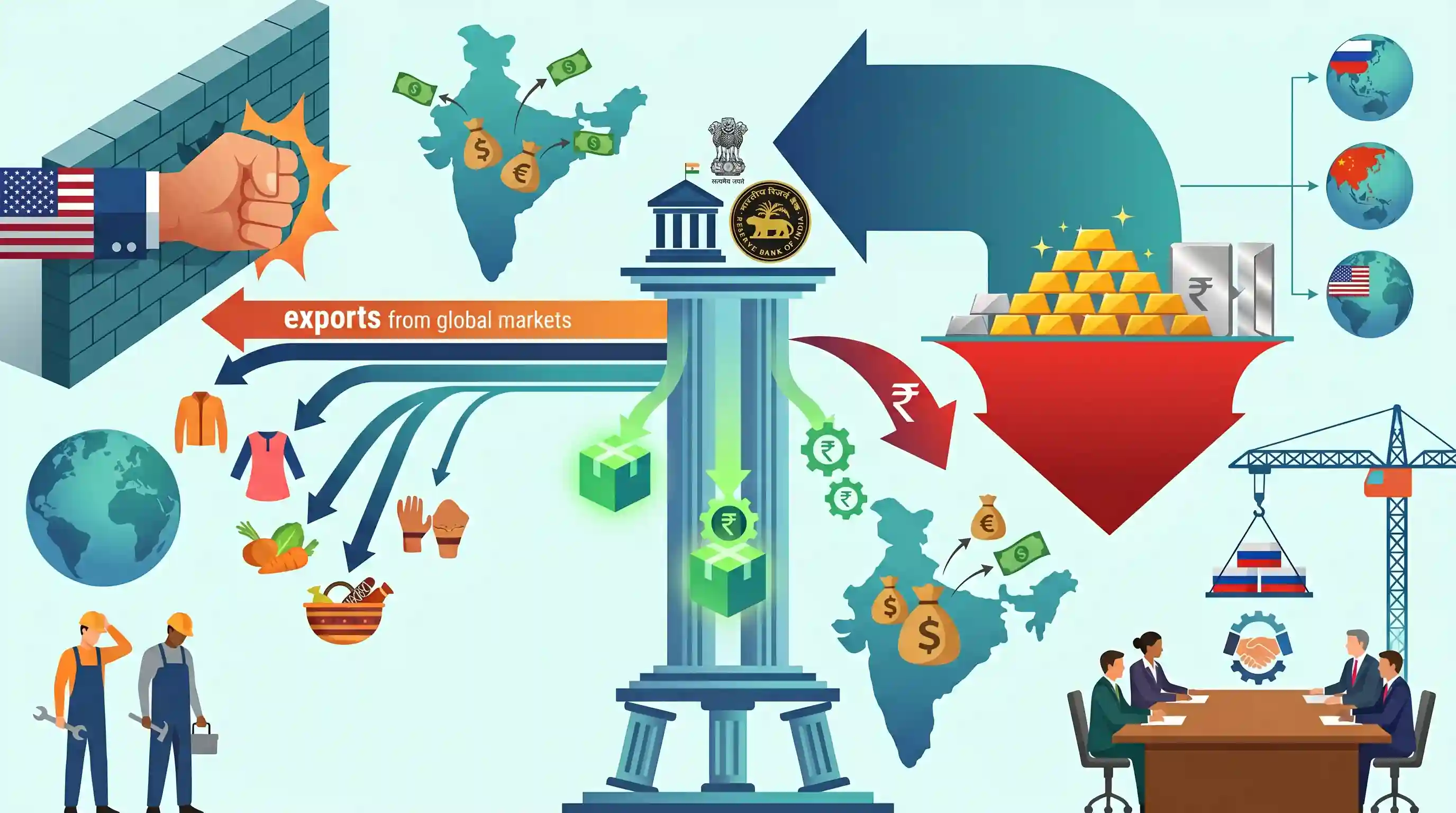
Highlights the severe macroeconomic consequences of sudden protectionist shocks and over-reliance on a single major export market, demonstrating the real-world impact of tariffs on currency stability, capital outflows, and labor-intensive manufacturing.
Summary
India's external trade landscape is experiencing severe turbulence, marked by a record goods trade deficit of $41.68 billion in October following a 50% U.S. tariff levy in August. The shock caused an 11.8% year-on-year drop in exports—disproportionately affecting labor-intensive sectors—while imports surged largely due to record inflows of precious metals serving as a hedge against economic uncertainty. Compounded by a depreciating rupee and foreign portfolio outflows, the crisis has prompted ₹25,060 crore in government export-promotion initiatives and RBI relief measures. The situation underscores the economic and diplomatic vulnerabilities of India's heavy dependence on the U.S. export market, highlighting the necessity of a structural shift in its trade portfolio, which may already be underway as seen in the drop in Russian imports and ongoing India-U.S. Bilateral Trade Agreement negotiations.
Key Points
- India's goods trade deficit reached a record $41.68 billion in October, primarily triggered by a 50% tariff levy imposed by the U.S. in August.
- Merchandise exports fell 11.8% year-on-year to $34.38 billion, heavily impacting labor-intensive sectors like textiles, apparel, and engineering goods.
- Imports surged due to a massive influx of gold and silver, acting as a hedge against economic uncertainty, alongside a depreciating rupee and foreign portfolio outflows.
- To mitigate the shock, the Centre announced a ₹25,060 crore export-promotion initiative, while the RBI introduced relief measures for affected exporters.
- A decline in Russian imports and an increase in U.S. imports indicate an ongoing structural shift to assuage American trade concerns and reduce economic vulnerability from overdependence on a single export market.
Important Terms
Trade Deficit

An economic condition where a country's import value exceeds its export value, resulting in a negative Balance of Trade.
UPSC context
GS Paper 3 (Economy); tested under Balance of Payments (BoP), macroeconomic stability, and external sector vulnerabilities.
India–U.S. Bilateral Trade Agreement
A proposed economic pact to reduce tariffs and trade barriers between India and the U.S., aimed at reaching a $500 billion trade goal.
UPSC context
GS Paper 2 (International Relations); tests understanding of strategic economic partnerships and bilateral diplomacy.
Foreign Portfolio Investment (FPI)
Passive investment by foreign entities in domestic financial assets like stocks and bonds without acquiring management control.
UPSC context
GS Paper 3 (Economy); relevant for studying capital account flows, market volatility, and "hot money" impacts.
Protectionism
Economic policies, such as tariffs or quotas, used by governments to restrict imports and protect domestic industries from foreign competition.
UPSC context
GS Paper 3 (Economy) and GS Paper 2 (IR); tests knowledge of global trade barriers and export-led growth challenges.
Labor-intensive Exports
Exports from sectors requiring high human labor (e.g., textiles, leather), which are critical for large-scale employment in India.
UPSC context
GS Paper 3 (Employment); central to discussions on inclusive growth and manufacturing-led job creation.
Currency Depreciation
The decrease in a currency's value relative to others, often driven by trade deficits, capital outflows, or market speculation.
UPSC context
GS Paper 3 (Economy); tests understanding of exchange rate mechanisms and the role of the RBI in forex management.
Prelims Trap
A depreciating rupee inevitably narrows the trade deficit by boosting export competitiveness.
While depreciation makes exports cheaper, India's reliance on inelastic imports (like oil and gold) often inflates the import bill faster than export revenues grow, widening the deficit.
Static Concepts Connected
What components constitute India's Current Account in the Balance of Payments?
- Trade in Goods: The export and import of physical merchandise, which directly determines the trade deficit or surplus.
- Trade in Services: Net income from intangibles like software, travel, and financial services, typically generating a surplus for India.
- Current Transfers: Unilateral receipts like worker remittances, donations, and grants where no goods or services are exchanged.
- Income Receipts: Net investment income including dividends, profit, and interest payments on foreign assets and liabilities.
How do foreign portfolio investment (FPI) outflows impact the domestic macroeconomy?
- Currency Depreciation: Mass withdrawal of foreign capital spikes demand for the US Dollar, causing the domestic currency to weaken.
- Imported Inflation: A weaker rupee makes inelastic imports like crude oil and gold costlier, driving up domestic prices.
- Forex Depletion: The RBI must sell dollar reserves to absorb excess rupee liquidity and stabilize the volatile exchange rate.
Cross-Topic Patterns
US Protectionism + Bilateral Trade Pivot
Rising US tariffs are accelerating India's push for a Bilateral Trade Agreement, simultaneously prompting a strategic reduction in Russian imports to appease American trade concerns.
Economic Uncertainty + Safe Haven Assets
Geopolitical turbulence drives capital toward safe-haven assets like gold, structurally widening India's goods trade deficit despite ongoing government export-promotion schemes.

Expect a multi-statement 2026 Prelims question linking US protectionist tariffs, FPI outflows, and their combined effect on India's BoP.
Linked PYQs · 3
Linked PYQs · 3
- 2025MainsGS3
What are the challenges before the Indian economy when the world is moving away from free trade and multilateralism to protectionism and bilateralism? How can these challenges be met?
- 2018MainsGS3
How would the recent phenomena of protectionism and currency manipulations in world trade affect macroeconomic stability of India?
- 2017MainsGS3
Account for the failure of manufacturing sector in achieving the goal of labour-intensive exports. Suggest measures for more labour-intensive rather than capital-intensive exports.
