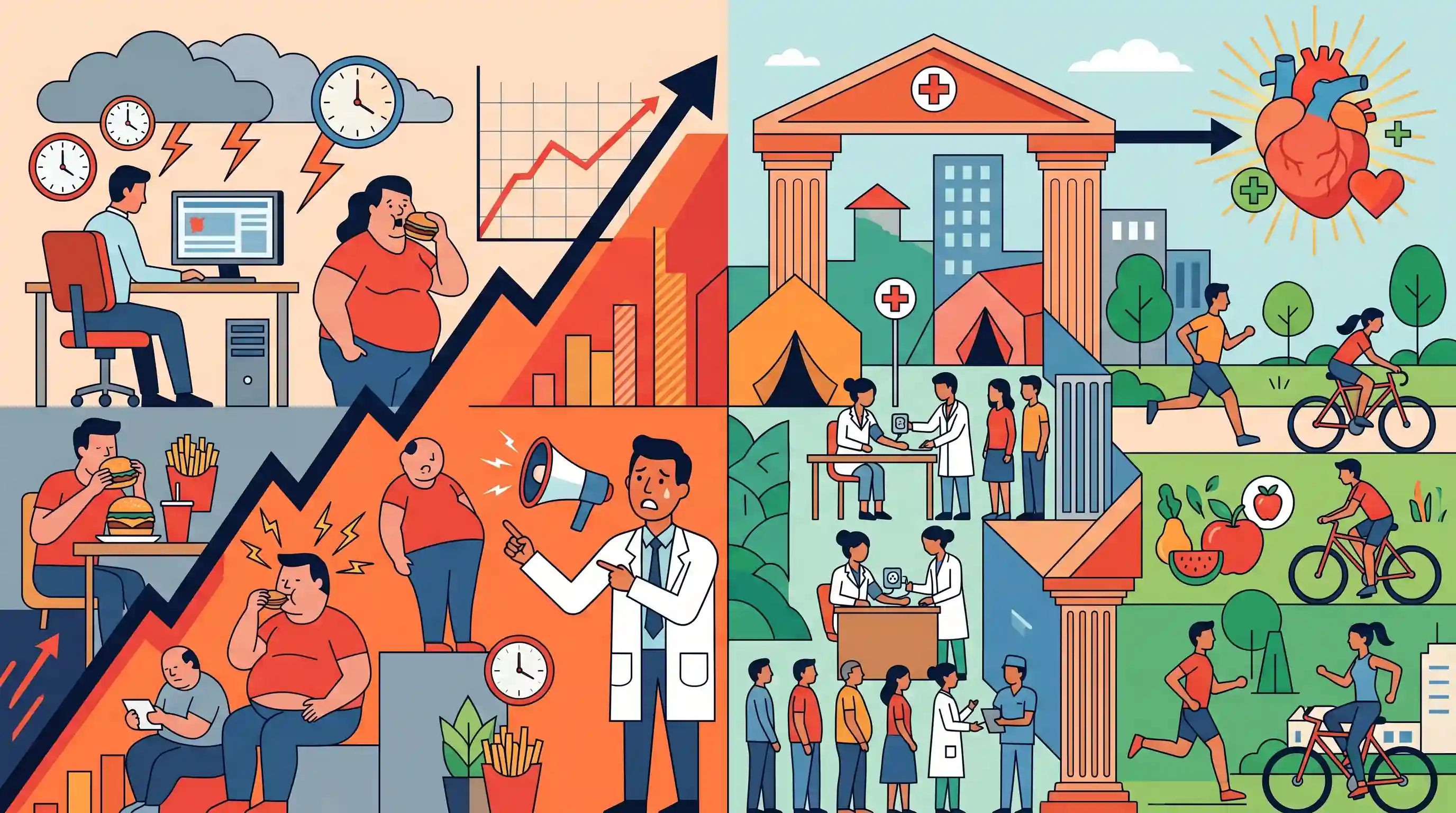
Lifestyle Stress and Weight Gain Trigger Rising Hypertension Rates
Source:The Hindu ↗
Why It Matters
The increasing prevalence of lifestyle diseases like hypertension among younger populations poses a major challenge to India's demographic dividend and public health infrastructure. It emphasizes the critical need for robust preventive healthcare policies and lifestyle modifications, which are important dimensions of the GS2 syllabus covering social sector and health issues.
Summary
On the occasion of World Hypertension Day, medical experts, including former IMA president Dr. V.S. Prasad, raised concerns about the rising prevalence of hypertension across all demographics. The surge is primarily attributed to modern lifestyle changes such as elevated stress levels, sedentary habits, excess body weight, and a dietary shift towards junk food. Highlighting the need for preventive healthcare, the article details community health camps in Srikakulam aimed at early detection and underscores the broader challenge of managing non-communicable diseases (NCDs) within India's public health framework.
Key Points
- The incidence of hypertension is increasing across all age groups, including youngsters, driven largely by lifestyle factors like stress, excess weight, and a lack of exercise.
- The transition from traditional, healthy diets to junk food is a major contributing factor to the rising prevalence of cardiovascular and lifestyle diseases.
- Regular medical screening and early detection through health camps play a vital role in addressing the growing public health burden of non-communicable diseases (NCDs).
- Experts emphasize the need for preventive healthcare, physical activity, and dietary interventions to mitigate the long-term impact of hypertension on public health.
Important Terms
Non-Communicable Diseases (NCDs)

Chronic medical conditions like heart disease, diabetes, and cancer that are not transmitted between persons, typically caused by genetic, environmental, or lifestyle factors.
UPSC context
GS Paper 2: Health; tests understanding of India's dual disease burden and Sustainable Development Goal (SDG) 3.4 targets.
Indian Medical Association (IMA)
The largest national voluntary organization of doctors of modern scientific medicine in India, established in 1928 to promote public health and protect professional interests.
UPSC context
GS Paper 2: Governance/Health; tests knowledge of professional bodies influencing health policy and ethics in India.
World Hypertension Day
Observed annually on May 17 to raise global awareness about high blood pressure, its prevention, and the importance of regular screening to prevent complications.
UPSC context
Prelims/GS Paper 2: Health; focuses on global health awareness days and their themes related to lifestyle diseases.
India Hypertension Control Initiative (IHCI)
A collaborative program by the Ministry of Health, ICMR, and WHO to strengthen hypertension management and achieve 25% reduction in prevalence by 2025.
UPSC context
GS Paper 2: Health; relevant for discussing government interventions in primary healthcare and NCD control.
Preventive Healthcare
A proactive healthcare approach focusing on screenings, vaccinations, and lifestyle modifications to detect and avoid diseases before they occur or worsen.
UPSC context
GS Paper 2: Social Justice/Health; tests knowledge of shifting health strategy from curative to preventive for economic sustainability.
Apitoria Pharma Private Limited
A subsidiary of Aurobindo Pharma involved in pharmaceutical manufacturing, active in corporate social responsibility (CSR) through community health camps in regions like Srikakulam.
UPSC context
GS Paper 2/4: Health/Ethics; demonstrates the role of private sector and CSR in public health service delivery.
Prelims Trap
"Communicable diseases remain the leading cause of mortality in India."
India has undergone an 'epidemiological transition'. NCDs (like hypertension and diabetes) now account for roughly 63-65% of all deaths, significantly outpacing communicable diseases.
Static Concepts Connected
What is the 'Epidemiological Transition' in India?
- The Shift: A demographic shift where Non-Communicable Diseases (NCDs) replace infectious or communicable diseases as the primary cause of mortality in a population.
- Current Burden: NCDs like cardiovascular issues, diabetes, and cancers now cause roughly 63-65% of all deaths in India, compared to just 37% in 1990.
- Main Drivers: Increasing life expectancy, rapid urbanization, sedentary habits, and the 'nutrition transition' towards processed foods.
What are the core features of the NP-NCD program?
- Target Population: Mandates 100% population-based screening for all individuals aged 30 years and above.
- Covered Diseases: Focuses on early detection of hypertension, diabetes, and three specific cancers (oral, breast, and cervical).
- Delivery Mechanism: Screening and essential medicine distribution are operationalized at the grassroots via Ayushman Arogya Mandirs (formerly Health and Wellness Centres).
Cross-Topic Patterns
Nutrition transition and urbanization
The shift from traditional diets to ultra-processed junk food links public health challenges directly to GS1 Urbanization and GS3 Food Processing themes, known as the 'nutrition transition'.
75/25 Initiative and PHC empowerment
Placing 75 million people under standard care by 2025 highlights the shift of NCD management from tertiary hospitals to decentralized Primary Health Centres (Ayushman Arogya Mandirs).

The '75/25 Initiative' and India's NCD mortality share (>63%) are prime candidates for a multi-statement health scheme question in 2026.
Linked PYQs · 3
Linked PYQs · 3
- 2024MainsGS2
In a crucial domain like the public healthcare system the Indian State should play a vital role to contain the adverse impact of marketisation of the system. Suggest some measures through which the State can enhance the reach of public healthcare at the grassroots level.
- 2020MainsGS2
In order to enhance the prospects of social development, sound and adequate health care policies are needed particularly in the fields of geriatric and maternal health care. Discuss.
- 2024PrelimsGS1
Which one of the following is synthesised in human body that dilates blood vessels and increases blood flow?
