Structural Challenges Hinder Economic Growth in Bihar
Source:The Hindu ↗
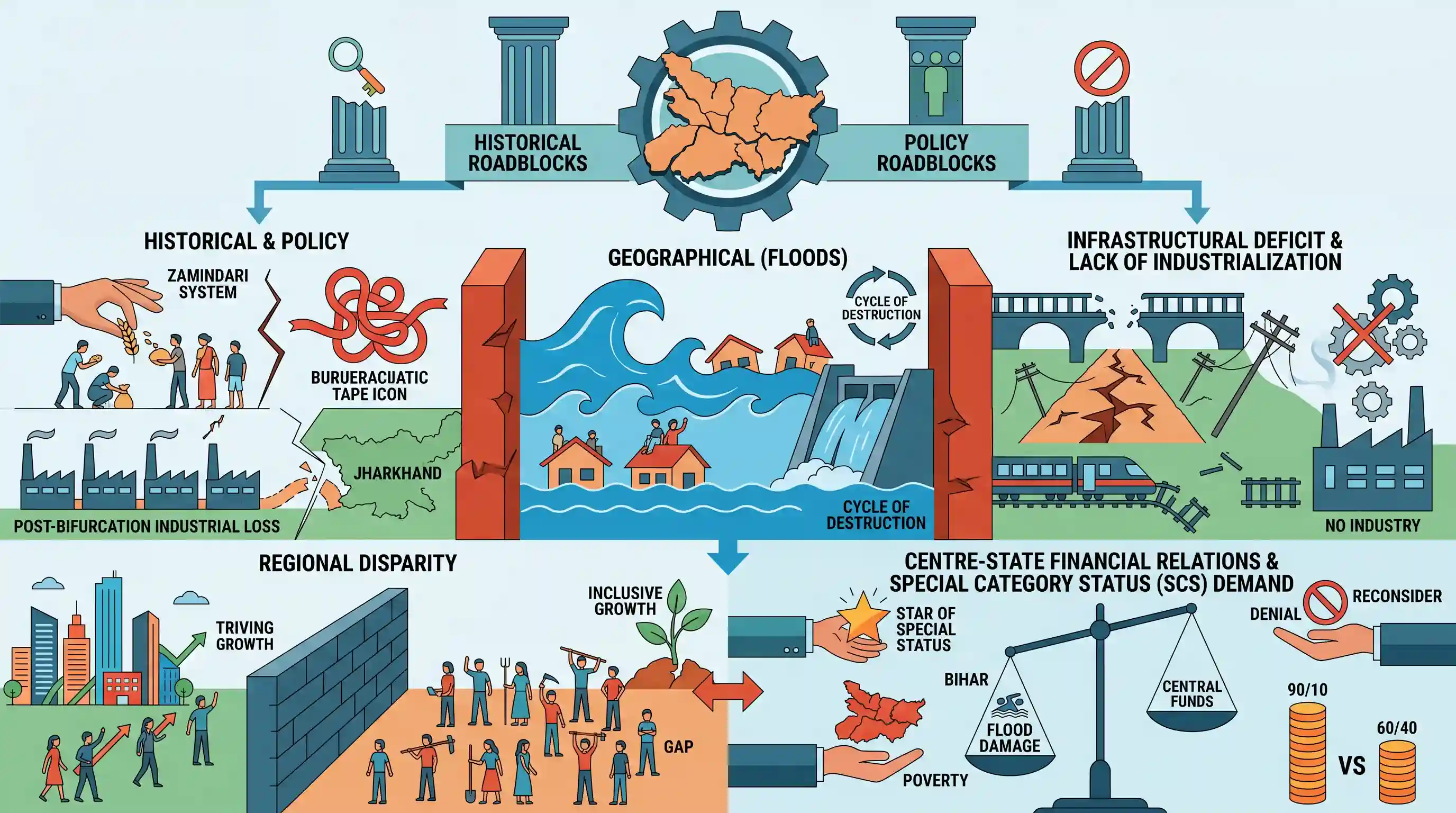
Why It Matters
Understanding the specific developmental hurdles of backward states like Bihar is crucial for analyzing regional disparities, evaluating Centre-State financial relations, and devising inclusive growth strategies for India as a whole.
Summary
An analysis of the historical, geographical, and policy-related roadblocks that have hindered Bihar's economic development. The article addresses critical factors such as frequent floods, severe infrastructural deficits, lack of industrialization, and the ongoing debate over the state's demand for Special Category Status to overcome regional backwardness.
Key Points
- Examines the structural and geographical challenges contributing to Bihar's developmental lag, including the devastating economic impact of recurrent floods in North Bihar.
- Analyses historical policy decisions, such as the Freight Equalisation Policy, which historically stripped the state of its natural resource advantage and disincentivised industrial investments.
- Highlights the state's heavy reliance on agriculture, compounded by a lack of substantial industrial infrastructure and low private sector investment.
- Discusses the ongoing political and economic debate surrounding Bihar's prolonged demand for Special Category Status versus the Centre's preference for special financial packages to bridge regional disparities.
Important Terms
Special Category Status (SCS)

A classification granted by the Centre to support states with geographical or socio-economic disadvantages. It provides 90% funding for Centrally Sponsored Schemes and tax concessions to promote regional parity.
UPSC context
GS Paper II & III; tests understanding of fiscal federalism, regional disparities, and center-state financial relations.
Freight Equalization Policy
A 1952 policy that subsidized the transportation of minerals like coal and iron ore, making them cost the same nationwide. It removed Bihar's locational advantage, hindering its industrialization until its 1993 repeal.
UPSC context
GS Paper I & III; tests factors affecting the location of industries and historical policy-driven economic backwardness.
Finance Commission
A constitutional body (Article 280) appointed every five years to recommend the distribution of net tax proceeds between the Union and States (vertical devolution) and among states (horizontal devolution).
UPSC context
GS Paper II; tests knowledge of constitutional fiscal architecture and the 'balancing wheel' of Indian federalism.
NITI Aayog
The premier policy think tank of the Government of India (est. 2015), replacing the Planning Commission. It fosters cooperative federalism through a bottom-up approach and strategic long-term policy formulation.
UPSC context
GS Paper II; tests institutional frameworks for development, cooperative federalism, and the shift from centralized planning.
Prelims Trap
"The 14th Finance Commission abolished Special Category Status for all states in India."
The 14th FC did not abolish SCS entirely; it stopped granting NEW status but retained it for the existing Northeastern and three Himalayan states.
Static Concepts Connected
What are the parameters for Special Category Status under the Gadgil Formula?
- Geography: Hilly and difficult terrain.
- Demography: Low population density or a sizable share of tribal population.
- Strategic borders: Strategic location along borders with neighboring countries.
- Fiscal viability: Severe economic and infrastructural backwardness, coupled with non-viable state finances.
What makes North Bihar uniquely prone to floods despite embankment construction?
- High sediment load: Himalayan rivers (Kosi, Gandak) carry massive silt loads that aggrade riverbeds upon hitting the plains.
- Embankment paradox: Embankments constrict the river, trapping sediment within the channel and raising the riverbed above the surrounding floodplains over time.
- Topography: The flat, downstream topography lacks the gradient required to quickly drain heavy monsoon influxes from Nepal.
Cross-Topic Patterns
SCS demands vs. Fiscal Federalism
The shift from granting Special Category Status to increasing baseline tax devolution (14th/15th FC) highlights the evolution of Centre-State fiscal relations and cooperative federalism.
Freight Equalisation and Migration
The 1952 policy's erosion of eastern India's industrial advantage structurally links to today's heavy out-migration of unskilled labor from Bihar to western and southern manufacturing hubs.
The Embankment Paradox
Structural flood controls in highly silted Himalayan rivers often backfire by raising riverbeds, a concept frequently tested in Disaster Management regarding the Kosi and Brahmaputra rivers.

Expect a multi-statement Prelims question comparing the Gadgil Formula criteria for SCS against Article 371 special provisions.
Linked PYQs · 4
Linked PYQs · 4
- 2016MainsGS1
What is the basis of regionalism? Is it that unequal distribution of benefits of development on regional basis eventually promotes regionalism? Substantiate your answer.
- 2021MainsGS3
“Investment in infrastructure is essential for more rapid and inclusive economic growth.” Discuss in the light of India's experience.
- 2025MainsGS2
Inequality in the ownership pattern of resources is one of the major causes of poverty. Discuss in the context of 'paradox of poverty'.
- 2020MainsGS1
The interlinking of rivers can provide viable solutions to the multi-dimensional inter-related problems of droughts, floods and interrupted navigation. Critically examine.
