Ex-CAPF Officers File Contempt Plea Over Supreme Court Order Delay
Source:The Hindu ↗
Why It Matters
Highlights recurring friction between generalist/all-India services (IPS) and specialized central forces (CAPF), demonstrating the administrative challenges of cadre management, promotional stagnation, and the friction between the Judiciary (mandating reforms) and the Executive (delaying implementation). Relevant for GS-2 (Governance/Polity) and GS-3 (Internal Security).
Summary
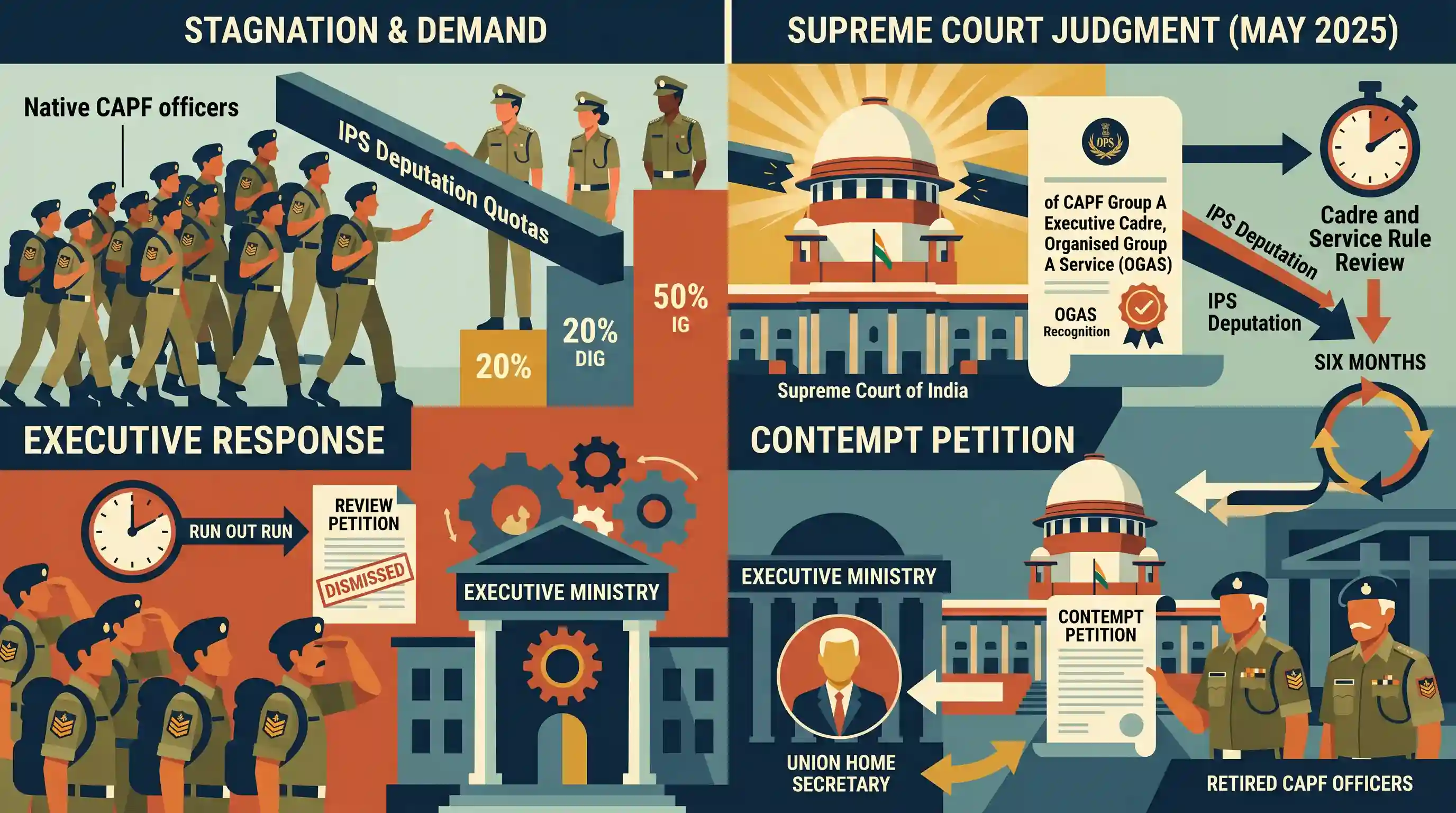
Retired Central Armed Police Force (CAPF) officers have filed a contempt petition in the Supreme Court against the Union Home Secretary. The plea alleges executive non-compliance with a May 2025 Supreme Court judgment that recognized CAPF Group A Executive Cadre officers as Organised Group A Services (OGAS) and directed the progressive reduction of Indian Police Service (IPS) deputation in top CAPF ranks over two years. The court had also ordered a cadre and service rule review within six months. Currently, significant quotas (20% for DIG and 50% for IG posts) are reserved for IPS officers on deputation, leading to severe promotional stagnation for around 13,000 native CAPF officers. Despite the Home Ministry's review petition being dismissed, substantive amendments to the service rules are yet to be implemented.
Key Points
- Retired CAPF officers filed a contempt petition in the Supreme Court against Union Home Secretary Govind Mohan for failing to implement a May 2025 SC order.
- The SC ruling recognized CAPF Group A Executive Cadre officers as Organised Group A Services (OGAS) and mandated a progressive reduction of IPS deputation in CAPFs within two years.
- Presently, 20% of DIG posts and 50% of IG posts in CAPFs are reserved for IPS officers, which restricts promotional avenues for native CAPF cadre officers.
- The SC also mandated a time-bound review of CAPF cadre and service rules within six months to address the stagnation affecting roughly 13,000 CAPF officers.
- Despite the dismissal of the Home Ministry's review petition in October 2025, lateral entry of IPS officers continues, and service rules remain unamended.
Important Terms
Central Armed Police Forces (CAPF)

A collective term for seven security forces under the Ministry of Home Affairs, including BSF, CRPF, CISF, ITBP, SSB, NSG, and Assam Rifles, tasked with border guarding and internal security.
UPSC context
GS Paper III (Internal Security); GS Paper II (Security Forces). Tests knowledge of India's security architecture and personnel management challenges.
Organised Group A Service (OGAS)
A status for Central Civil Services involving direct recruitment through competitive exams and a structured hierarchy, entitling officers to benefits like Non-Functional Financial Upgradation (NFFU).
UPSC context
GS Paper II (Role of Civil Services). Relates to administrative reforms and the dispute over inter-service parity between CAPF and IPS cadres.
Non-Functional Financial Upgradation (NFFU)
A financial scheme where Group A officers receive the pay scale of their peers in the IAS/IPS once the latter are promoted, intended to alleviate career stagnation.
UPSC context
GS Paper II (Civil Service Reforms). A key fiscal benefit at the center of the CAPF demand for service parity.
Contempt of Court
The power of the Supreme Court (Article 129) or High Courts (Article 215) to punish willful disobedience of orders (civil) or actions that undermine judicial authority (criminal).
UPSC context
GS Paper II (Judiciary). Tests the enforcement of judicial mandates and the constitutional balance between the executive and judiciary.
Deputation
The temporary transfer of a government officer from their parent cadre (e.g., IPS) to another organization (e.g., BSF) for a specific period to fill specialized or leadership roles.
UPSC context
GS Paper II (Executive). Relates to cadre management and the structural friction between deputed All India Service officers and native cadre officers.
Indian Police Service (IPS)
One of the three All India Services, managed by the Ministry of Home Affairs, responsible for law and order and providing leadership for state and central police organizations.
UPSC context
GS Paper II (Role of Civil Services). Focuses on the role of All India Services in the national security framework and inter-service coordination.
Prelims Trap
Willful disobedience of a Supreme Court judgment or direction constitutes Criminal Contempt.
Willful disobedience of a judgment, decree, or order is defined specifically as 'Civil Contempt' under the 1971 Act. Criminal contempt involves scandalizing or lowering the authority of the court.
Static Concepts Connected
What is the difference between Civil and Criminal Contempt of Court?
- Civil Contempt: Willful disobedience to any judgment, decree, direction, or order of a court, or willful breach of an undertaking given to a court.
- Criminal Contempt: Publication or act that scandalizes/lowers the authority of any court, prejudices judicial proceedings, or obstructs the administration of justice.
- Constitutional Backing: Articles 129 and 215 empower the Supreme Court and High Courts respectively to punish for contempt of themselves.
What are the Central Armed Police Forces (CAPF) and their administrative control?
- Administrative Control: CAPFs function under the authority of the Ministry of Home Affairs (MHA), serving as the primary internal security and border guarding forces.
- Core Forces: Comprises seven forces: Assam Rifles, BSF, CISF, CRPF, ITBP, NSG, and SSB.
- Assam Rifles Anomaly: Assam Rifles is unique as it is under the administrative control of MHA but under the operational control of the Indian Army (Ministry of Defence).
Cross-Topic Patterns
Executive-Judiciary friction over administrative rules
Judicial interventions directing the executive to amend service rules (like granting OGAS status) often face institutional resistance, leading to increased civil contempt litigation.
IPS dominance vs. border security morale
Career stagnation and lack of native top leadership in CAPFs directly link to the broader Internal Security theme of effective border management and troop motivation.

Civil vs Criminal contempt under the 1971 Act, paired with Constitutional powers (Art 129/215), is highly probable for Prelims 2026.
Linked PYQs · 5
Linked PYQs · 5
- 2023MainsGS3
What are the internal security challenges being faced by India? Give out the role of Central Intelligence and Investigative Agencies tasked to counter such threats.
- 2020MainsGS3
Analyze internal security threats and transborder crimes along Myanmar, Bangladesh and Pakistan borders including Line of Control (LoC). Also discuss the role played by various security forces in this regard.
- 2021MainsGS2
To what extent, in your view, the Parliament is able to ensure accountability of the executive in India?
- 2020MainsGS2
Judicial Legislation is antithetical to the doctrine of separation of powers as envisaged in the Indian Constitution. In this context justify the filing of large number of public interest petitions praying for issuing guidelines to executive authorities.
- 2020MainsGS2
Institutional quality is a crucial driver of economic performance". In this context suggest reforms in Civil Service for strengthening democracy.
