Evidence Based Urban Policy for Street Dog Management
Source:Indian Express ↗
Why It Matters
Stray dog management represents a complex intersection of municipal governance, public health, and animal welfare ethics. It serves as a practical case study for UPSC aspirants on how urban local bodies must balance crisis management (rabies/dog bites) with scientific policy implementation (ABC Rules) and constitutional duties (Article 51A).
Summary
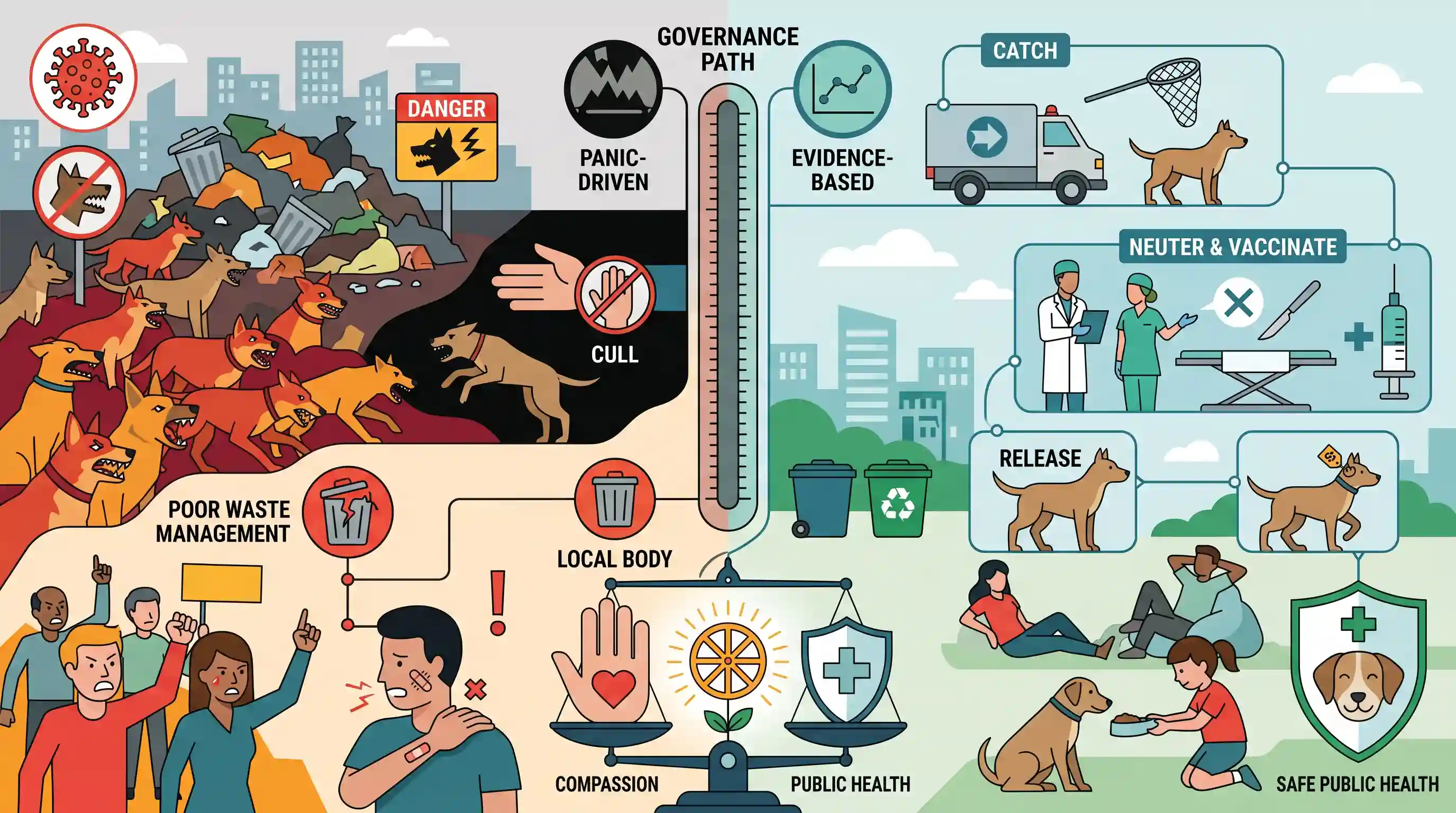
The article underscores the necessity of evidence-based policymaking in managing India's street dog population, rather than resorting to panic-driven culling. It advocates for the comprehensive implementation of the Animal Birth Control (ABC) Rules, focusing on systematic sterilization and vaccination programs. The author highlights that effective stray dog management is inherently tied to urban governance; specifically, municipalities must address poor waste management to eliminate food sources for strays. Additionally, it calls for a balanced approach that safeguards public health from rabies while upholding the ethical and constitutional duty of compassion toward animals.
Key Points
- The article highlights the growing human-animal conflict in urban India regarding stray dog populations and the corresponding risk of dog bites and rabies.
- It argues against panic-driven, knee-jerk reactions such as mass culling or relocation, stating that such measures are not only unethical but scientifically ineffective in controlling the population in the long run.
- Advocates for an evidence-based approach centered strictly around the rigorous implementation of the Animal Birth Control (ABC) program (sterilization and anti-rabies vaccination).
- Emphasizes the crucial role of Urban Local Bodies (municipalities) in improving solid waste management to eliminate the garbage dumps that serve as a food source and breeding ground for stray dogs.
- Stresses the need to balance constitutional mandates—namely public health (Article 47) and the fundamental duty of compassion for living creatures (Article 51A(g)).
Important Terms
Animal Birth Control (ABC) Rules, 2023

Statutory guidelines under the PCA Act, 1960, mandating sterilization and vaccination to manage stray dog populations humanely. They prohibit culling and relocation, recognizing strays as "community animals."
UPSC context
GS-II: Government policies; GS-IV: Ethics (Compassion vs. Public Safety). Tests understanding of humane urban governance.
Prevention of Cruelty to Animals Act, 1960
India's primary legislation enacted to prevent "unnecessary pain or suffering" to animals. It establishes the legal framework for animal welfare and created the Animal Welfare Board of India.
UPSC context
GS-II: Statutory bodies and laws. Crucial for questions on animal rights and environmental legislation.
Article 51A(g)
A Fundamental Duty in the Indian Constitution requiring every citizen to protect the natural environment and have "compassion for living creatures." It serves as a constitutional basis for animal rights.
UPSC context
GS-II: Fundamental Duties. Often cited in judicial interpretations of Right to Life (Article 21) for animals.
Animal Welfare Board of India (AWBI)
A statutory advisory body established under the PCA Act, 1960. It advises the government on animal welfare laws, provides grants to organizations, and promotes humane education.
UPSC context
GS-II: Statutory, regulatory and quasi-judicial bodies. Tests knowledge of institutional frameworks for welfare.
Urban Local Bodies (ULBs)
Local government entities (like Municipal Corporations) responsible for urban governance, including waste management and implementing animal birth control programs to mitigate human-animal conflicts.
UPSC context
GS-II: Devolution of powers and local governance. Key to solving urban public health and sanitation issues.
Prelims Trap
Under the ABC Rules 2023, local bodies can relocate stray dogs to shelters outside city limits to prevent conflict.
The ABC Rules strictly mandate a "catch-neuter-vaccinate-release" model where dogs must be returned to their original territory. Relocation and culling are prohibited.
Static Concepts Connected
What is the statutory and constitutional basis for animal welfare in India?
- Statutory Basis: The Prevention of Cruelty to Animals (PCA) Act, 1960 establishes the legal framework and the Animal Welfare Board of India (AWBI).
- Fundamental Duty: Article 51A(g) makes it a fundamental duty for every citizen to have compassion for living creatures.
- DPSPs: Article 47 mandates the improvement of public health, while Article 48 directs the State to organize animal husbandry on scientific lines.
How does the Constitution distribute urban health and sanitation powers?
- 12th Schedule: Added by the 74th Amendment Act, it lists 18 administrative functions designated for Urban Local Bodies (ULBs).
- Article 243W: Empowers state legislatures to endow municipalities with powers to manage public health, sanitation, conservancy, and solid waste management.
Cross-Topic Patterns
One Health & NAPRE 2030
Stray dog management is central to the National Action Plan for Dog Mediated Rabies Elimination (NAPRE), utilizing a 'One Health' approach combining environmental, animal, and human health.
Solid Waste & Urban Ecology
Inefficient solid waste management by Urban Local Bodies creates artificial food sinks, directly driving the hyper-breeding and territorial aggression of commensal urban species like street dogs.

Expect a Prelims question intertwining ABC Rules 2023 (prohibition of relocation), AWBI's statutory status, and Article 51A(g).
Linked PYQs · 4
Linked PYQs · 4
- 2024MainsGS2
Analyse the role of local bodies in providing good governance at local level and bring out the pros and cons merging the rural local bodies with the urban local bodies.
- 2020MainsGS4
Distinguish between laws and rules. Discuss the role of ethics in formulating them.
- 2015PrelimsGS1
"To uphold and protect the Sovereignty, Unity and Integrity of India" is a provision made in the
- 2020PrelimsGS1
Which part of the Constitution of India declares the ideal of Welfare State?
