Andhra Pradesh Tribal Housing and Water Supply Target 2027
Source:theprint ↗
ఇది ఎందుకు ముఖ్యం
The announcements provide a critical update on Andhra Pradesh's targeted development programs for its tribal populations. Familiarity with specific schemes (like Adavi Talli Bata), regional geographic identifiers for agricultural produce (such as Araku Coffee and Seethampeta turmeric), and cultural milestones (Dhimsa dance, Alluri Sitarama Raju) is highly beneficial for the APPSC Group 1 Prelims, which frequently tests state-specific governance and geographic knowledge.
సారాంశం
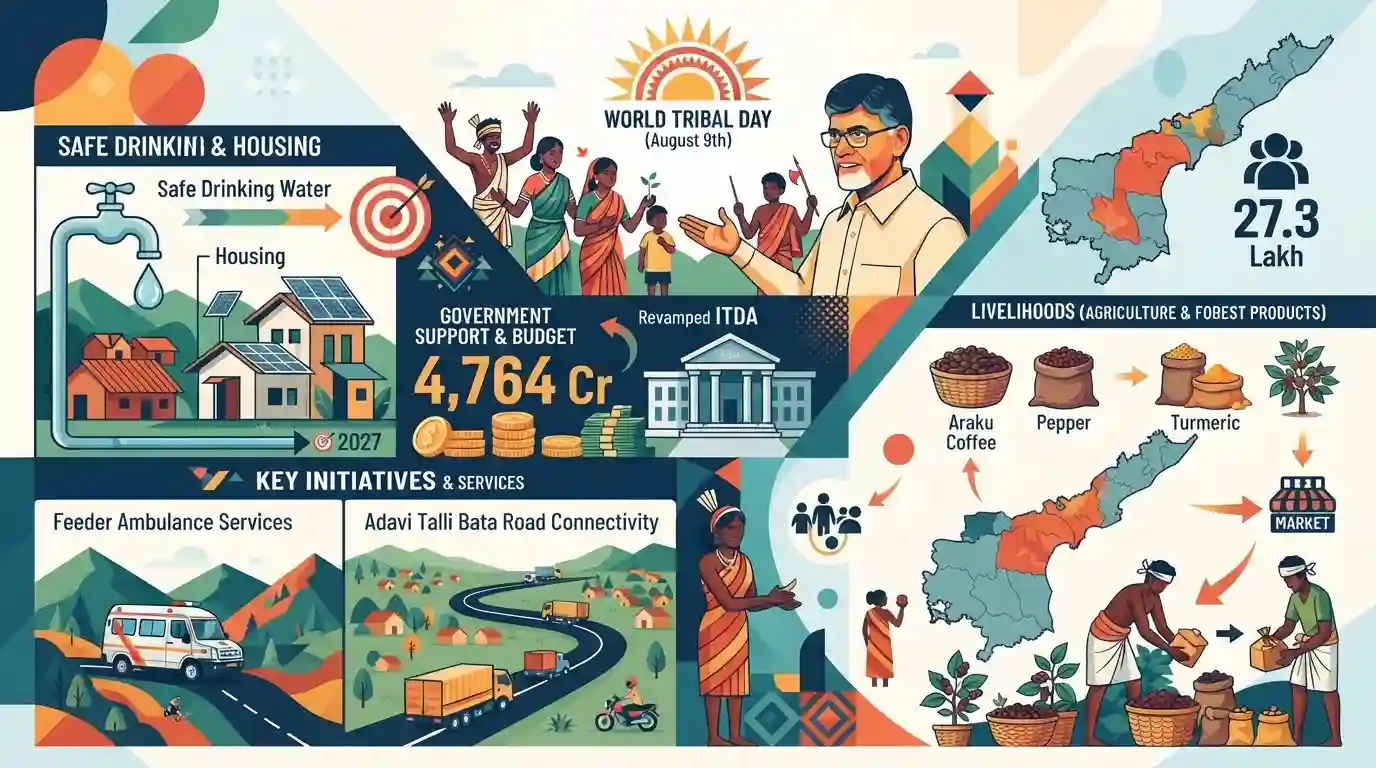
On World Tribal Day, Andhra Pradesh Chief Minister N Chandrababu Naidu announced a target to provide safe drinking water and housing to all tribal families in the state by 2027. Outlining the government's commitment to the 27.3 lakh tribal population, he highlighted a budget allocation of Rs 4,764 crore and the revamping of Integrated Tribal Development Agencies (ITDA). Key initiatives include restoring feeder ambulance services, implementing the 'Adavi Talli Bata' road connectivity scheme, and extensively promoting regional agricultural and forest products such as Araku Coffee, pepper, and turmeric to boost tribal livelihoods.
ముఖ్య అంశాలు
- AP CM N Chandrababu Naidu committed to providing safe drinking water and housing to every tribal family by 2027.
- A budget of Rs 4,764 crore has been allocated for the welfare of the state's 27.3 lakh tribal population.
- The state will implement the 'Adavi Talli Bata' scheme, spending Rs 1,000 crore to construct 905 km of roads in tribal areas.
- Initiatives include re-introducing feeder ambulances in remote areas, skill training for 1.5 lakh tribal youth, and promoting Araku Coffee alongside other regional forest products like Seethampeta turmeric and Rampachodavaram rubber.
- The Bhogapuram international airport is set to be named in honor of tribal freedom fighter Alluri Sitarama Raju.
ముఖ్యమైన పదాలు
Integrated Tribal Development Agencies (ITDA)

Institutions established in Tribal Schedule Areas for single-line administration, ensuring prompt delivery of government services, infrastructure, and welfare programs for Scheduled Tribes.
UPSC context
GS-2 (Governance/Vulnerable Sections). Tests knowledge of administrative mechanisms and targeted schemes for tribal empowerment.
Adavi Talli Bata
An Andhra Pradesh state government initiative aimed at improving road connectivity, basic infrastructure, and eco-tourism in remote tribal villages to enhance local livelihoods.
UPSC context
GS-2 (State Schemes). Tests awareness of state-level governance interventions for marginalized communities and rural infrastructure.
Araku Coffee
An Arabica coffee cultivated in the Eastern Ghats by tribal communities using organic methods. It was awarded a Geographical Indication (GI) tag in 2019 for its unique flavor and origin.
UPSC context
GS-1/GS-3 (Geography/Economy). Tests knowledge of GI tags, agroforestry, and sustainable agricultural practices supporting tribal economies.
World Tribal Day
Observed globally on August 9th to protect the rights of indigenous populations and recognize their contributions to society, cultural heritage, and environmental preservation.
UPSC context
GS-1/GS-2 (Society/Vulnerable Sections). Tests awareness of international observances for minority rights and global indigenous issues.
ప్రిలిమ్స్ ఉచ్చు
Araku Valley Arabica Coffee is exclusively cultivated in Andhra Pradesh.
Aspirants often associate Araku Valley strictly with AP, missing that the GI-tagged Arabica coffee is also cultivated by tribes in the contiguous Koraput region of Odisha.
అనుసంధానమైన స్థిర భావనలు
What is the role of ITDAs under the Tribal Sub-Plan (TSP)?
- TSP Origin: Introduced during the 5th Five-Year Plan to ensure proportional budget allocation for tribal development.
- ITDA Structure: Integrated Tribal Development Agencies operate as nodal agencies at the district/meso level, primarily in states with Schedule V areas.
- Function: They ensure the convergence of funds and resources from Central and State schemes for localized socio-economic planning and implementation.
What were the key aspects of the Rampa Rebellion (1922-1924)?
- Core Cause: Triggered by the oppressive Madras Forest Act of 1882, which restricted tribal access to forests and shifting cultivation (podu).
- Leadership: Led by Alluri Sitarama Raju ('Manyam Veerudu'), who successfully united various tribes and employed guerrilla warfare against British outposts.
- Outcome: The rebellion ended when Raju was captured and executed in 1924, though it remains a landmark in anti-colonial tribal resistance.
అంతర-అంశ నమూనాలు
GI tags and tribal livelihoods
UPSC often links GI tags with socio-economic benefits. Araku Coffee illustrates how GI-tagged agricultural/minor forest produce directly enhances tribal livelihoods and secures premium export markets.
Infra expansion in Schedule V areas
Schemes like 'Adavi Talli Bata' for road connectivity in Scheduled Areas highlight the persistent governance challenge of balancing the Forest Conservation Act, tribal rights, and basic infrastructure needs.

Expect a paired-matching question in Prelims 2026 linking specific tribal uprisings (like Rampa), their leaders, and the triggering laws.
అనుసంధాన PYQలు · 2
అనుసంధాన PYQలు · 2
- 2024APPSC_PRELIMSGS1
Consider the following erstwhile districts of Andhra Pradesh : I. West Godavari II. East Godavari III. Visakhapatnam IV. Srikakulam In which of the above districts are coffee plantations mainly existing in their agency areas ?
- 2023APPSC_PRELIMSGS1
One of the following welfare programmes implemented by Government of Andhra Pradesh is not part of Navaratnalu.
