Invisible chemical toxicity and ground level ozone air pollution risks
Source:The Hindu ↗
Why It Matters
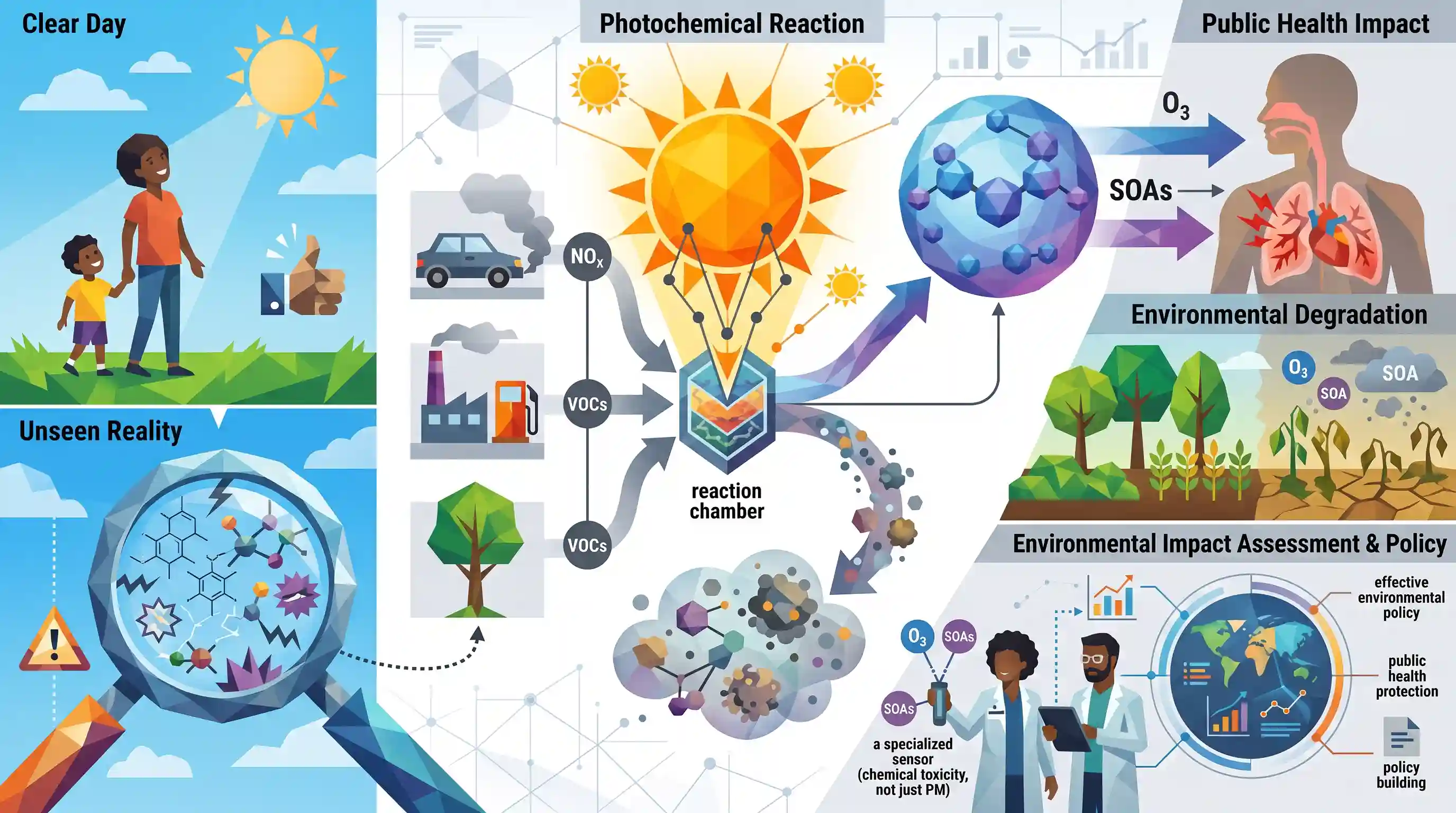
Air pollution in India is frequently perceived solely through the lens of winter smog and PM2.5. Recognizing that chemical toxicity (such as ozone and SOAs) persists and even peaks on clear, sunny days is crucial for a comprehensive understanding of photochemical smog. This nuance is directly relevant for GS3 Environment questions and evaluating the National Clean Air Programme (NCAP).
Summary
The article dispels the common misconception that clear skies equate to clean air. It highlights the growing threat of invisible chemical pollutants, primarily ground-level ozone ($O_3$) and secondary organic aerosols (SOAs). These secondary pollutants are generated through complex photochemical reactions when precursor gases—such as Nitrogen Oxides ($NO_x$) from vehicles and Volatile Organic Compounds (VOCs) from industrial or biogenic sources—are exposed to strong sunlight. Consequently, clear, sunny days often provide the ideal meteorological conditions for these invisible toxicants to peak. The piece underscores the necessity of monitoring chemical toxicity beyond just visible particulate matter (PM2.5/PM10) to formulate effective environmental policies and protect public health.
Key Points
- Invisible Toxicity: Air quality cannot be judged solely by visual clarity; clear skies can harbor dangerously high levels of invisible gases and secondary organic aerosols (SOAs).
- Ground-Level Ozone: Unlike the protective stratospheric ozone layer, tropospheric (ground-level) ozone is a harmful secondary pollutant formed when sunlight triggers chemical reactions between Nitrogen Oxides (NOx) and Volatile Organic Compounds (VOCs).
- Photochemical Smog: Intense sunlight, high temperatures, and vehicular/industrial emissions accelerate the formation of photochemical smog components like ozone and Peroxyacetyl Nitrate (PAN), meaning toxicity often peaks on sunny days.
- Role of VOCs: Volatile Organic Compounds, crucial precursors for both ozone and SOAs, are emitted from paints, solvents, fuels, and even certain plant species.
- Health and Policy Implications: Long-term exposure to these chemical pollutants exacerbates asthma, reduces lung function, and increases cardiovascular risks, emphasizing the need for robust monitoring via the National Air Quality Index (AQI).
Important Terms
National Clean Air Programme (NCAP)

A time-bound national strategy launched in 2019 to reduce particulate matter (PM10 and PM2.5) concentrations by 40% by 2026 in 131 non-attainment cities.
UPSC context
GS Paper III (Environment); vital for questions on pollution governance and national environmental targets.
Ground-level Ozone (O3)
A secondary pollutant and potent greenhouse gas formed by photochemical reactions between Nitrogen Oxides (NOx) and Volatile Organic Compounds (VOCs) in the presence of strong sunlight.
UPSC context
GS Paper III (Environment); essential for understanding photochemical smog and non-particulate chemical toxicity.
National Air Quality Index (AQI)
A color-coded communication tool launched in 2014 that transforms complex air quality data of eight pollutants into a single index value to inform the public about health risks.
UPSC context
GS Paper III (Environment); frequently tested in Prelims regarding the specific 8 pollutants monitored.
Central Pollution Control Board (CPCB)
A statutory organization established under the Water Act (1974) and empowered by the Air Act (1981) to set environmental standards and coordinate pollution control nationwide.
UPSC context
GS Paper II (Statutory Bodies); key for governance-related questions on environmental regulation.
Secondary Organic Aerosols (SOAs)
Fine particulates (major components of PM2.5) formed in the atmosphere through the oxidation and condensation of gaseous organic precursors rather than being emitted directly.
UPSC context
GS Paper III (Environment/Science); relevant for advanced atmospheric chemistry and "invisible" pollution threats.
Volatile Organic Compounds (VOCs)
A diverse group of organic chemicals with high vapor pressure that react with nitrogen oxides to produce ground-level ozone and secondary aerosols.
UPSC context
GS Paper III (Environment); critical as precursor pollutants from industrial and biogenic sources.
Prelims Trap
"Ground-level ozone is directly emitted into the atmosphere by vehicular emissions and industrial exhausts."
Ground-level ozone is a secondary pollutant. It is never directly emitted by any source; rather, it forms via photochemical reactions between NOx and VOCs.
Static Concepts Connected
What differentiates Photochemical (Los Angeles) from Classical (London) smog?
- Classical Smog: Occurs in cool, humid climates. It is a mixture of smoke, fog, and sulphur dioxide, and is chemically reducing in nature.
- Photochemical Smog: Occurs in warm, dry, sunny climates. Formed by the action of sunlight on NOx and VOCs, making it chemically oxidizing.
- Key Components: Photochemical smog is characterized by the presence of secondary pollutants like ground-level Ozone, PAN, and aldehydes.
Which 8 pollutants are measured in India's National Air Quality Index (NAQI)?
- Particulate Matter: PM2.5 and PM10 are the primary physical indicators.
- Reactive Gases: Nitrogen Dioxide (NO2), Sulphur Dioxide (SO2), Carbon Monoxide (CO), and Ozone (O3).
- Additional Parameters: Ammonia (NH3) and Lead (Pb) complete the eight-parameter list.
Cross-Topic Patterns
BS-VI transition and NOx reduction
The leap to BS-VI vehicular standards specifically targeted NOx reduction, which acts as the primary precursor for ground-level ozone and photochemical smog in Indian megacities.
Indoor VOCs vs Outdoor smog
While VOCs are frequently tested regarding indoor air pollution (paints, formaldehyde), they are equally critical as outdoor ozone precursors, linking indoor toxicity to outdoor smog.

Expect a multi-statement question on secondary pollutants, specifically testing biogenic VOCs, PAN formation, and NAQI ozone metrics.
Linked PYQs · 4
Linked PYQs · 4
- 2022PrelimsGS1
In the context of WHO Air Quality Guidelines, consider the following statements: 1. The 24-hour mean of PM2.5 should not exceed 15 µg/m³ and annual mean of PM2.5 should not exceed 5 µg/m³. 2. In a year, the highest levels of ozone pollution occur during the periods of inclement weather. 3. PM10 can penetrate the lung barrier and enter the bloodstream. 4. Excessive ozone in the air can trigger asthma. Which of the statements given above are correct?
- 2013PrelimsGS1
Photochemical smog is a resultant of the reaction among
- 2021MainsGS3
Describe the key points of the revised Global Air Quality Guidelines (AQGs) recently released by the World Health Organisation (WHO). How are these different from its last update in 2005? What changes in India's National Clean Air Programme are required to achieve these revised standards?
- 2022MainsGS3
Discuss in detail the photochemical smog emphasizing its formation, effects and mitigation. Explain the 1999 Gothenburg Protocol.
