Employment Quality and Decent Work Deficit in India
Source:The Hindu ↗
Why It Matters
Crucial for understanding the distinction between job quantity and job quality in India's growth model, frequently asked in Mains GS3 under inclusive growth and employment.
Summary
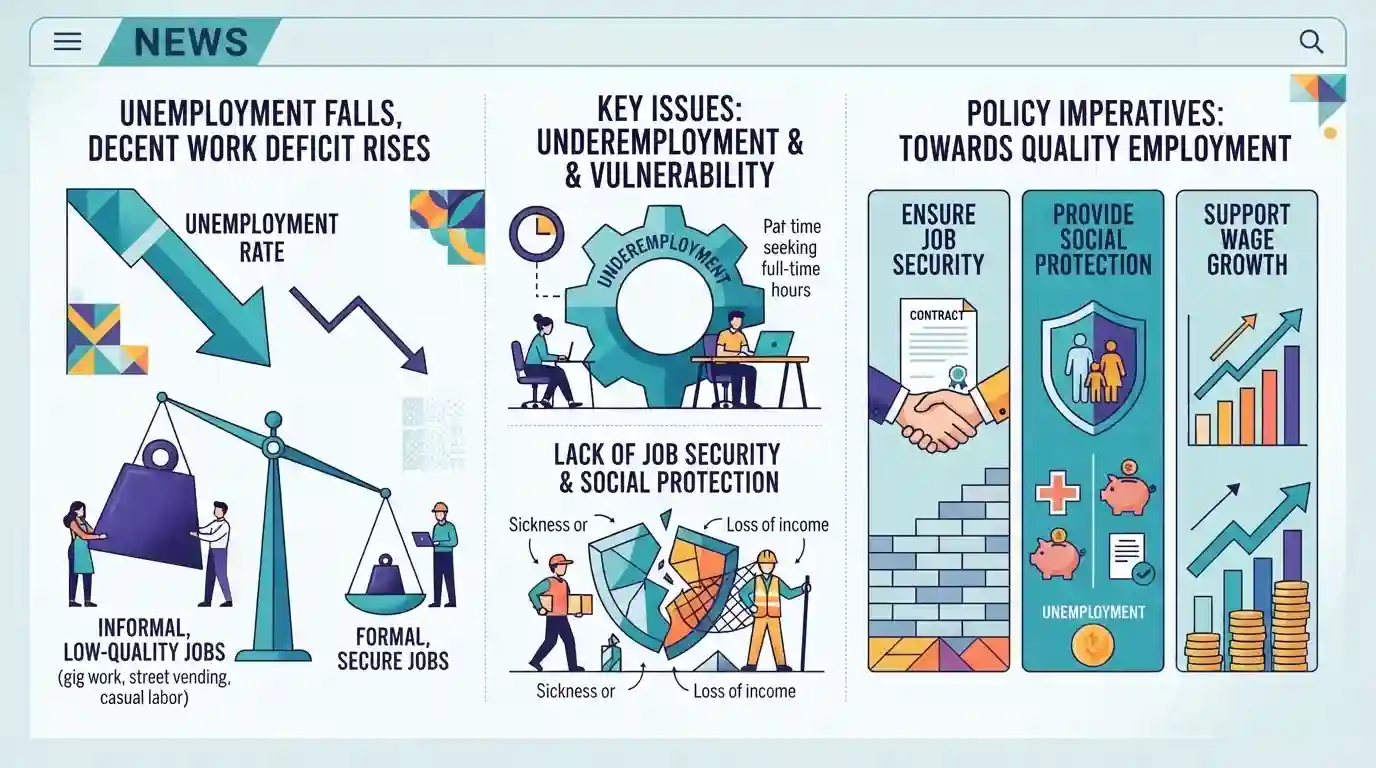
The article examines India's employment landscape, pointing out that despite falling unemployment rates, the country faces a serious deficit of 'decent work'. It highlights the proliferation of informal, low-quality jobs and underemployment, arguing that employment policies must pivot toward ensuring job security, social protection, and wage growth.
Key Points
- While conventional unemployment rates have shown a declining trend in India, there is a persistent crisis concerning the quality of employment, marked by a lack of 'decent work'.
- A significant share of the workforce remains trapped in informal, low-paying, or self-employed arrangements with little job security or social protection.
- The growth in employment numbers often masks underemployment and casual labor rather than steady, salaried formal jobs with social security benefits.
- Addressing India's structural employment challenge requires shifting focus from mere job quantity to creating productive, high-wage, and formal employment opportunities.
Important Terms
Periodic Labour Force Survey (PLFS)

India’s primary official employment survey, conducted by the National Statistical Office (NSO) to measure labor force participation rates, worker-population ratios, and unemployment trends across rural and urban areas.
UPSC context
GS Paper III (Inclusive Growth and Employment); vital for analyzing data on unemployment, job quality, and labor market reforms in India.
Prelims Trap
Declining conventional unemployment rates imply a robust formal labor market with widespread social security coverage.
A falling unemployment rate reported by PLFS does not indicate an increase in formal jobs; over 90% of workers remain in the informal sector.
Static Concepts Connected
What are the key dimensions of the ILO's 'Decent Work' agenda?
- Definition: ILO core standard ensuring productive work with freedom, equity, security, and human dignity.
- Pillars: Covers fair income, security in the workplace, social protection, and freedom of expression.
Cross-Topic Patterns
Jobless Growth & Welfare Economics
Rising informalization during periods of high GDP growth highlights the decoupling of jobless growth from welfare gains, a central theme in Indian economic policy.
Demographic Dividend & Gender Parity
Low female labor force participation and poor quality of work are core bottlenecks in translating demographic dividend into actual economic output.

PLFS data trends + informal sector share (~90%) often tested via analytical statements on employment quality vs quantity.
Linked PYQs · 3
Linked PYQs · 3
- 2024MainsGS3
Discuss the merits and demerits of the four 'Labour Codes' in the context of labour market reforms in India. What has been the progress so far in this regard?
- 2023MainsGS3
Most of the unemployment in India is structural in nature. Examine the methodology adopted to compute unemployment in the country and suggest improvements.
- 2022MainsGS3
Economic growth in the recent past has been led by increase in labour productivity." Explain this statement. Suggest the growth pattern that will lead to creation of more jobs without compromising labour productivity.
